
A Complete Guide to Cars Keys Programming
- yelluk

- 3 days ago
- 14 min read
Car key programming is all about creating a secure, electronic link between a new or replacement key and your vehicle’s computer. Think of it as a digital handshake; it's a vital security step that makes sure only a key authorised by you can actually start the engine.
How Modern Car Keys Actually Work
Ever wondered how your car knows it's your key? It’s not magic, but it is a very clever and secure digital conversation that happens in a flash. The days when any bit of cut metal could get a car on the road are long gone. Today's vehicles are protected by a sophisticated anti-theft system called an immobiliser.
At the heart of this system is the relationship between your car's brain—the Engine Control Unit (ECU)—and a tiny microchip hidden inside the plastic head of your key. This crucial connection is what modern cars keys programming is all about.
The Digital Handshake Explained
It’s a bit like a secret password exchange. When you pop the key in the ignition or press the start button, your car’s immobiliser sends out a low-frequency radio signal. This signal "wakes up" the chip in your key, prompting it to send back its unique, pre-programmed code.
If the ECU recognises that code, it gives the all-clear, and the engine is allowed to start. If the code is wrong—or if there's no code at all, like with a simple metal key—the immobiliser keeps the engine firmly shut down. This entire back-and-forth is the "digital handshake," and it happens seamlessly every single time you start your car.
This security check is exactly why a key that has only been physically cut will turn the ignition but won't start the engine. The mechanical part fits, but the essential electronic password is missing.
Why This Technology Is Essential
This system is a massive deterrent to car thieves. Without the correctly programmed key, they can't simply hotwire the vehicle or use a copied blank. Each key's chip has a unique digital signature, making it incredibly difficult to bypass. It's the cornerstone of modern vehicle security and the reason why professional cars keys programming is such a specialised and vital service.
The chip responsible for this secure conversation is called a transponder. To really get to grips with this foundational bit of kit, check out our guide on what a transponder key is and how it works. Understanding this technology is key to appreciating why programming is so much more than a convenience—it's a critical security measure.
Understanding Your Car Key's Technology
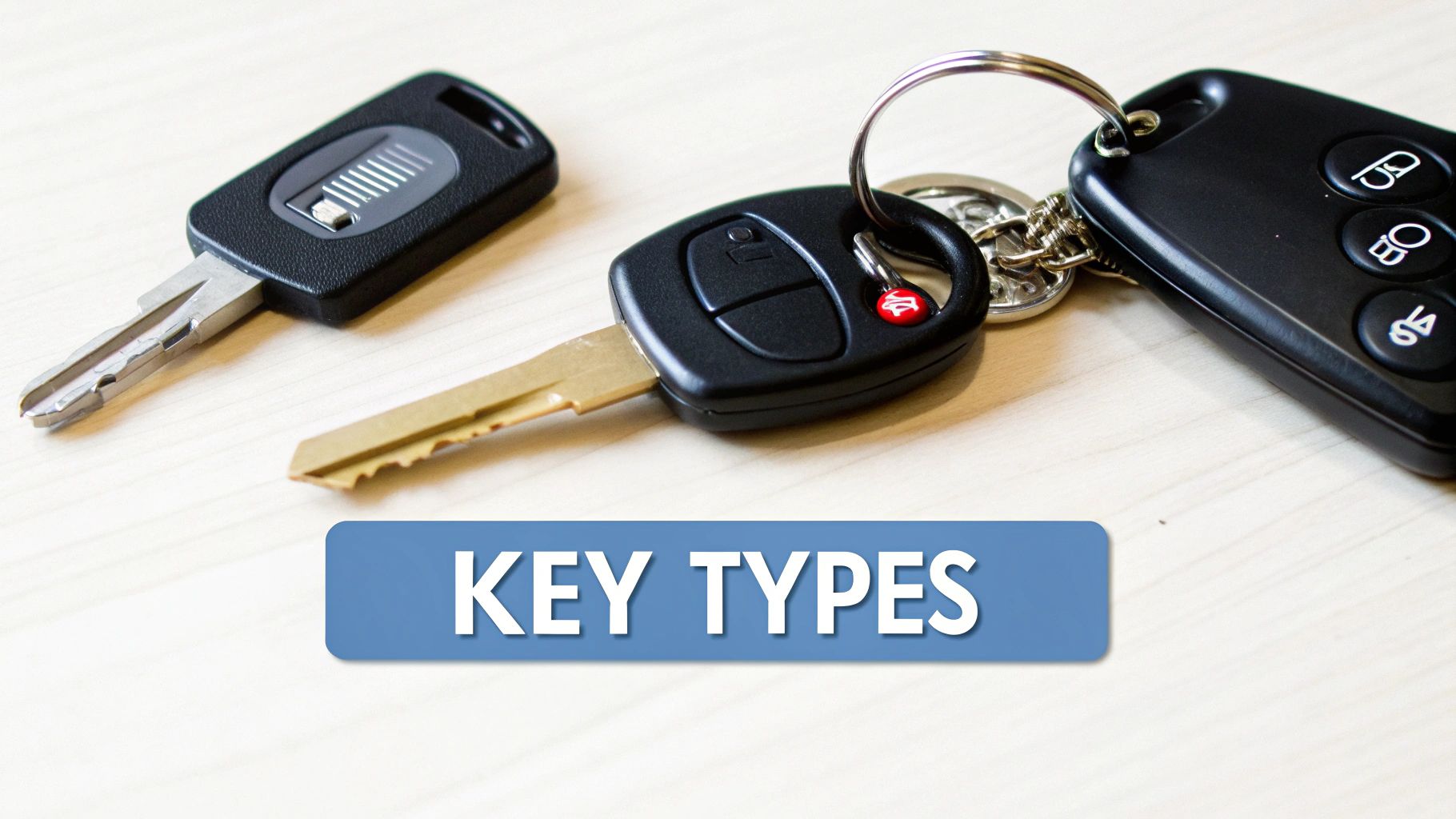
To really get why cars keys programming is a specialist job, you need to understand the tech hidden inside your key. Long gone are the days of a simple piece of cut metal. Modern car keys are tiny computers, designed to keep your vehicle secure while making your life easier.
They generally fall into three main types, with each one building on the technology of the last. Knowing which kind you have is the first step in figuring out what’s wrong and what a programming service actually involves. Let's start with the bedrock of modern car security.
Transponder Keys: The Silent Password
Even if your key looks incredibly basic with no buttons, there's a good chance it’s a transponder key. Buried inside the plastic head is a tiny glass or carbon chip that holds a unique code—think of it as a silent, digital password.
When you turn the key, your car's immobiliser sends out a radio signal that wakes up the chip. The chip then broadcasts its unique code back. If it matches the code stored in your car's computer, you get the green light to start the engine. It’s a simple but brilliantly effective anti-theft system that’s been standard on most cars since the mid-1990s.
Think of it like this: The cut metal part of the key is like the key to your front door, but the transponder chip is the unique alarm code you need to disarm the system once you're inside. Without both, you're not getting anywhere.
Remote Key Fobs: The Advent of Convenience
The next leap forward is the remote key fob, which is what most of us have in our pockets today. It takes the security of a transponder chip and adds the convenience of remote control, all packed into a single unit with buttons.
These fobs use a separate radio frequency transmitter for actions like:
Locking and unlocking the doors
Popping the boot
Setting off a panic alarm
To stop thieves from just copying your signal, these remotes use a clever system called "rolling codes." Every time you press a button, the fob and the car generate a new, synchronised code. If they match, the door unlocks. This constant change means an old code is useless, making it a highly secure system. Programming these involves syncing both the transponder chip and this rolling code system.
Smart Keys: The Peak of Keyless Technology
At the top of the tree, you have the smart key, the tech behind keyless entry and push-to-start ignition. You don’t even have to take this out of your pocket. It’s constantly emitting a low-frequency signal that your car is actively listening for.
As you get close, sensors on the car pick up the key's signal. Once you're within a few feet, you can unlock the doors just by touching the handle. Inside, the car confirms the key is present again, letting you start the engine with a simple push of a button.
The technology in these keys, especially smart keys, relies on secure communication. For a closer look at the principles behind it, it's worth understanding RFID technology, which works in a similar way. Identifying your own key is the first step, and if you're curious about the whole range, you can explore the 7 main types of car keys explained for 2025. It gives you a great overview of how key tech has evolved and why specialised programming is now essential for pretty much every modern car on the road.
Signs You Need Car Key Programming Services
How can you be certain the problem is your key's programming and not something simpler, like a dead battery or a faulty ignition? There are a few tell-tale signs that point directly to a communication breakdown between your key and the car's computer, signalling that professional cars keys programming is what you need.
Spotting these symptoms early can save you from the stress of being stranded. It helps you get to the root of the problem and know exactly when it’s time to call in an expert.
Common Warning Signs of a Programming Issue
The most obvious red flag is when your remote suddenly stops working for no clear reason. If you’ve swapped the battery and it still won’t lock or unlock the doors, the issue is almost certainly with its programming. But there are more specific symptoms to watch out for.
The Key Turns But Won't Start the Engine: This is a classic symptom of a transponder chip failure. The mechanical cut of the key is correct, so it turns the ignition, but the car’s immobiliser isn't getting the right digital handshake. As a security measure, it cuts power to the engine.
An Intermittent Connection: Does your key work perfectly one minute and fail the next? This kind of unreliable performance often points to a failing transponder chip or a weak signal that needs reprogramming to restore a stable connection.
Dashboard Warning Lights: Most modern cars have a specific security light, often shaped like a key or a padlock. If this light is flashing or stays lit when you try to start the car, it’s a direct message from your vehicle that it doesn’t recognise the key.
Before you assume the worst, it's sometimes worth trying a few simple fixes. If the remote is your main issue, you might find an easy solution in our guide on what to do when your key fob is not working.
Critical Situations Requiring Immediate Programming
Beyond a gradual failure, some events demand immediate professional attention to keep your vehicle secure and accessible. These aren't just minor inconveniences; they are critical security situations.
A common scenario we see is with newly purchased second-hand cars. If the seller only gives you one key, you have no way of knowing who might have the other. Erasing all old keys from the car’s memory and programming new ones is the only way to guarantee your vehicle's security.
In the UK, the average age of cars reached 8.2 years in 2018, which means more vehicles on the road rely on older transponder technology that needs expert programming when keys go missing or get damaged.
Other urgent scenarios include:
Lost All Your Keys: This is an emergency where a mobile auto locksmith is essential. They can create and program a brand new key on-site, saving you the hassle and cost of towing your car to a dealership.
After a Theft or Break-In: If your keys were stolen, it's vital to have the old keys wiped from the vehicle's system immediately. A technician can program new keys and ensure the stolen ones are rendered useless.
Visible Key Damage: If the key fob has been dropped, crushed, or suffered water damage, the internal chip may have been compromised. This will almost always require a full replacement and programming service.
DIY vs Professional Key Programming
When you've got a key problem, a quick online search throws up a tempting world of do-it-yourself guides and cheap gadgets promising an easy fix. But when it comes to the complex electronics inside modern cars, what looks like a simple solution can quickly spiral into a very costly mistake.
The choice between trying it yourself and calling a professional for cars keys programming isn't just about money—it's about risk, reliability, and your own peace of mind.
Making the right call really depends on your car's age and the tech it's packing. You might be able to program a simple remote fob for a car from the early 2000s with a specific sequence of ignition turns and button presses. Trying that same trick on a newer vehicle with a smart key system, however, could have seriously expensive consequences.
The Lure and the Reality of DIY Programming
The main draw of a DIY approach is, of course, the chance to save a few quid. For some very specific, older models, you might get lucky and manage to sync a new remote's lock and unlock buttons yourself. This usually means following a precise, often timing-sensitive, set of instructions you've found in the owner's manual or a reputable online forum.
But it's crucial to understand that the scope for a successful DIY job is incredibly narrow. Syncing a remote's buttons is a world away from programming the transponder chip that the car needs to actually start the engine.
Get it wrong, and the risks are huge:
Bricking Your Car: A failed programming attempt can easily trigger your car's anti-theft system, leaving it completely immobilised. Your key issue has now become an emergency that needs a tow truck and a much more expensive professional fix.
Frying the Brain: Using unverified, cheap programming tools can corrupt your car’s Engine Control Unit (ECU). The ECU is the vehicle's brain, and repairing or replacing it can cost hundreds, if not thousands, of pounds.
Wasted Time and Money: You could waste hours trying to follow a complex sequence only to find it doesn't work for your specific model year, or you could buy a cheap online tool that's either incompatible or just plain faulty.
Attempting DIY key programming on a modern car is a bit like trying to perform surgery with a kitchen knife. While it might theoretically be possible in a very rare, simple case, the potential for causing catastrophic damage is incredibly high.
Why a Professional Service is the Smarter Choice
Calling in a professional auto locksmith just eliminates all the guesswork and risk. A trained technician arrives with specialised, dealership-grade diagnostic equipment that can securely talk to virtually any vehicle's computer system without a hint of danger. This is the only reliable way to handle modern cars keys programming.
A professional service guarantees the result and provides a complete solution. They don't just program the key; they cut the blade with precision, sync all the remote functions, and, most importantly, correctly pair the new transponder chip to your car's immobiliser.
This head-to-head comparison shows you exactly what you're up against.
Comparing DIY and Professional Programming
Tackling key programming yourself might seem like a good way to save money, but it's a high-stakes gamble. Here’s a clear breakdown of how a DIY attempt stacks up against calling in the professionals.
Factor | DIY Approach | Professional Service |
|---|---|---|
Success Rate | Very low, limited to old models | Extremely high, over 95% of vehicles |
Equipment | Basic tools, unverified gadgets | Specialised diagnostic equipment |
Risk | High risk of immobilising the vehicle | Virtually zero risk, with a warranty |
Time Investment | Hours of research and trial-and-error | Typically under one hour on-site |
Guarantee | None, you are liable for damages | Workmanship and new key are guaranteed |
Convenience | Requires extensive effort from you | Mobile service comes directly to you |
At the end of the day, a professional ensures the job is done right, the first time. The convenience of a mobile service means you aren't left stranded, and their expertise guarantees your car's security systems stay fully functional. When it comes to something as vital as your car key, the professional route is always the smartest and safest investment.
What Happens When We Arrive? The On-Site Key Programming Process
So, you’ve realised you need a hand with your car key and have made the call. What actually happens when a mobile auto locksmith pulls up? It’s not just a case of cutting a bit of metal; it’s a highly skilled process that blends traditional locksmithing with modern vehicle diagnostics, all designed to get you back on the road safely and without delay.
The whole service is built to be transparent and efficient. From the moment you ring, a qualified technician is already figuring out your problem, making sure they arrive with the right key blanks and gear for your specific car.
The Initial Phone Consultation
The process kicks off with your first phone call. This isn't just about booking a time; it’s a crucial diagnostic step. We’ll ask for a few key details to make sure the on-site service is as smooth as possible.
Vehicle Details: We'll need the make, model, and year of your car.
VIN (Vehicle Identification Number): This is the single most important bit of information. It allows us to access the specific key codes and security data for your exact car.
Your Situation: Letting us know if you’ve lost all your keys, just need a spare, or have a broken key helps us prepare the right tools and plan our approach.
This quick chat ensures the technician arrives fully prepared, which dramatically speeds up the work once they're with you.
Arrival and Getting Hooked In
Once our mobile locksmith arrives, the first job is to connect their specialised diagnostic equipment directly to your vehicle. This is done through the OBD-II (On-Board Diagnostics) port, which you can usually find tucked away under the dashboard on the driver's side.
This port is the gateway to your car's brain—the Engine Control Unit (ECU). It allows our technician to securely communicate with the vehicle's immobiliser system, which is the part of the car that authorises the key. Think of it as plugging in a highly advanced laptop that speaks your car’s unique digital language.
This connection is secure and starts as read-only. A professional technician’s equipment is designed to safely access the necessary security modules without any risk of damaging your car's sensitive electronics—a key difference from dodgy DIY tools.
This flowchart gives you a simplified look at how a professional service compares to a DIY attempt.
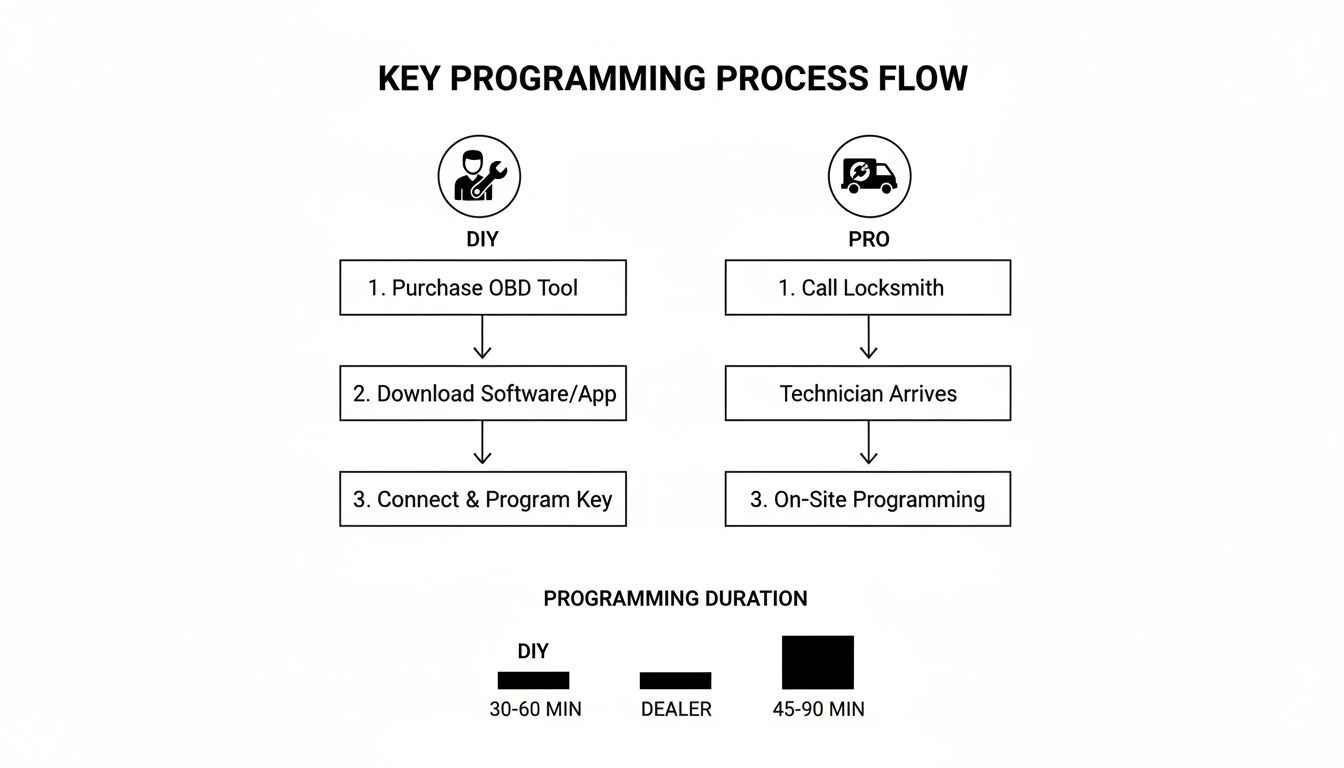
As you can see, the professional route is all about efficiency and a guaranteed result, a stark contrast to the lengthy and uncertain nature of trying it yourself.
Key Cutting and Transponder Programming
With access to the car’s system, the real work of cars keys programming begins. The technician will carry out two critical tasks, often at the same time.
Cutting the Key Blade: Using the information from your car's VIN or by decoding the lock itself, a precision key-cutting machine right in the van cuts a new metal blade. This guarantees it will turn perfectly in your door locks and ignition.
Programming the Transponder Chip: This is the high-tech part. The diagnostic tool is used to register a new, blank transponder chip with your car’s immobiliser. A unique code is generated and stored on both the chip and in the car’s memory, creating that essential digital handshake.
Finally, if your key has remote functions for locking and unlocking, these are synced to the car as well. The technician will then give the new key a thorough test—making sure it starts the engine, operates all the locks, and that every remote button works flawlessly. From start to finish, you get a fully functional key, ready to go.
Your Car Key Programming Questions Answered
When you’re staring at a key that’s suddenly stopped working, or worse, you’ve lost the lot, questions about car key programming pop up thick and fast. It can all feel a bit technical and overwhelming, but getting straight answers is the key to making a good decision without the stress. This is where we tackle the most common queries we hear from drivers every single day.
We've put together direct, no-nonsense answers to help you get your head around the costs, timings, and the tech involved. Our goal is to give you the confidence to handle any car key problem, knowing exactly what to expect when you call in a pro.
How Much Does Car Key Programming Cost in the UK?
There’s no single, fixed price for programming a car key, as the cost really depends on your car's make, model, year, and the type of key it uses. But we can give you a very clear idea of what you should expect to pay.
For a standard transponder key on a popular car, like a Ford Fiesta or a Vauxhall Corsa, you’re typically looking at a range of £80 to £150 from a mobile auto locksmith. That price should be all-inclusive, covering the call-out, the new key itself, the cutting, and the final programming.
If you drive a premium brand like BMW, Audi, or Mercedes, or your car uses a more complex smart key system for keyless entry, the price is naturally a bit higher. You can expect to be quoted somewhere in the region of £150 to over £300. Even at the top end, this is almost always a more affordable route than a main dealership, which often tacks on towing costs and higher labour rates, pushing their final bill way higher.
A reputable mobile service will always give you a firm, upfront quote over the phone before they even think about setting off. This kind of transparency is crucial and means you won’t get hit with any nasty surprises or hidden fees once the job’s done.
How Long Does It Take to Program a New Car Key?
Speed is one of the biggest wins when you choose a mobile auto locksmith. We get it—you need to get back on the road. The whole service is designed to be as efficient as possible without cutting any corners on quality.
For the vast majority of vehicles, the entire process—from the technician arriving at your car to you holding a fully programmed and tested key—is done and dusted in under an hour. That includes cutting the physical key blade, programming the transponder chip to your car's immobiliser, and syncing up any remote locking functions.
A few more complex systems, particularly on certain European cars or brand-new models, might take a little longer, perhaps up to 90 minutes. But that's still incredibly quick compared to the alternative. A main dealer will often need you to leave your car with them for a full day, sometimes even longer, which can cause a huge disruption to your week.
Can a Locksmith Program a Key for Any Car Model?
That's a great question, and the answer is a resounding yes, for the most part. Professional auto locksmiths invest a huge amount of money in state-of-the-art programming equipment designed to cover the massive range of car makes and models you see on UK roads.
This means we can handle all the popular brands you'd expect, like:
Ford
Vauxhall
Volkswagen
Peugeot
Nissan
But it also goes much further, covering premium and luxury manufacturers like Jaguar, Land Rover, and even Porsche. We also have the specialist gear needed for commercial vans—the lifeblood of so many businesses—as well as modern electric and hybrid vehicles, which come with their own unique security systems.
While an extremely rare classic car or a highly specialised import might occasionally throw up a challenge, a qualified locksmith can successfully work on well over 95% of vehicles. The easiest way to be sure is to just give us a call with your car's details; you'll get a straight answer in seconds.
What Happens If I Lose All My Car Keys?
Losing all your keys is probably one of the most stressful things a driver can go through, but it's an emergency a mobile locksmith is perfectly set up to solve. The most important thing to remember is that you do not need to get your car towed to a dealer.
The entire solution happens right there on the roadside, at your home, or in the office car park.
Non-Destructive Entry: First, the technician will gain entry to your vehicle using specialised tools that leave no marks or damage whatsoever.
Key Decoding and Cutting: Next, they'll decode your car's lock. This lets them cut a brand-new, perfectly fitting key blade from the blanks they carry in their van.
On-Board Programming: The final, crucial step is the programming. The technician plugs their diagnostic tool into your car's OBD-II port and programmes a new transponder chip directly to your car’s computer.
Erasing Old Keys: For your security and peace of mind, the locksmith will also erase the lost keys from the vehicle’s memory. This is a vital step that ensures if your old keys ever fall into the wrong hands, they can no longer be used to start the engine.
This all-in-one, on-site service turns a major crisis into a manageable problem that gets solved quickly and securely, right where you are.
At Blade Auto Keys, we are your local experts in car key programming, ready to handle any situation with speed and professionalism. If you're locked out, have lost your keys, or simply need a spare, we offer a 24/7 mobile service across South Wales. Don’t stay stranded—contact us now for a fast, reliable solution at https://www.bladeautokeys.co.uk.


Comments