
How Does Keyless Entry Work A Simple Guide
- yelluk

- 4 days ago
- 12 min read
At its heart, keyless entry works by sending a unique, encrypted code using radio waves from your key fob to a receiver in your car. If the codes are a match, the doors unlock. Think of it as a secret, invisible handshake that happens every time you press that button.
The Invisible Handshake Unlocking Your Car
Imagine your key fob and your car are two old friends who share a secret password. Instead of saying it out loud for anyone to hear, they communicate it over a secure radio signal.
This signal, sent by the fob, is a complex code that your car is specifically tuned to listen for. It’s not just a simple on/off switch; it’s a sophisticated digital conversation designed to ensure only your key can get into your vehicle. The system is built to ignore signals from any other device, adding a serious layer of security that traditional metal keys just can't match.
How It Works Step-By-Step
The whole process happens in a blink of an eye, but it can be broken down into a few crucial stages. Each step is vital for making the system both convenient and secure.
Activation: The moment you press the unlock button on your fob, its internal battery powers up a tiny transmitter, kicking off the entire sequence.
Signal Transmission: The fob then broadcasts that unique, encrypted code on a specific radio frequency. This is the "secret password" that only your car's receiver is programmed to understand.
Reception and Verification: A receiver module in your car picks up the signal. It immediately passes the code to the vehicle’s main computer, which acts like a security guard, checking the code against the one stored in its memory.
Action: If the code is a perfect match, the computer gives the green light and sends a command to the door-locking mechanisms. Click—you're in.
This visual breaks down that simple flow from your key fob to your unlocked car.
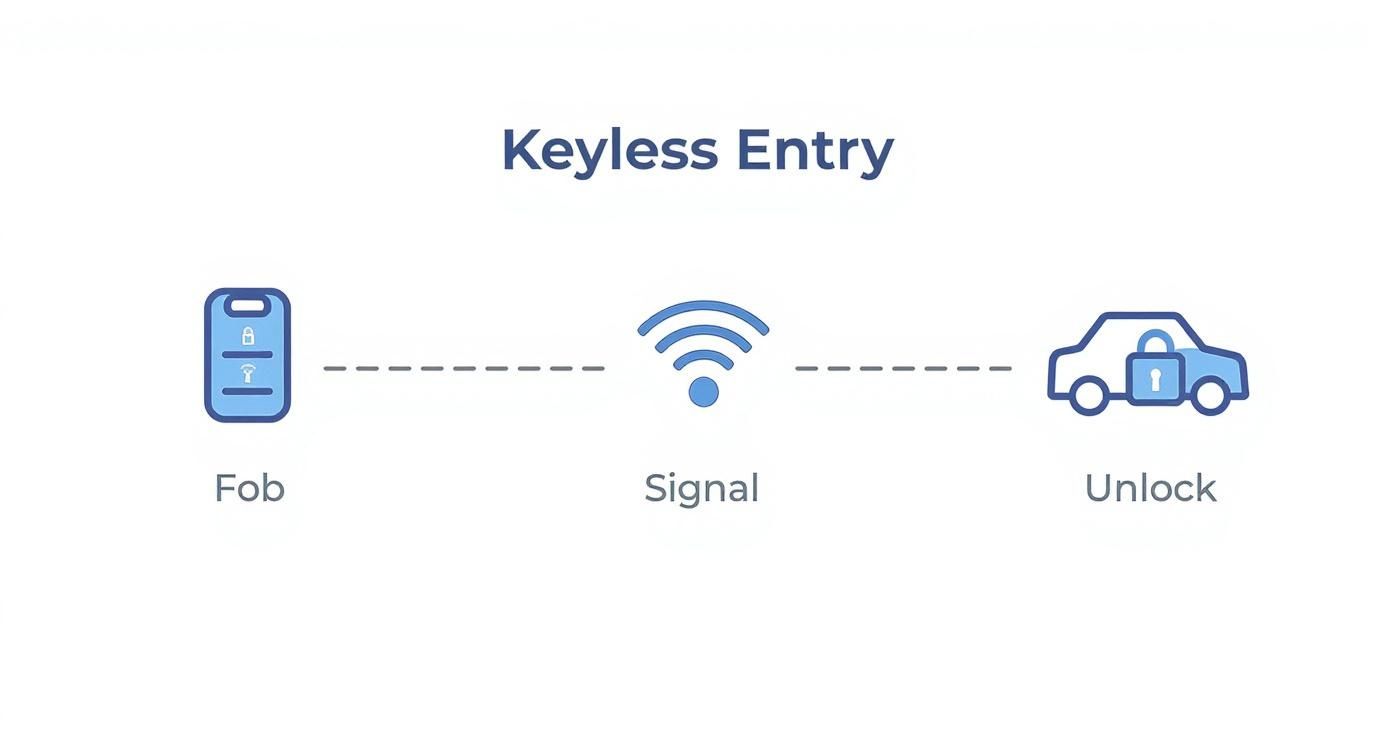
As the infographic shows, it’s a three-stage process: the fob sends its signal, the car receives it, and the lock is released. Getting this basic foundation right makes it much easier to understand the more advanced features, which we’ll get into a bit later.
To give you a clearer picture, here’s a quick summary of the main players in this digital handshake.
Keyless Entry System at a Glance
A quick summary of the main components and their roles in a typical keyless entry system.
Component | Primary Function | Simple Analogy |
|---|---|---|
Key Fob Transmitter | Broadcasts the encrypted security code when a button is pressed. | The messenger delivering a secret, coded note. |
Vehicle Receiver | Listens for and captures the radio signal from the key fob. | The lookout waiting for the specific messenger. |
Vehicle's Computer (ECU) | Verifies the received code against its stored, correct code. | The security guard who checks the note's password. |
Actuators | The physical mechanisms that lock or unlock the car doors. | The doorman who opens the door on command. |
This table neatly lays out how each part has a distinct job to do, all working together in a fraction of a second to grant you access.
Inside Your Key Fob: The Digital Messenger
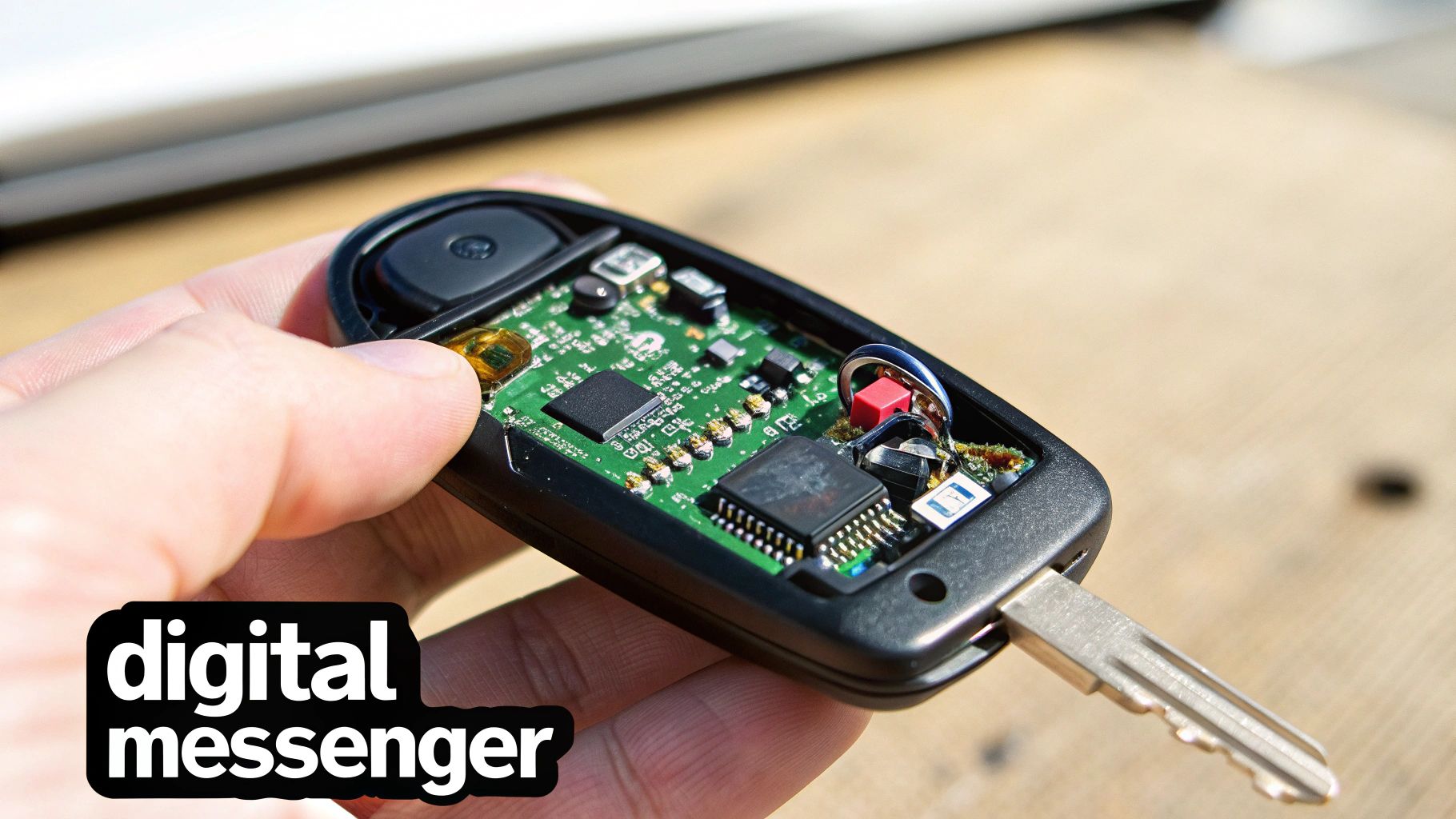
That small device in your hand is far more than a simple button. Think of your key fob as a highly secure digital messenger, with one vital mission: to deliver a secret message that only your car can possibly understand. It’s a marvel of compact engineering, with several key parts working in perfect harmony to make the magic happen.
At its heart, the fob has a small circuit board powered by a coin-sized battery. When you press a button, this battery zaps a tiny burst of energy to the other components, waking them up and kicking off the communication sequence. Of course, this battery won't last forever, and knowing about car key battery replacement is a useful DIY skill for any driver.
Crafting the Secret Message
Once powered up, the first crucial component to act is the integrated circuit (IC) chip. This is the fob’s brain. In a flash, it generates a unique, single-use access code. This isn’t a static password like "1234"; it’s a complex and seemingly random string of data that changes every single time you use it. This dynamic process is the first layer of security.
Next, this brand-new code is handed over to an encryption chip. This component acts like a digital vault, scrambling the code using a sophisticated algorithm. It wraps the secret message in a practically unbreakable digital envelope, ensuring that even if the signal were intercepted, it would be gibberish to anyone without the specific key to decrypt it.
This process is remarkably similar to the encryption used for online banking. It transforms a simple command into a highly secure piece of data that is virtually impossible for unauthorised parties to crack or replicate.
Broadcasting the Signal
With the message created and secured, the final job is to send it. This is where the radio-frequency (RF) transmitter comes in. The encrypted code is converted into a radio wave and broadcast on a specific frequency—typically somewhere between 315 MHz in North America and 433.92 MHz here in Europe and Asia.
The transmitter is designed to be low-power, which is why keyless entry systems generally have a limited range of around 15-20 metres. This is an intentional design feature, not a flaw. A shorter range minimises the risk of accidental unlocking or signal interception from a distance.
So, in that split second after you press the button, your fob has performed a complex series of tasks:
Generated a unique, one-time-use code.
Encrypted that code to make it secure.
Transmitted it via a specific radio frequency.
This entire sequence turns a simple physical action into a complex and safe electronic command, ready for your car to receive and act upon.
The Car's Side of the Conversation: How It Listens
While your key fob is the messenger, your vehicle is the attentive listener, constantly waiting for the right signal. It’s a two-part process involving a specialised receiver and a powerful control module, working together to verify the message and grant you access in an instant.
Think of your car's receiver module as its ears. This small electronic component is tuned to a specific radio frequency—the same one your key fob broadcasts on. It constantly scans the airwaves, ignoring all the random noise of other radio signals until it detects the unique digital signature from your paired fob. Once it picks up this signal, its job is done, and it immediately passes the encrypted message along for verification.
This is where the real decision-making happens.
The Brain of the Operation
The message is sent to the Body Control Module (BCM), which acts as the central brain for many of your car’s electronic functions, including the locks, lights, and windows. The BCM holds the digital "key" needed to unscramble the fob's message, performing a rapid calculation to see if the received code matches the expected code in its sequence.
If there’s a perfect match, the BCM authorises the action and sends an electrical impulse to the door lock actuators, which physically move to unlock the doors. This entire handshake—from signal reception to the click of the lock—happens in less than a second. This process is far more complex and secure than older systems; understanding what a transponder key is and how it works can provide even more insight into how far vehicle security has come.
Essentially, the BCM functions like a digital gatekeeper. It doesn't just check for a password; it confirms that the password is the correct one for that exact moment, preventing old codes from ever being used again.
Why Manufacturer Systems Matter
The tight integration between the receiver, BCM, and physical locks is what makes factory-fitted keyless entry systems so reliable. In the UK, these original equipment manufacturer (OEM) solutions are highly favoured for their robust security. Aftermarket systems can sometimes introduce vulnerabilities, as they aren't as deeply woven into the vehicle's core electronics. The preference for OEM systems stems from the increased risks that can come with third-party devices, which might compromise a car's security. You can find more details on this trend and its market impact by exploring the latest automotive security research.
Keeping Thieves Out with Rolling Codes
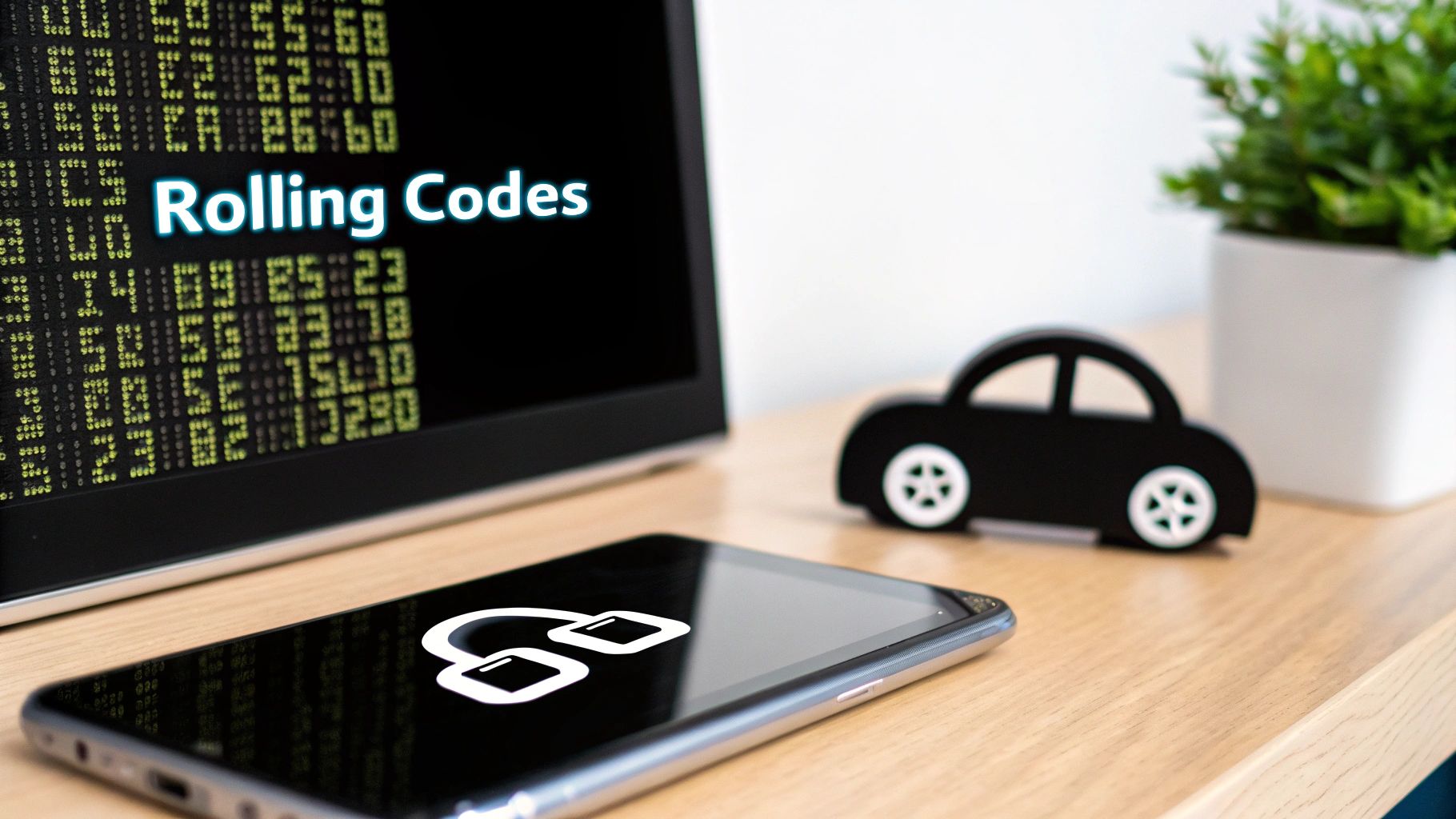
Security is the absolute cornerstone of any keyless entry system. While the convenience is fantastic, the real goal is to make sure only you can get into your car. This is where a clever and vital piece of technology known as rolling codes comes in, forming the secure backbone of how your key fob works.
Imagine having a password to your car that changes every single time you use it. That's the basic idea behind rolling codes. Each time you press a button, your key fob sends a brand-new, never-before-used code to your car. Both the fob and the car’s computer share a secret algorithm, allowing them to predict what the next correct code in the sequence will be.
Defeating the Replay Attack
This constantly changing system is specifically designed to stop a common method of theft known as a 'replay attack'. In this scenario, a thief uses a scanner to capture the radio signal your key fob sends out. With an older, static code system, they could simply record that signal and broadcast it again later to unlock your car.
Rolling codes, however, make that captured signal instantly useless. By the time the thief tries to replay it, your car is already listening for the next code in the sequence, making the old one obsolete. The intercepted code is like a used lottery ticket—it was valid once, but it’ll never work again.
This constantly changing code provides a powerful layer of defence, comparable to the high-level encryption used for online banking. It ensures that even if a signal is intercepted, it cannot be reused to compromise your vehicle's security.
This advanced security has become more important than ever. The alarming rise in vehicle thefts—with a staggering 129,159 vehicles stolen between April 2023 and March 2024 in the UK alone—has pushed manufacturers to adopt more robust systems like these.
How Rolling Codes Stay Synchronised
A common question is how the key fob and the car stay on the same page, especially if you accidentally press a button while out of range. The system is designed with this in mind.
The car’s receiver doesn’t just accept the one single 'next' code; it actually keeps a window of several hundred or even a thousand upcoming valid codes in its memory. This ensures that even if you press the button multiple times in your pocket, the system can find a match within its acceptable range and re-synchronise itself the next time you use it near the car.
This makes the system not only secure but also resilient and user-friendly. While no system is entirely foolproof, rolling codes represent a massive leap forward in vehicle protection. For more practical advice, check out our guide on how to prevent keyless car theft with expert UK tips.
The Next Step: Passive Entry and Smart Keys
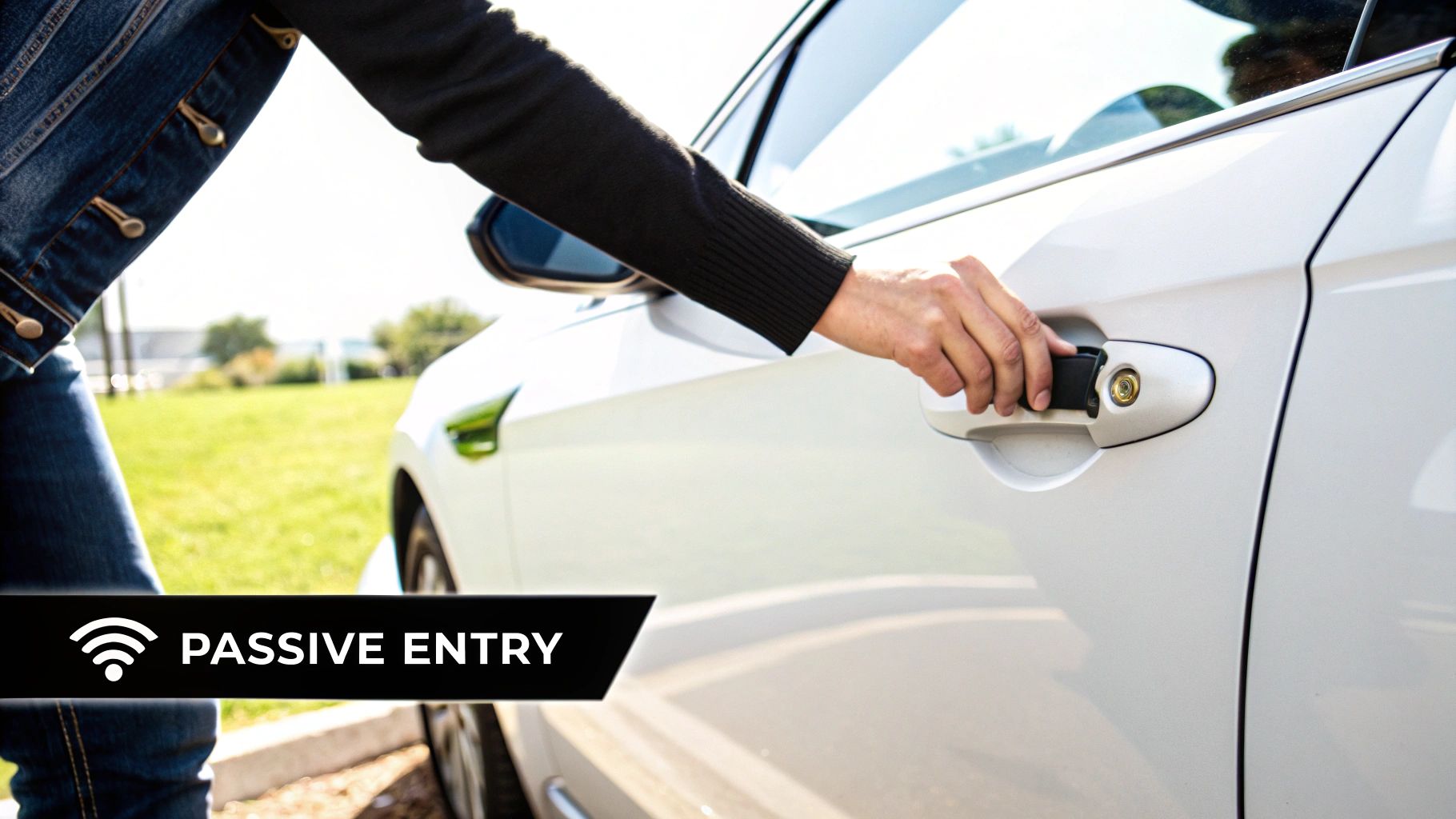
As technology marched on, the sheer convenience of keyless entry took another huge leap forward with Passive Keyless Entry (PKE), which you probably know as a "smart key" system. This evolution did away with the need to even press a button on your fob. With a smart key, you can unlock your car, fire up the engine, and drive off, all while the key stays tucked away in your pocket or bag.
The fundamental difference is who starts the conversation. Instead of you telling the fob to talk to the car, the car now talks to the fob first. Your vehicle is constantly broadcasting a low-frequency (LF) signal in a very short radius, typically just a few metres. This LF signal is like a persistent, quiet question: "Is an authorised key nearby?"
When your key fob enters this bubble, the LF signal provides just enough energy to "wake up" the fob’s internal circuitry.
The Automatic Handshake
Once awake, the fob automatically replies by broadcasting its own unique, high-frequency (HF) signal which contains that all-important secure rolling code. The car’s receiver picks up this reply, verifies the code, and—if it matches—authorises the doors to be unlocked the second you pull the handle or press a button on the door itself. This entire exchange happens seamlessly in the background.
To get a better grip on the principles behind smart keys and passive entry, it's worth exploring this article on Radio Frequency Identification (RFID) technology. Understanding RFID helps to clarify how this automated, proximity-based communication works so effectively.
A New Security Challenge: The Relay Attack
However, this incredible convenience accidentally opened the door to a new vulnerability: the relay attack. This is where the always-on nature of the passive system can be exploited. Thieves, often working in pairs, use specialised signal amplifiers to trick your car into thinking your key fob is right next to it, even when it’s safely inside your house.
In a relay attack, one criminal stands near your home with a device to capture your key’s signal, while an accomplice stands by your car with a second device that relays that captured signal, effectively unlocking the car.
Here’s the step-by-step of how they pull it off:
Capture: The first thief’s device picks up the fob's signal from inside your home.
Amplify & Relay: This signal is amplified and transmitted to the second thief’s device next to the car.
Unlock: The car receives the relayed signal, believes the key is present, and unlocks.
This vulnerability has forced manufacturers to innovate again, setting the stage for the next generation of security measures designed to stop these digital car thieves in their tracks.
The Future of Vehicle Security
As thieves get cleverer with their tech, carmakers are having to fight back with equally impressive security. This constant cat-and-mouse game is pushing vehicle protection beyond simple rolling codes and into a new world of spatial awareness and biometric identity.
The future isn't just about making cars smarter; it's about making them contextually aware of who you are and where you are. The question is shifting from, "Is the correct key nearby?" to a much tougher one: "Is the correct key right here, and is the person holding it actually you?"
The Rise of Ultra-Wideband Technology
One of the most exciting developments on this front is Ultra-Wideband (UWB) technology. Think of it as a hyper-accurate indoor GPS for your key fob. While your current keyless entry system can tell if the fob is somewhere nearby, UWB can pinpoint its exact location, often down to the centimetre.
This incredible precision is a direct shot at relay attacks. These vulnerabilities, where criminals amplify your key fob’s signal to trick your car into unlocking, have been a major headache. UWB makes that attack useless because the car can measure the signal's travel time with pinpoint accuracy. It knows instantly if the key is genuinely next to the door or if its signal is being sneakily relayed from 20 metres away inside your house. You can find out more about how this tech is shaking up the industry in this automotive keyless entry system industry analysis.
UWB technology gives your car a kind of spatial awareness. It doesn't just hear the key's "password"; it can see exactly where that key is in three-dimensional space. This adds a physical layer of security that simple radio frequency signals just can't match.
Beyond the Fob: Biometrics and Digital Keys
The next logical step is to get rid of the physical fob altogether. Carmakers are already integrating new ways to verify your identity that are unique to you—things that simply can't be stolen or copied like a traditional key.
These aren't science fiction concepts anymore. We're talking about:
Biometric Scanners: Fingerprint readers built into the door handle or ignition button that ensure only an authorised user can get in and start the engine.
Facial Recognition: Advanced cameras that identify you as you approach the car, not only unlocking the doors but also automatically adjusting your seat and mirror settings.
Digital Keys: Your smartphone becomes your car key, stored securely in its digital wallet. This lets you grant temporary access to a family member or a valet from anywhere, and you can revoke it just as easily.
These technologies represent a fundamental change in how we interact with our cars. They promise a future where your vehicle isn't just more secure, but more personalised and seamlessly connected to you than ever before.
Of course. Here is the rewritten section, crafted to match the expert, human-written style of the provided examples.
Your Keyless Entry Questions, Answered
Even when you know how the tech works, it’s only natural to have a few lingering questions about security and what to do when things go wrong. Let's tackle some of the most common worries drivers have about this slick, convenient technology.
Is Keyless Entry Really Less Secure Than a Traditional Metal Key?
This is the big one, and it’s a fair question. The answer isn't a simple yes or no. A traditional key can be physically copied by anyone with the right tools, but a modern keyless system uses rolling codes and advanced encryption that are incredibly tough to crack digitally.
The trade-off for convenience is a different kind of risk: the relay attack. Top-tier systems are constantly being updated to fight this, but it just goes to show that security is all about layers, not just one feature.
The bottom line? A high-quality, manufacturer-fitted keyless system is far more secure against old-school theft than a standard key. The threat has simply shifted from a physical key-cutter to a digital snooper.
What on Earth Happens If My Key Fob Battery Dies?
Every driver has had that sinking feeling, picturing themselves stranded with a dead fob. But don't worry, carmakers have a simple, clever backup plan.
Virtually every key fob, no matter how minimalist it looks, has a secret physical key hidden inside. You can usually pop it out by pressing a small button or sliding a catch. Your car also has a hidden keyhole, typically tucked away under a small plastic cap on the driver’s door handle to keep the design clean. A quick flick through your owner's manual will show you exactly where to find both.
Can My Keyless Car Be Stolen Easily?
The risk of a relay attack is real, but "easily" is the key word here. Thieves need specialised, expensive gear to pull it off. The good news for you is that the best defence is incredibly simple and cheap.
All you need is a Faraday pouch. Storing your key fob in one of these signal-blocking pouches (or even just a metal tin) when you're at home makes it completely invisible to thieves. Their relay equipment can't pick up a signal that isn't there. This one tiny habit completely neutralises the main vulnerability of keyless entry, giving you total peace of mind.
If you're facing any issues with your car keys, from a dead battery to needing a complete replacement, Blade Auto Keys provides expert, non-destructive services across South Wales. Find fast, reliable help at https://www.bladeautokeys.co.uk.

Comments