
How to Protect Keyless Entry Cars from High-Tech Theft
- yelluk

- 4 days ago
- 13 min read
That feeling of convenience when your car unlocks as you approach is one of modern driving’s little luxuries. But this seamless tech has a dark side, creating a silent vulnerability that thieves are all too eager to exploit. The problem is rooted in the very signal that makes it all work.
Your key fob is constantly broadcasting a low-power radio signal, like a digital handshake waiting for your car to recognise it. Unfortunately, criminals have become frighteningly good at intercepting and amplifying that signal.
The most common tactic they use is the relay attack. It’s a shockingly simple, two-person job that can be done in under a minute. One thief stands near your house with a device that captures the signal from your key fob—it can pick it up right through your front door, windows, and walls. That signal is then relayed to a second thief standing next to your car, whose device mimics your key, tricking your car into unlocking and starting. It's that fast.
Understanding the Thieves' Toolkit
Relay attacks aren't the only trick up their sleeve. Criminals have a few methods for getting around your car's security, and knowing what they are is the first step to building a solid defence.
Signal Jamming: This one is brutally effective. A thief uses a device to block the locking signal as you walk away from your car. You press the lock button on your fob, hear the familiar beep, and assume it’s secure, but the car never received the command. It’s left unlocked and waiting.
Key Cloning & OBD Hacking: More sophisticated thieves can capture your key's signal to create a clone. Others might gain entry and plug into your vehicle’s On-Board Diagnostic (OBD) port to program a blank key, giving them total control.
This isn't just a rare occurrence; it's an epidemic. Keyless car theft has surged across the UK, now accounting for the majority of stolen vehicles. Data from the Office for National Statistics is genuinely alarming: between March 2023 and March 2024, an incredible 58% of all car thefts involved criminals exploiting key fob signals with relay attacks.
To see how convenience and security clash in other areas, it's interesting to look at how smart locks for apartments operate in residential spaces, which highlights similar vulnerabilities and defence strategies.
Getting to grips with the technology behind these systems is your best defence. You can dive deeper with our complete guide to keyless car entry systems to understand exactly how your key and car communicate.
Simple Habits to Secure Your Car Tonight
You don’t need to be a security expert or spend a fortune to get a massive boost in your car’s defences. More often than not, protecting your vehicle comes down to a few simple, clever habits that make it a far less tempting target for thieves. These are the practical, low-cost routines you can start tonight, forming the first and most critical layer of your security.
The single most effective tool in your arsenal is a signal-blocking Faraday pouch. This small, inexpensive sleeve is lined with a special metallic fabric that creates a barrier—a Faraday cage—around your key fob. This barrier physically stops the radio signals your key constantly emits, making it impossible for a thief's relay device to capture and amplify them.
It's a simple concept with a powerful outcome. No signal, no theft.
Where You Store Your Keys Matters
Even if you don't have a pouch, your daily habits can make a huge difference. The golden rule is to put as much distance as you can between your keys and the outside walls of your home. Never, ever leave your fob on a hook by the front door or on the kitchen counter next to a window. These are the prime spots thieves target to pick up a signal from the street.
A great DIY alternative is a simple metal container. Storing your keys inside a metal biscuit or tea tin can often be enough to block or significantly weaken the signal. It’s a no-cost fix that offers a surprising amount of protection.
"The vast majority of keyless thefts rely on convenience. By simply disrupting the signal path from your fob to the street, you remove that convenience and force criminals to move on to an easier target."
This diagram below shows just how easily thieves can pull off a relay attack.
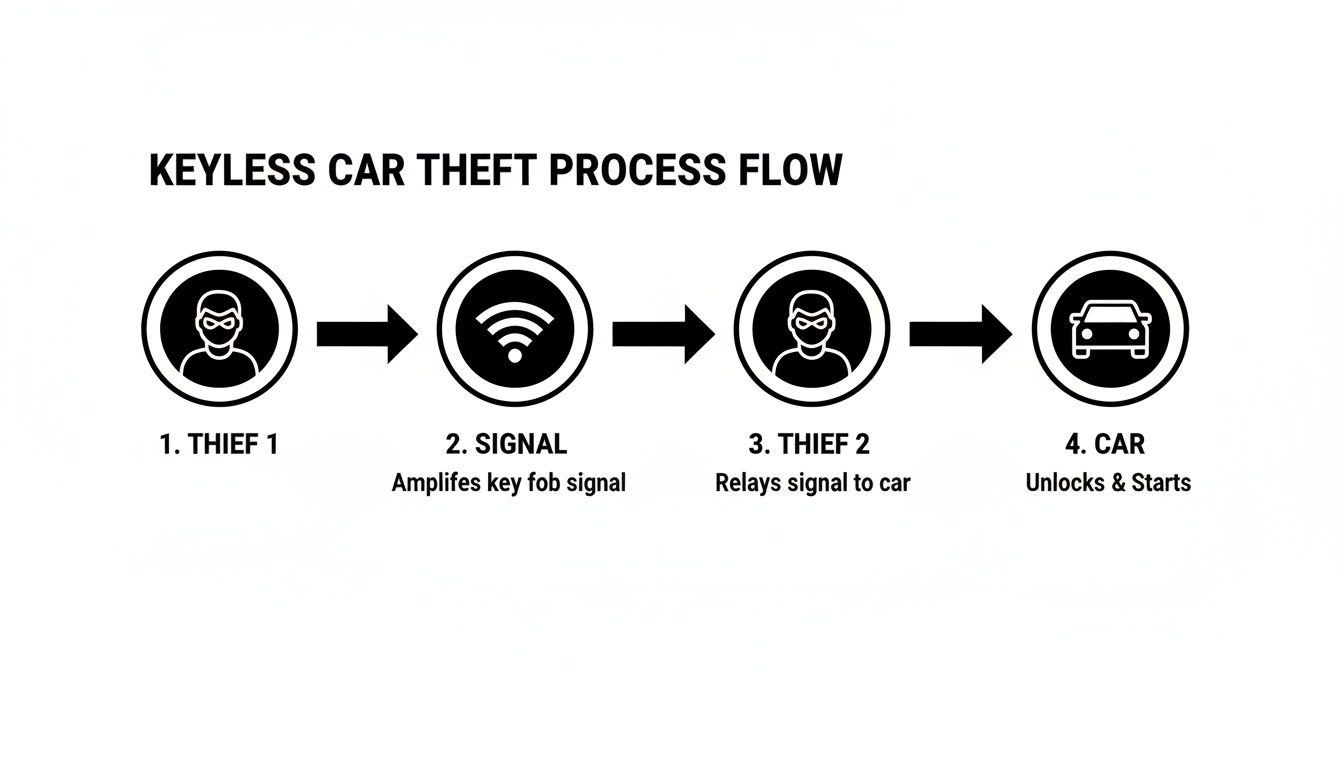
As you can see, it’s a two-person job where one thief captures your key's signal while the other uses it to unlock and start your car. The whole thing can be over in less than 60 seconds.
For a quick overview of the most impactful changes you can make right away, have a look at this table. These are the easy wins that will drastically lower your risk.
Quick Security Wins for Your Keyless Car
Security Measure | How It Works | Estimated Cost | Effectiveness Level |
|---|---|---|---|
Faraday Pouch | Creates a signal-blocking cage around the key fob, preventing relay attacks. | £5 - £15 | Very High |
Metal Storage Tin | A DIY Faraday cage using a biscuit tin or similar to weaken or block the signal. | £0 - £5 | High |
Strategic Parking | Parking in a garage, a well-lit area, or close to a wall makes access harder. | £0 | Medium |
Manual Fob Deactivation | Some fobs can be temporarily turned off. Check your car's manual. | £0 | Very High (if available) |
Steering Wheel Lock | A strong, visible physical deterrent that stops the car from being driven away. | £30 - £100 | High |
Implementing even one or two of these measures will make a thief's job significantly harder, often convincing them to look for a softer target elsewhere.
Smart Parking and Daily Routines
Your defensive mindset needs to extend to where you park your car. If you have a garage, use it. A vehicle that's out of sight is always a safer bet than one parked on the street.
When parking in public or on your driveway, start thinking strategically:
Park defensively. Whenever you can, position your car with the driver's side close to a wall, another vehicle, or a fence. This makes physical access to the door more awkward and time-consuming for a thief.
Choose well-lit areas. Criminals thrive in the dark. Parking under a streetlight or in a monitored car park is a powerful, natural deterrent.
Be aware of your surroundings. When you lock your car, listen for the familiar click and watch for the flashing lights. This confirms your signal hasn't been blocked by a jammer.
By combining mindful key storage with smart parking, you create multiple obstacles for any would-be thief. These small, consistent habits disrupt their process and are often all it takes to convince them your car simply isn't worth the risk.
Tapping Into Your Car's Built-In Defences
Beyond clever habits and aftermarket gadgets, your vehicle probably has its own security features just waiting to be activated. Many car manufacturers have responded to the rise in keyless theft by building in defences, but these tools are often hidden away in settings menus, completely unknown to the average owner.
Taking a few minutes to explore what your car already offers is one of the most effective ways to protect it.
The Simple Power of 'Sleep Mode'
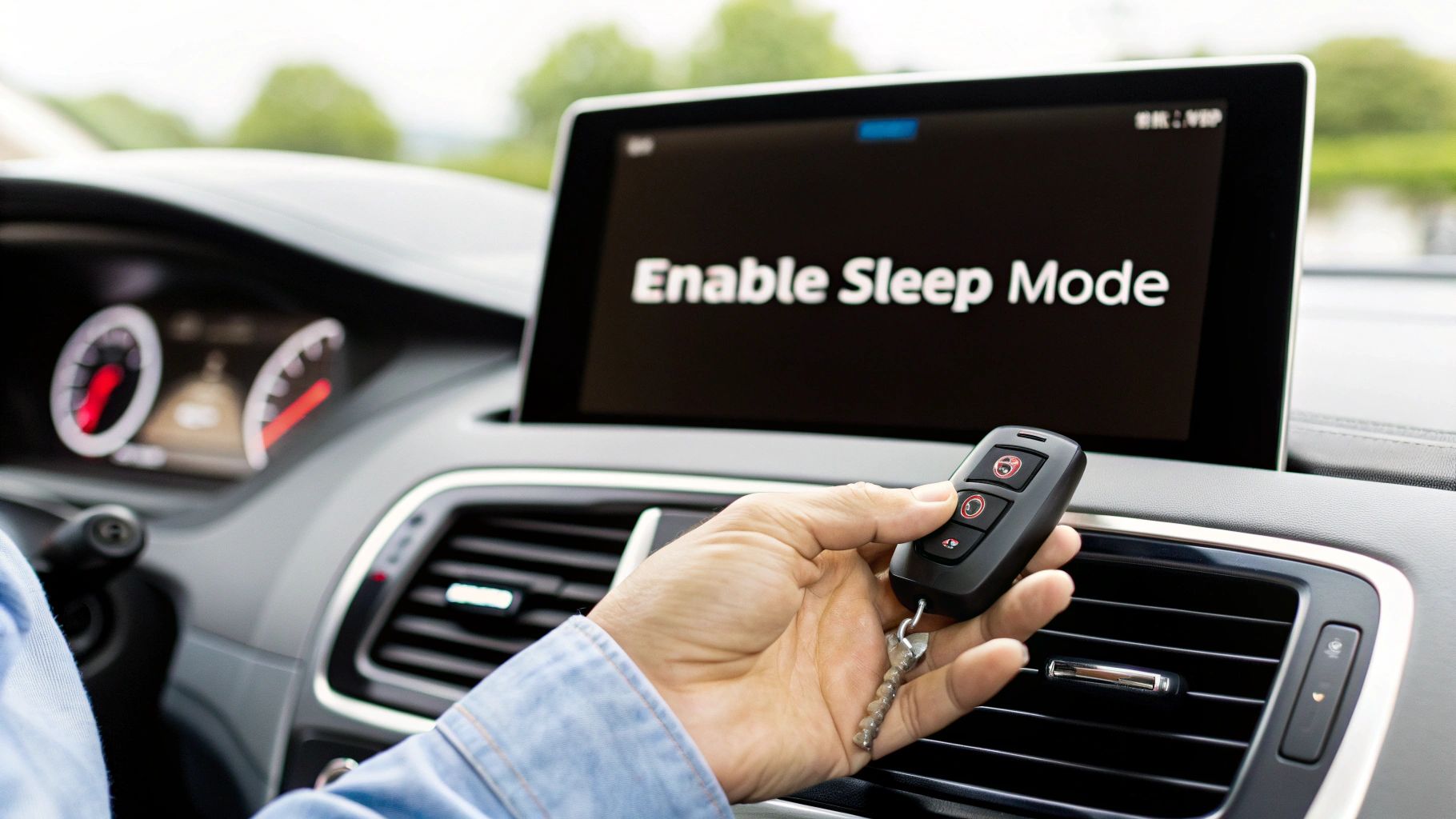
One of the most powerful built-in features is the key fob 'sleep mode'. It’s a beautifully simple concept. When enabled, motion sensors inside the fob detect when it has been stationary for a minute or two—for instance, when you've left it on a hallway table.
The fob then simply stops transmitting its signal. This effectively cuts off a relay attack at the source before it can even begin. Check your vehicle’s handbook or the manufacturer’s website to see if your model supports this; it's often a simple toggle in the car's settings that makes a massive difference.
Why You Can't Ignore Software Updates
Just like your smartphone, your car's software needs regular updates. Manufacturers are constantly releasing firmware patches that close security loopholes discovered long after a car leaves the factory. These updates can strengthen encryption, improve how the car communicates with the key, or fix flaws that thieves have learned to exploit.
Ignoring these updates is like leaving a digital window wide open for criminals. You can typically check for updates through your car's infotainment screen or by getting in touch with your local dealership. Staying current is a free, simple way to ensure your vehicle has the latest protection against ever-evolving theft techniques.
Key protection is a constant cat-and-mouse game. While newer cars often use advanced technology to verify a fob's distance, making relay attacks much harder, millions of older vehicles aren't so lucky. Even with major brands like Land Rover investing heavily in security overhauls, the fact remains that a huge number of UK cars still lack basic protections.
The Next Generation of Keyless Security
Modern vehicles are increasingly equipped with something called ultra-wideband (UWB) technology, and it's a real game-changer. Unlike older radio frequency systems that just check for a signal's presence, UWB measures the precise time it takes for that signal to travel between the fob and the car.
This allows the vehicle to calculate the exact distance of the key. It renders a relayed signal useless because the tiny time delay instantly exposes it as a fake. If you're buying a new car, it's well worth asking the dealer specifically if it includes UWB protection. To get a better handle on the inner workings of these advanced systems, our practical guide to car transponder keys offers a detailed breakdown.
Why Physical Deterrents Still Matter
In an age of high-tech car crime, it's easy to think that the old ways are obsolete. Thieves are using signal amplifiers and sophisticated software, so what good is a simple, brute-force lock? As it turns out, a whole lot of good. These traditional deterrents are making a huge comeback, and for good reason. They add a crucial, visible layer of security that digital defences just can't offer on their own.
The real point of a physical lock isn't to make your car completely impossible to steal. It’s about making the whole process noisy, time-consuming, and risky for the thief. A criminal might bypass your keyless entry system in seconds, but they still have to physically defeat a sturdy steering wheel lock. That requires tools, makes a racket, and draws exactly the kind of attention they want to avoid.
This delay is often the single deciding factor that sends them looking for an easier target. It turns a quick, silent digital crime into a very conspicuous physical struggle.
Choosing the Right Physical Lock
Not all physical locks are created equal, and a cheap one can give you a false sense of security. When you’re choosing one, always look for products that are Sold Secure or Thatcham approved. These accreditations mean the device has been independently and rigorously tested against the kinds of attacks thieves actually use.
There are several excellent options you can add to your security routine:
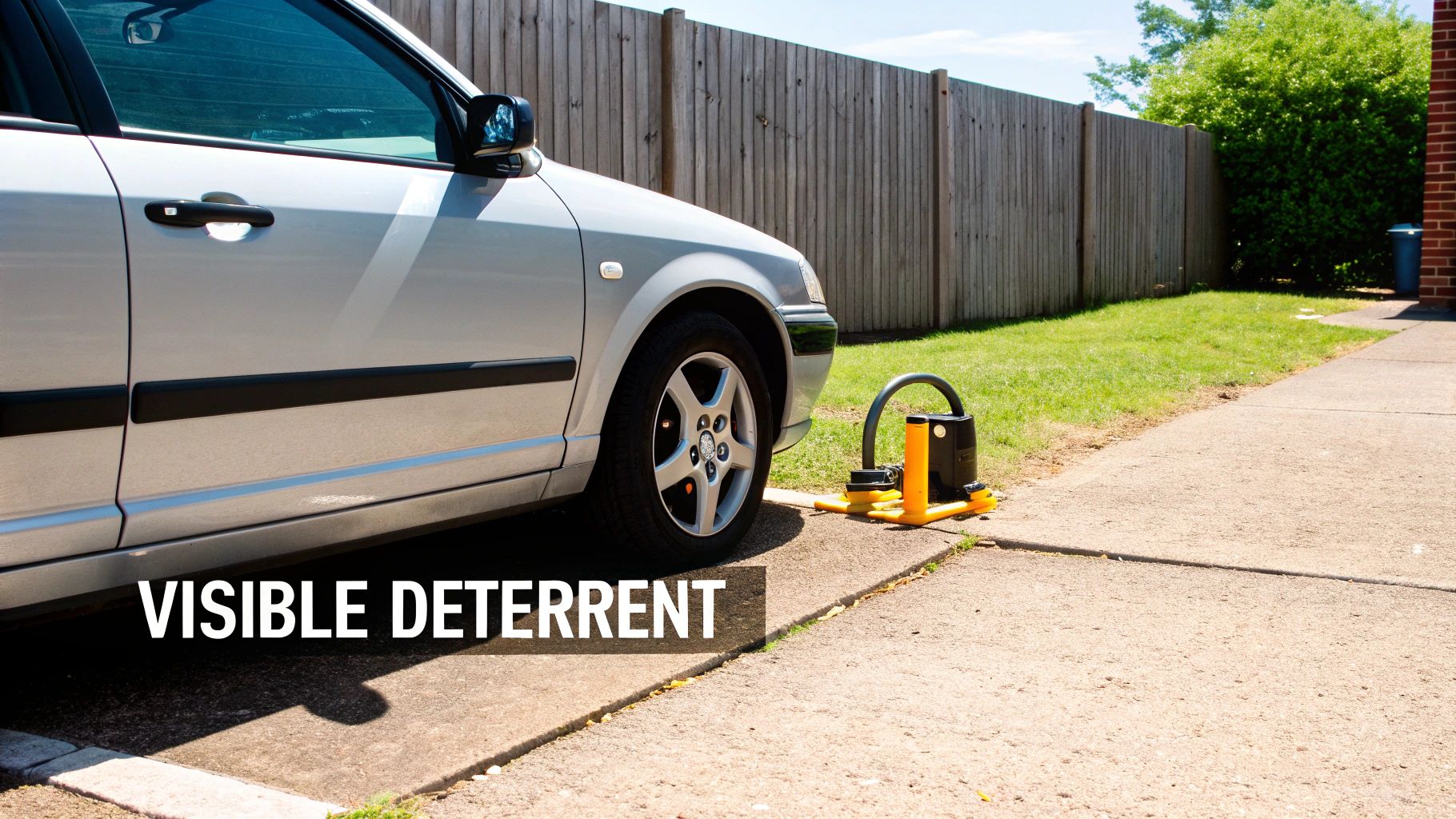
Steering Wheel Locks: These are the most common for a reason—they're highly effective. A brightly coloured lock, like the classic ones from Disklok or Stoplock, is instantly visible through the windscreen, advertising that your car is not going to be an easy win.
Gearstick Locks: These devices lock the gear selector in place, preventing the car from being driven. They’re a fantastic secondary measure, especially for automatic vehicles.
Wheel Clamps: While they might be a bit more cumbersome for daily use, a wheel clamp is an undeniable visual statement. It’s an excellent choice if you’re leaving your car parked for a longer period, like at an airport or while you're on holiday.
The true power of a physical lock is its visibility. A potential thief scanning a street will almost always bypass the car with a bright yellow steering lock in favour of the unprotected one right next to it. It’s all about creating the perception of difficulty.
Expanding Your Physical Defences
For the ultimate peace of mind at home, you can take physical protection a step further. If you're serious about protecting your vehicle on your own property, it’s worth looking into more substantial measures like security bollards for driveways as a robust deterrent against car thieves. These provide a formidable barrier, making it physically impossible for a thief to simply drive your car away.
When you combine a Faraday pouch for your keys with smart storage habits and a tough, visible lock, you create a layered defence. This approach frustrates both digital and physical theft attempts, proving that sometimes, the oldest tricks are still the best ones.
Professional Upgrades for Ultimate Protection
If you're serious about security, it’s time to move beyond the basics. While Faraday pouches and steering locks are fantastic deterrents, professional and aftermarket solutions take your vehicle’s defence to a whole new level. This is where you stop just discouraging thieves and start actively defeating their high-tech tools.
Think of it as hardening your car’s digital immune system. An expert automotive locksmith can plug directly into your car's brain and implement changes that make it a significantly tougher target for today’s sophisticated criminals.
Advanced Key Reprogramming
One of the most effective professional services available is key reprogramming. Modern thieves are experts at exploiting the predictable "rolling codes" that your key fob sends to the car. These are the encrypted signals that change with every use, but they can still have weaknesses. An expert can reprogram your existing fobs to use far more secure and unpredictable code sequences.
This process essentially changes the digital locks on your car. Any signals that thieves might have previously captured or cloned are instantly rendered useless. It’s a precision strike against the technology used in relay attacks.
The need for this is more urgent than ever. Vehicle thefts in England and Wales shot past 80,000 in just the first nine months of 2025, which works out to a car being stolen every 4.9 minutes. Professional reprogramming directly tackles the vulnerabilities that are driving these shocking statistics.
Installing Aftermarket Immobilisers
For the ultimate peace of mind, nothing beats a ‘ghost’ immobiliser. This is a small, covert device that a specialist wires deep into your car’s electronic systems, making it completely invisible to a thief. It adds a layer of authentication that your car’s original keyless system simply doesn’t have.
A ghost immobiliser requires you to enter a unique PIN using your car's existing buttons—like a specific sequence of presses on the steering wheel or window controls—before the engine will start. Even if a thief pulls off a perfect relay attack and gets inside, they won't be able to drive away.
This upgrade is an almost foolproof method of protection, especially for high-value vehicles or frequently targeted commercial vans like the Ford Transit.
Stealth Installation: Professionals hide the device so well within the vehicle's wiring loom that it's nearly impossible for thieves to find and disable it quickly.
No Extra Fobs: The system is clever, using your car’s own buttons, so there are no extra tags or fobs to carry, lose, or have stolen.
Vehicle Specific: The PIN sequence is completely unique to you and your vehicle, offering truly personalised security.
The Value of a Professional Diagnostic Check
Finally, don't overlook the power of a professional diagnostic check. An experienced auto locksmith can scan your car’s computer systems to spot hidden vulnerabilities you’d never find on your own. This is particularly crucial for modern electric and hybrid vehicles with their incredibly complex electronics.
A specialist can ensure all your security software is up-to-date and that no digital backdoors have been left open for thieves to exploit. To explore your options further, check out our guide on the UK’s best car security systems.
Your Keyless Security Questions Answered
Even with the best security habits, it’s completely normal to have a few lingering questions. Getting the details right is what gives you real confidence that you’ve done everything possible to protect your car. Let’s tackle some of the most common queries I hear from drivers.
Will a Faraday Pouch Drain My Key Fob Battery?
This is a question I get asked all the time, and the short answer is a definite no. A Faraday pouch won't drain your key fob's battery. If anything, you could argue it helps preserve it, although the effect is tiny.
The pouch is just a physical shield that stops radio signals from getting in or out. Your key fob only really uses power when you press a button or when it’s actively ‘talking’ to your car. Inside the pouch, it’s completely isolated and silent, unable to send or receive anything.
This means it can't be tricked into a constant back-and-forth chatter with a nearby relay device, so it’s not causing any extra battery drain. Its only job is to block signals, and it does that without affecting your fob’s lifespan at all.
Are Some Car Brands More Vulnerable Than Others?
Yes, but it's more about the age of the tech than the badge on the bonnet. You'll often see brands like Range Rover or popular models like the Ford Fiesta pop up in theft reports, and that’s usually because thieves have found a specific, repeatable weakness in older versions of their keyless systems.
However, manufacturers are in a constant arms race with thieves. Jaguar Land Rover, for instance, has poured a fortune into developing newer, much more secure systems using ultra-wideband (UWB) technology.
This means a brand-new, budget-friendly car can have far stronger defences than a premium older vehicle. That’s why keeping your car’s software updated and thinking about professional security upgrades is so critical, no matter what you drive.
Your security plan should be based on the technology in your car, not just the brand. An older, high-end vehicle without modern UWB protection and software updates can be a much easier target than a new family hatchback with the latest security features.
Is My Older Car Too Outdated to Secure Properly?
Absolutely not. It’s a huge mistake to think an older car can't be made secure. While it might not have rolled out of the factory with the latest built-in tech, you can easily build a formidable, layered defence that makes it an incredibly tough target.
Think of it as adding modern armour to a classic frame.
First, a diligent routine of keeping your keys in a Faraday pouch is your frontline defence. Then, add a high-quality, Thatcham-approved steering wheel lock—it’s a massive visual deterrent that tells a thief to just move on.
The final layer, and probably the most effective, is a professionally installed aftermarket immobiliser. An expert auto locksmith can fit a modern 'ghost' immobiliser that requires a unique PIN sequence—entered using your car's existing buttons like those on the steering wheel or window controls—before the engine will even think about starting. This single upgrade gives an older vehicle cutting-edge protection that often surpasses the security on many newer models.
Is a GPS Tracking Device a Good Investment?
A GPS tracker is an excellent piece of kit, but you have to understand its role. A tracker is a recovery tool, not a prevention tool. It won't stop a thief from taking your car; it will only help you and the police find it after the fact.
For that reason, a tracker should be your last line of defence. The best strategy is always to combine strong prevention methods (pouches, physical locks, and immobilisers) with a recovery method like a tracker.
For high-value vehicles, a professionally installed, hidden tracker is often a much better bet than a factory-fitted one. Thieves are pros at finding and disabling standard systems. A well-hidden aftermarket tracker gives you a real fighting chance of getting your car back if your other defences are somehow breached.
If you're looking to implement professional-grade security like advanced key reprogramming or a ghost immobiliser, trust the experts. Blade Auto Keys provides specialised automotive locksmith services across South Wales and surrounding areas, ensuring your vehicle is protected with the latest technology. Contact us 24/7 for emergency help or a security consultation at https://www.bladeautokeys.co.uk.

Comments