
CAN Bus Immobiliser Guide: What It Stops in South Wales

A CAN bus immobiliser is an independently fitted device that interrupts the starting or power circuit until a concealed, separately authenticated user action is completed, and it only addresses attack routes that reach that circuit.
Your keyless car might be outside your Cardiff home right now, with both keys safely indoors. Or you might be deciding how to protect a delivery van that has to be ready for work tomorrow. The useful question isn't whether an immobiliser sounds secure. It's which theft route it blocks on your particular vehicle, and what remains exposed.
Which Car Thefts a CAN Bus Immobiliser Stops
A CAN bus immobiliser adds protection alongside the factory immobiliser. It doesn't replace it, and fitting one doesn't make every theft method ineffective.
The distinction matters because thieves don't all use the same route. Someone using a copied key is exploiting different access from someone connecting equipment to exterior wiring. A thief loading the vehicle onto a transporter may never attempt to start it.
Theft methods and what a CAN bus immobiliser does against each
Theft method | How it works | Addressed by a CAN bus immobiliser? |
|---|---|---|
Key copying or cloning | Thief duplicates the key's code or transponder | Partly: a second authorisation step blocks a copied key on its own |
Relay attack | Thief extends the key's radio signal from outside the home | Partly: separate start authorisation adds a step, but a signal-blocking pouch is the direct control |
CAN-bus injection | Forged messages reach the start control through accessible wiring | Yes, if the device sits in the start or power circuit and the wiring is protected |
Physical removal by towing | Vehicle is loaded and taken away | No: a tracker supports recovery, while an alarm may warn of movement |
Diagnostic port bypass | Access gained through the on-board diagnostic port | Only where the installation resists diagnostic bypass and the port is appropriately protected |
A successful entry attempt shouldn't automatically become a successful drive-away. That's the purpose of the independent authorisation barrier. However, its usefulness against network injection rests on the actual installation, not the product's description.
Physical deterrents serve a different purpose. For households protecting motorcycles as well as cars, Flex Electric's guide to motorcycle disc locks with alarms illustrates how mechanical restraint and audible warning can work together. That isn't equivalent to immobilising a car's starting circuit, but it's a useful distinction when choosing security for different vehicles.
Practical rule: Match the protection to the theft method, not to the most alarming headline.
Start with your vehicle's likely exposure. If it has keyless entry, protect the key signal. If accessible wiring presents a known route into its security systems, assess independent immobilisation and wiring protection. If physical removal is credible where you park, include movement detection and recovery rather than expecting a start block to solve it.
How a CAN Bus Immobiliser Sits Inside the Car's Network
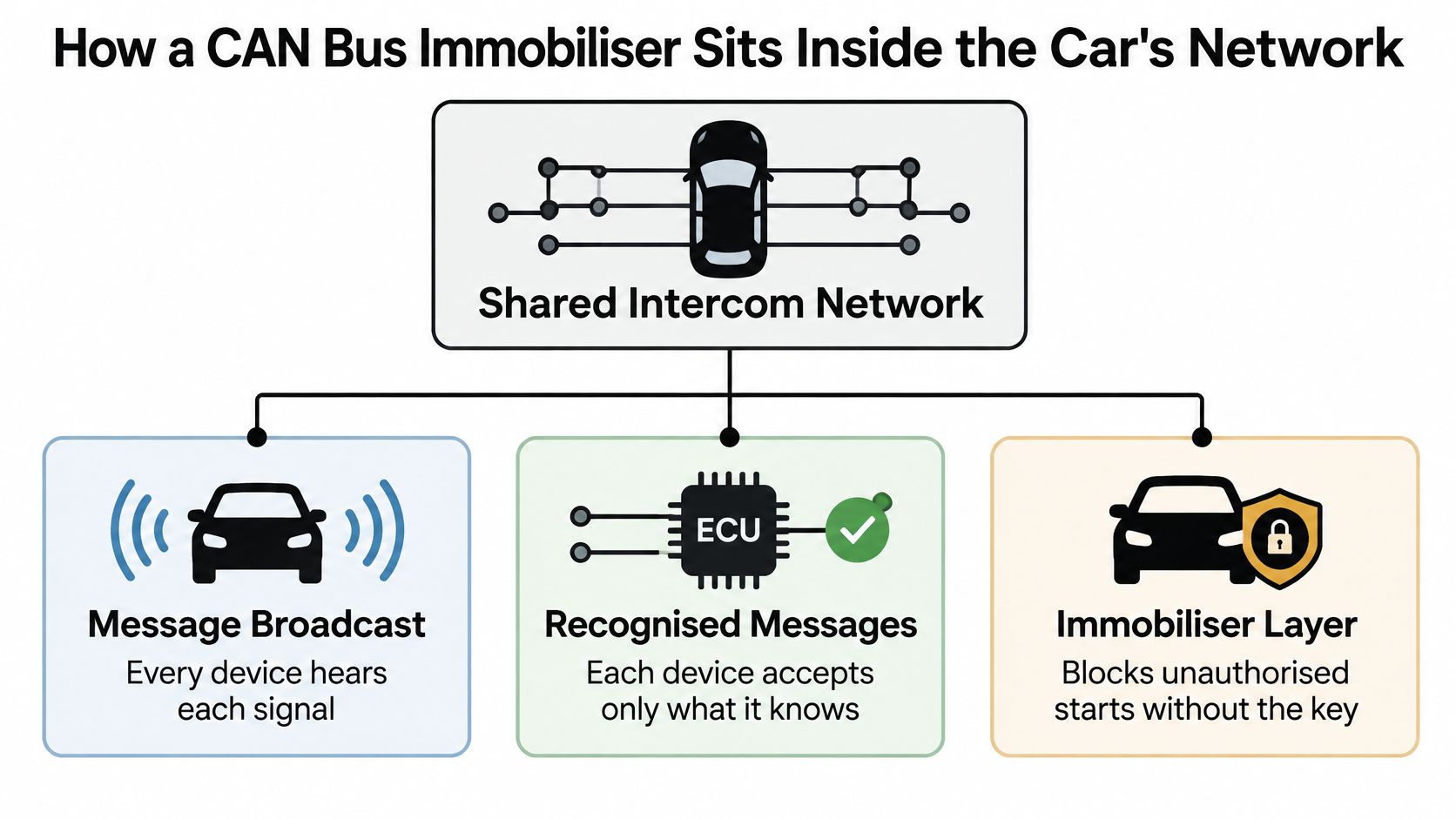
A vehicle's Controller Area Network (CAN bus) lets electronic control units exchange messages. The engine controller, body control module and keyless receiver may communicate across different network segments, with gateways between them. The wiring diagram for the specific model determines how those systems connect.
The diagram shows how shared messages travel and where an additional immobiliser layer can fit.
Reliable messaging isn't authenticated messaging
Standard CAN manages traffic arbitration and error detection, but it does not provide native cryptographic authentication or encryption. Coventry University's vehicle cybersecurity work identifies message injection, eavesdropping and operational disruption as risks.
A message can be electrically valid without being authorised. If an attacker reaches a vulnerable network segment, another controller may accept an instruction without independently verifying its origin.
An aftermarket immobiliser needs to inhibit a critical start or power-control function and require separate user authorisation before that function is available. Ask which function the proposed device blocks on your vehicle. CAN-connected products do not all work in the same way.
What a sound installation includes
Correct network integration: Preserve the manufacturer's CAN termination and topology. Change wiring arrangements only where the model-specific installation requires it.
Protected connections: Conceal and secure wiring, use appropriate low-current connections, and avoid locations that are easy to reach and bypass.
Diagnostic validation: Record existing faults before installation, then check for new communication faults or warning indicators afterwards.
Functional commissioning: Test authorised starting, start refusal without authorisation, locking, sleep behaviour and the documented recovery procedure.
UN Regulation No. 155 sets cybersecurity requirements for newly type-approved vehicles. That does not establish that any individual car is immune to theft. Factory protection depends on the vehicle's generation and specification, so check the applicable manufacturer information before assessing it.
How Thieves Reach the CAN Bus Past the Factory Key
Consider a keyless car parked outside a South Wales home. The owner still has the keys, yet the car disappears without anyone obtaining them. A network attack can explain that apparent contradiction.
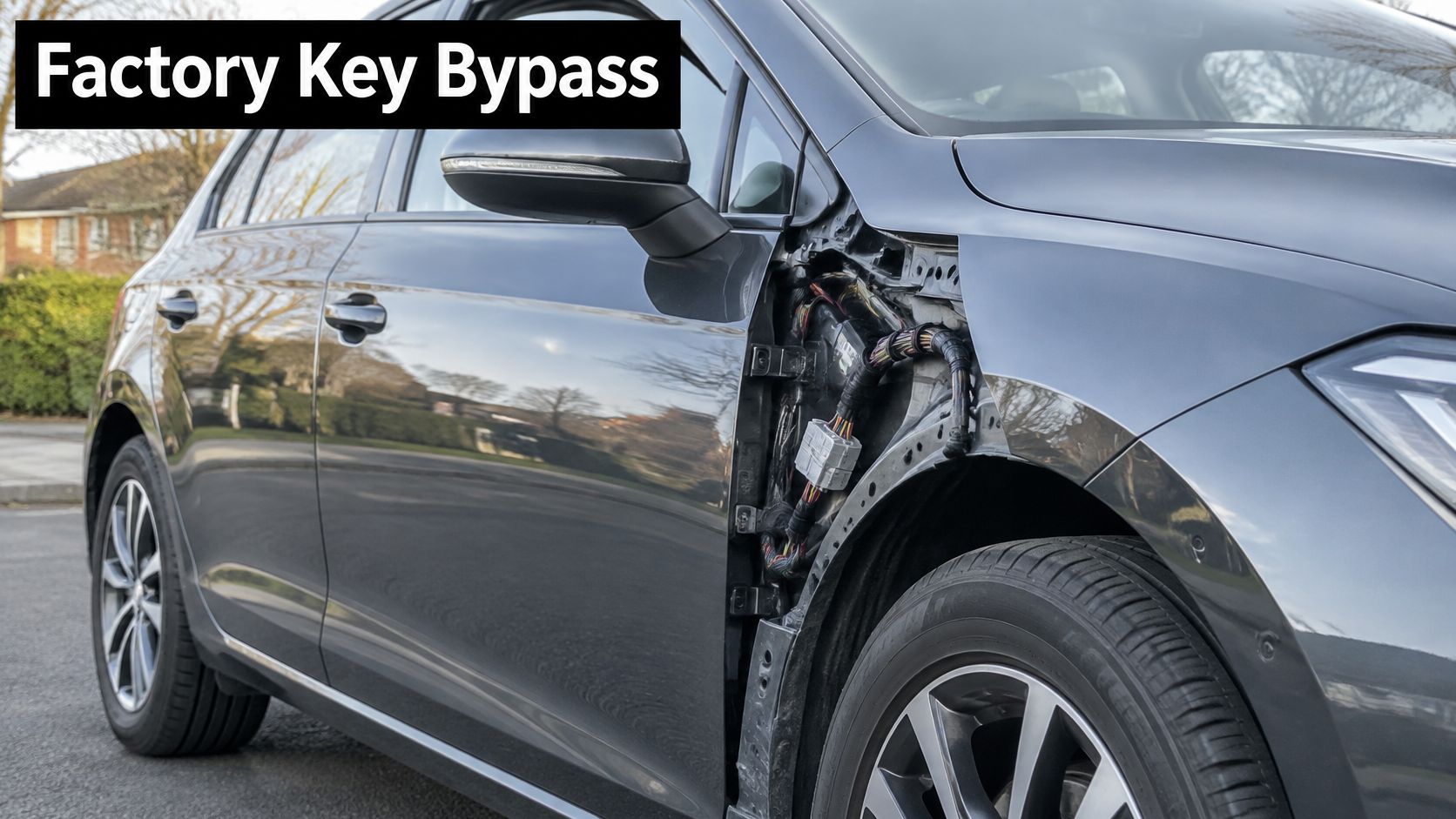
Exterior wiring is relevant because the attacker needs a route into a vulnerable part of the vehicle's electronics. This image shows the sort of wiring area an installer must assess, not proof that every vehicle has the same exposure.
The attack route in plain terms
The BBC's explanation of CAN-bus theft describes criminals connecting equipment to vehicle wiring and injecting false messages to bypass factory security. At a high level, the sequence is:
Reach a vulnerable wiring point. Exterior wiring can provide access on susceptible vehicle platforms.
Connect specialist equipment to that wiring, creating a path into the relevant network segment.
Send forged authorisation messages. The vulnerable security architecture accepts messages that appear legitimate.
Once the factory system accepts the false authorisation, the start control can permit the vehicle to be driven away.
Technical coverage in E-Mobility Engineering describes attacks through headlamp wiring and reports equipment costing approximately £2,500–£4,000. This is a specialist method involving physical access, not a thief remotely pressing a button from anywhere.
That reporting also describes enhanced security hardware and altered platform designs on newer versions of targeted models. Network segmentation and intrusion detection are relevant countermeasures, but registration age alone doesn't establish which protection a particular vehicle has.
The video provides further context for electronic vehicle theft.
Why protecting the key isn't the whole answer
Relay theft extends the key's radio signal. CAN injection instead presents forged messages to the vehicle's electronics, so the original key needn't participate. A pouch can't block a message arriving through wiring.
For wider context, Home Office data reported by the BBC showed recorded vehicle theft offences in England and Wales were almost 50% higher in 2025–26 than a decade earlier, with electronic key cloning and signal amplification identified among theft methods. That isn't a South Wales-specific increase or a measurement of CAN-injection theft.
For everyday keyless precautions, use the guide to preventing keyless car theft alongside a vehicle-specific wiring assessment. Ask the installer which exterior access routes matter on your model and whether the proposed immobilisation remains effective if those routes are compromised.
Which Vehicles Gain Most and Where It Falls Short
Suitability starts with the exact vehicle, not the fuel type. A familiar-looking model can have different control modules, wiring layouts and security features across generations.
The starting arrangements below are typical patterns, not a compatibility list. A mechanical key doesn't automatically mean a simple installation, and a push-button start doesn't prove vulnerability to every electronic attack.
Vehicle types and how a CAN bus immobiliser fits each
Vehicle type | Typical starting control | Main limitation | Suitability |
|---|---|---|---|
Petrol or diesel car without keyless entry | Mechanical key with transponder | Fewer keyless-related routes, but CAN exposure still needs checking | Often a straightforward fit after compatibility checks |
Keyless petrol or diesel car | Push-button start through a body control module | Several network segments to assess | Needs an access-point review first |
Hybrid | Hybrid control unit coordinating engine start and ready state | Some procedures are dealer-only | Confirm permitted procedures before fitting |
Battery electric vehicle | Electronic power-ready control | High-voltage isolation and dealer-only limits | Specialist assessment required |
Van or light truck with fleet telematics | Keyless or key-fob start with fleet modules | Separate networks and fleet modules | Survey the wiring for each vehicle |
Benefits worth paying for
Independent authorisation: Possession of a working factory key doesn't, by itself, satisfy the additional security layer.
Effective start inhibition: A correctly engineered installation blocks the relevant starting or power-ready function, rather than merely generating a warning.
Model-specific integration: Compatible systems can use existing vehicle controls without requiring the same installation design across every make.
The daily-use trade-off is another action before driving. Choose an authorisation method you can operate reliably, and understand how servicing, another authorised driver and emergency recovery will work before accepting the installation.
Limits that should stay visible
Physical removal remains possible: Immobilisation doesn't anchor the vehicle to its parking space.
Access routes aren't universal: A protected circuit doesn't establish that every network segment or diagnostic function is protected.
Poor wiring creates problems: Bad connections can introduce intermittent faults and diagnostic trouble codes.
Factory updates still matter: Aftermarket protection doesn't replace manufacturer security maintenance.
Certain electric and hybrid models have dealer-only procedure limits. The installer must establish what's permitted before starting, and high-voltage systems require specialist assessment. An aftermarket security job shouldn't involve improvising around traction-battery circuits.
A compatible device is only the starting point. The proposed inhibition method and the quality of integration decide whether the installation makes sense.
Confirm the make, model, year and relevant powertrain specification. Vehicle category alone isn't enough to approve the work.
South Wales Fitting Scenarios for Cars, Vans and Fleets
A Cardiff commuter's car and a Swansea delivery van face different risks because they are parked and used differently. The right protection depends on the vehicle, where it stays overnight and who is responsible for responding to an alert.
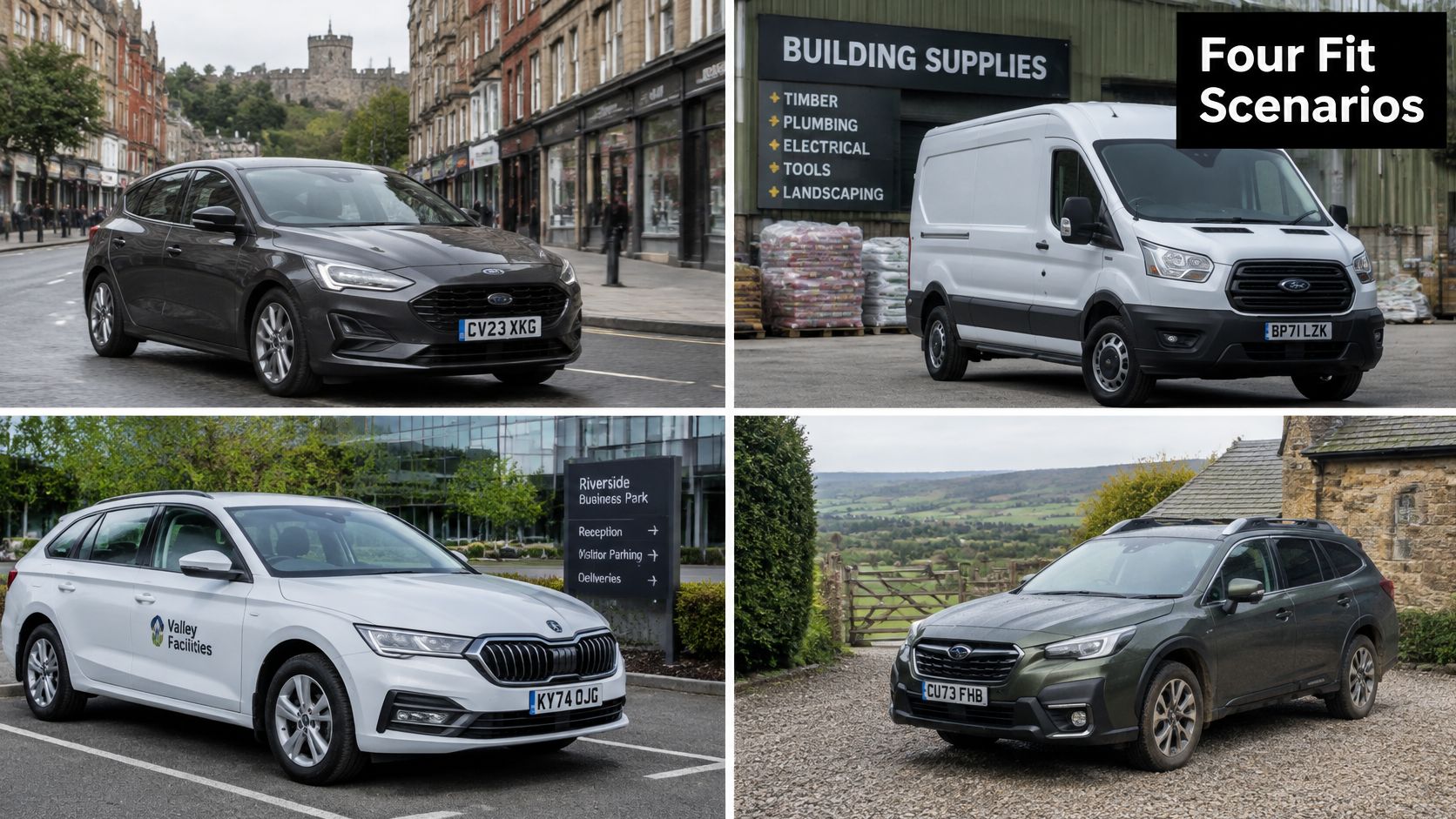
Practical local fitting scenarios
Cardiff commuter with a keyless hatchback. Consider whether relay theft is a concern and whether exterior wiring is accessible. A signal-blocking pouch addresses key-signal exposure; a CAN bus immobiliser addresses unauthorised starting through the vehicle network. They tackle different routes and do not replace one another.
Swansea delivery van parked overnight in a yard. An immobiliser can obstruct a drive-away attempt, while a monitored tracker can help locate the vehicle after movement. Decide who will receive alerts and respond when the business is closed.
Newport fleet with mixed vans. Treat each vehicle configuration separately rather than assuming one installation suits every van. Geofencing can support movement monitoring, while clear procedures for issuing, returning and tracking keys reduce confusion. See this guide to fleet key management.
Rural driveway in the valleys. An immobiliser and monitored tracker can provide separate layers of protection. If movement alerts matter, check that communications and alert delivery work at the actual parking location.
For local vehicle-offence figures, consult South Wales Police's statistics service.
Blade Auto Keys offers Scorpion Ghost immobiliser and vehicle tracker fitting in South Wales. The business also provides emergency auto locksmith services across South Wales and surrounding regions.
Layering an Immobiliser, Tracker and Insurer Checks
Layer | Stops or delays theft? | Helps recover the vehicle? | Insurance treatment |
|---|---|---|---|
Factory immobiliser | Prevents starting without the correct key, but may be vulnerable to network-level attacks | No | Declare factory security accurately; confirm policy requirements |
CAN bus immobiliser | Blocks starting until the correct disarm sequence is entered | No | Get written confirmation before fitting |
Monitored tracker | Does not block starting; reports the vehicle's location and movement | Yes, supports recovery | Confirm the required category and monitoring conditions |
Signal-blocking pouch | Helps limit relay attacks on keyless entry | No | Policy-dependent; ask the insurer |
Mechanical wheel or steering lock | Slows unauthorised use or removal | No | Visible deterrent; confirm recognition with the insurer |
Geofencing and fleet alerts | Does not physically prevent theft | Supports a response to unexpected movement | Fleet policies differ by insurer |
The practical distinction is prevention versus recovery. An immobiliser blocks the start sequence; a tracker reports location and movement. Each addresses a different stage, so one does not replace the other.
Driver recognition and monitoring
The Ghost and Scorpion tracking package description says ScorpionTrack S5 includes Automatic Driver Recognition, using a recognised tag, card or smartphone credential, while S7 does not include the same feature. Movement without the required authorisation can trigger an alert to the monitoring centre.
For a fleet, decide who responds to an unexpected-movement alert, how they check whether a driver is authorised and who contacts the monitoring service. The Oz Coach Hire GPS tracking guide provides further background on GPS tracking technology.
Get insurance acceptance in writing
MoneySuperMarket's car-security guidance explains that an immobiliser or alarm may reduce insurance costs, depending on the insurer and policy. A discount is not guaranteed, and a device may not meet a policy's tracking conditions.
Before fitting, send the insurer the proposed product details. Ask what documentation, monitoring arrangement and ongoing use they require. Keep the written response with the installation record, and check what happens if a subscription lapses or an authorisation credential is lost.
Insurance check: Product marketing does not confirm cover. Ask the insurer to accept the actual installation and its operating conditions.
The comparison of UK car security systems can help organise the choices. An immobiliser addresses unauthorised starting; monitored tracking supports recovery if the vehicle is moved. Key handling and physical security address other risks.
Confirm Compatibility Before You Book a Fitting
Prepare the vehicle details and the questions that affect the installation before agreeing to work. That makes a quote more useful and reduces the chance of discovering a compatibility restriction after booking.
Use this checklist graphic as a prompt to consider both the vehicle and its daily parking routine.
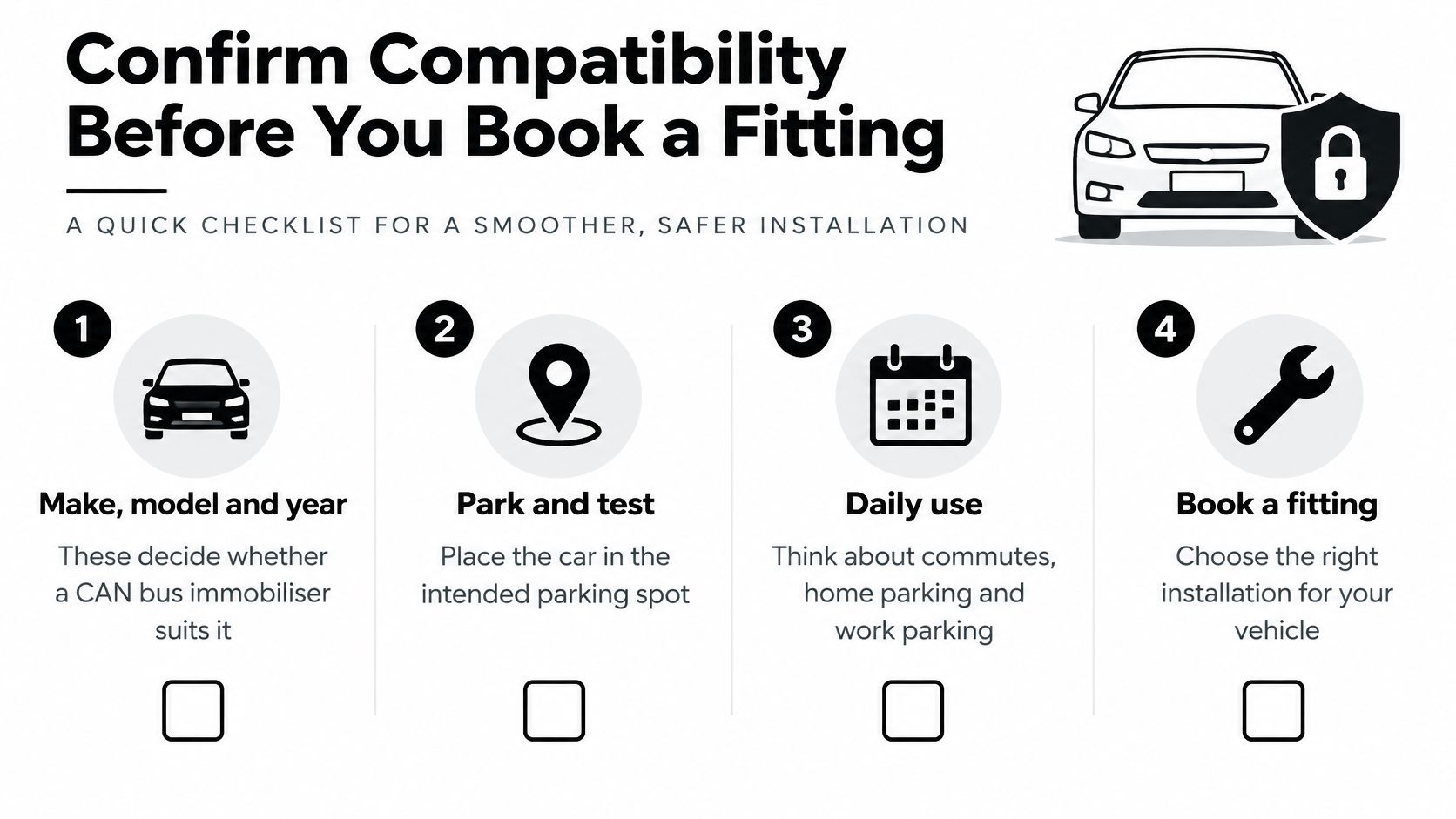
Your pre-booking checklist
Record the make, model and year. Include these when contacting us so we can give more accurate information.
Identify the vehicle's technical category. Flag a hybrid or electric powertrain and any possible dealer-only restrictions.
Obtain written insurer confirmation. Establish whether the proposed installation changes cover, conditions or premium.
Choose the threat you need addressed. Check that the proposed protection covers that route rather than a different theft method.
Request documented commissioning. Include a post-fit diagnostic test, functional checks and a written handover covering normal use and recovery.
Request a no-obligation quote using the registration number. Ask for an itemised breakdown covering the survey, device, wiring and post-fit commissioning.
Make the handover useful
Keep the installation record somewhere secure, separate from the vehicle. Learn the approved recovery and service procedures before you need them, and make sure another authorised user can operate the system without being given unnecessary installation details.
This guide doesn't quote fitting prices. A meaningful price needs an agreed scope, especially where existing electrical faults or additional fleet equipment require investigation. For local electrical support, our auto electrician information for Bridgend provides further context.
Call 0330 043 3804 or 07777 930667 for emergency or scheduled work, with your make, model, year and registration ready. A fitted immobiliser lowers one risk, so confirm the rest of your security stack before choosing.
Blade Auto Keys offers Scorpion Ghost immobiliser and vehicle tracker fitting across South Wales, helping owners address start protection and vehicle recovery as separate needs. Visit Blade Auto Keys to request a no-obligation quote with your registration, make, model and year, and discuss the right installation for your vehicle and parking arrangements.
Comments