
Keyless Entry vs Keyless Start Guide

You've parked outside your home in Cardiff, pressed the button on the door handle, and watched the car grant access without taking the fob from your pocket. The next morning, the engine starts with a push, yet the key never enters an ignition barrel. Many owners describe both features as “keyless”, but keyless entry and keyless start aren't the same system, and they don't create exactly the same security exposure.
That distinction matters across South Wales, where a vehicle can be targeted because thieves want access, a running engine, or both. The right response starts with identifying what your car does, then matching its weaknesses with sensible habits, physical protection, an aftermarket immobiliser, and recovery technology where the risk justifies it.
Feature | What it does | Main security concern | Useful protection |
|---|---|---|---|
Keyless entry | Unlocks the vehicle when the fob is nearby, often through a door-handle touch | Relay equipment may imitate the fob's proximity | Faraday pouch, fob sleep mode, steering wheel lock |
Keyless start | Starts the engine without inserting a physical key | A stolen or relayed authorisation may allow the car to be driven away | PIN-based immobiliser, secure fob storage, tracker |
Both systems | Provides passive access and push-button starting | Door access and engine authorisation may be attacked together | Layered protection rather than one device |
Understanding Modern Vehicle Access Systems
A driver arrives at a supermarket in Swansea with a fob in a coat pocket. The car opens as a hand reaches for the handle. Inside, the driver presses the start button and leaves without inserting a blade. That vehicle has keyless entry and keyless start, but the two functions have performed separate jobs.
Keyless entry controls access to the doors. The vehicle detects an authorised fob nearby and releases the locks, usually when the driver touches a handle or uses a passive-entry sensor. The practical benefit is convenience, especially when your hands are full or you're loading a delivery vehicle.
Keyless start controls engine authorisation. Once the driver is inside, the vehicle checks for the relevant fob and allows the engine to start through a button, rather than requiring a physical key blade to turn an ignition barrel. A car can have remote locking and push-button start without offering passive door access, so the owner must check the actual specification rather than rely on the word “keyless”.
The electronic distinction
Both systems use electronic identification, but the vehicle's access logic determines what happens after the fob responds. The car communicates with the fob using short-range wireless signals and an embedded transponder or identification circuit. Keyless entry handles the lock command. Keyless start handles the authorisation to run the engine.
That separation creates an important practical question. If someone defeats the entry function, have they only opened the doors, or can they also satisfy the conditions required to start and drive the vehicle? The answer depends on the manufacturer, model, fob design, and how the vehicle separates access from immobiliser authorisation.
For a straightforward explanation of passive entry and related systems, see this guide to keyless car entry systems. Owners should also check the handbook for terms such as passive entry, smart key, proximity key, push-button start, and keyless access. Marketing language varies, while the underlying security behaviour can differ substantially.
Practical rule: Never assume that a push-button start vehicle has the same wireless features as a passive-entry vehicle. Test whether the doors unlock when the fob remains in your pocket.
Security Risks of Proximity Signals
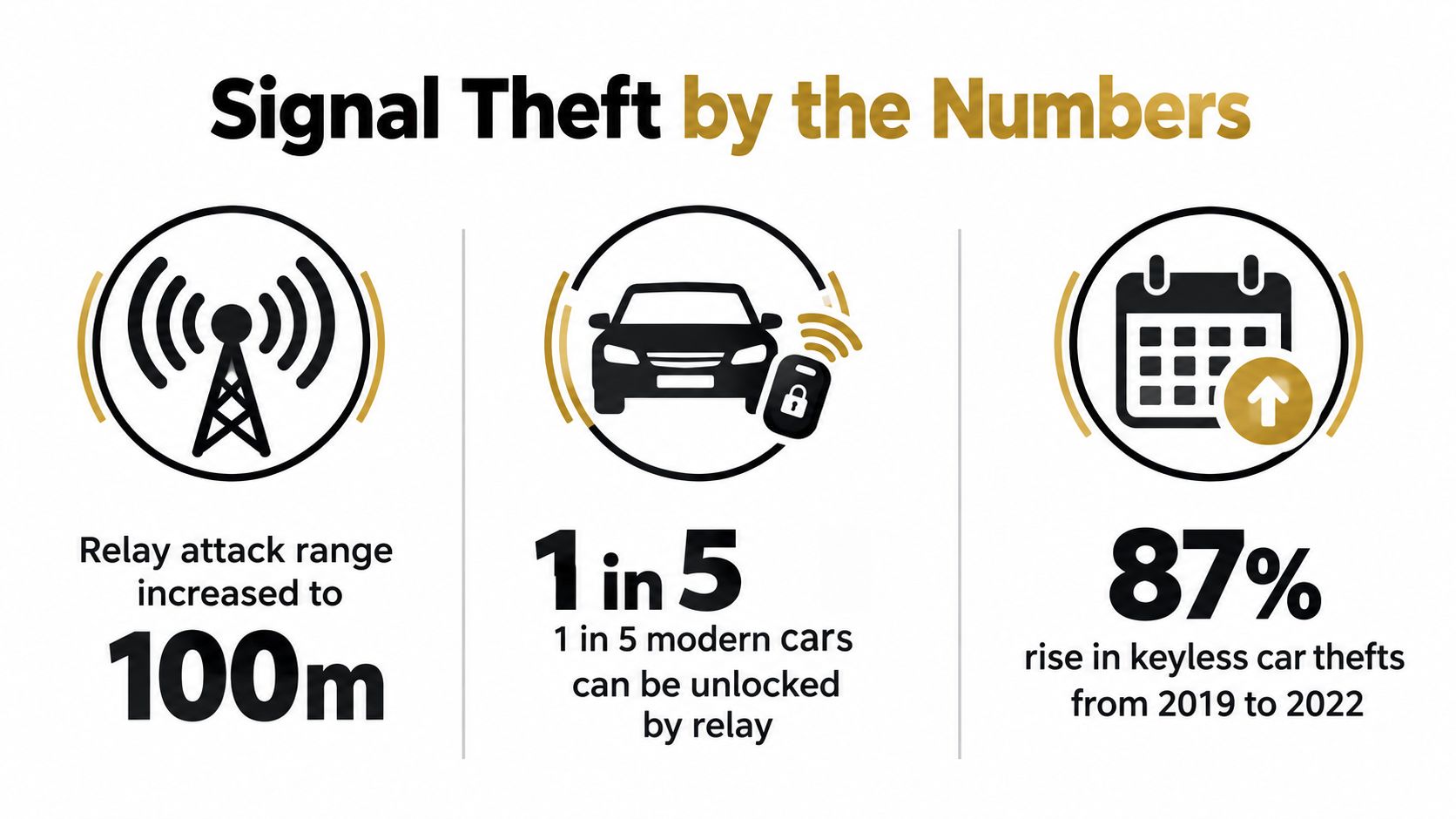
A relay attack targets the wireless exchange between a vehicle and its fob. The thief does not need to take the key, break a window, or copy a visible metal blade. Relay equipment extends the apparent range of the fob, so the vehicle can interpret a distant authorised key as nearby.
A typical attempt places one device beside the car and another near the property where the fob is kept. The equipment passes the vehicle's challenge and the fob's response between both points. If the car accepts that exchange, the thief may gain entry. Where the starting authorisation is also vulnerable, they may try to start and drive the vehicle.
Entry and starting require separate checks
The UK risk picture shows why South Wales owners should not treat keyless entry and keyless start as interchangeable. Crime Survey for England and Wales data reported that 58% of car thefts in the year ending March 2024 involved signal manipulation or relay-style attacks, compared with 14% in 2019, as reported in UK car crime statistics. The wider vehicle-theft total also remained high, with 133,708 recorded offences in 2023-24, compared with 118,948 in 2019-20, according to BBC reporting on Home Office data.
These figures describe a national pattern, not a precise theft rate for every street in Cardiff, Newport, Swansea, or the Valleys. They still support a careful review of wireless security, particularly for valuable SUVs, vans, and fleet vehicles parked outside overnight.
A vehicle with keyless entry may be opened through a relay attempt, exposing property inside and creating access for further attacks. Keyless start can create a more serious outcome if the same weakness satisfies engine authorisation. A What Car? security test found that a keyless-entry vehicle could be stolen up to 90% faster than one with traditional locks and ignition, in as little as 10 seconds, while Aviva reported that owners of keyless-entry cars were twice as likely to have a theft claim as owners of non-keyless cars.
Owners should also understand proximity key fob cloning, because copying and relaying are different attack methods. The correct protection depends on which functions the factory system permits.
Factory protection can leave a gap
UK testing covered 237 keyless vehicles, with 230 susceptible to relay attacks and only three models fully resisting the attack, according to Auto Express coverage of keyless vulnerability testing. That result does not mean every vehicle will be stolen in the same way. It does challenge the assumption that a modern badge guarantees strong wireless protection.
Ask two practical questions: can a wireless attack open the vehicle, and can it authorise starting? If either answer is yes, a signal-blocking case alone may not provide enough protection. An aftermarket immobiliser and tracker can add independent security for vehicles regularly left on South Wales driveways or streets.
Comparing Convenience and Vulnerability Profiles
Keyless entry and keyless start feel like one premium feature from the driver's seat. Security assessment requires a more precise view. One function governs the first barrier, the doors. The other influences whether the vehicle can leave under its own power.
System Comparison Matrix
Feature | Keyless Entry | Keyless Start |
|---|---|---|
Driver experience | Unlocks the vehicle when the fob is close, commonly through a handle sensor | Starts the engine with a button while the fob remains nearby |
Primary benefit | Quick access without removing the fob | No physical key insertion during starting |
Main attack surface | Passive door-unlock communication | Engine-start authorisation and the communication that precedes it |
If compromised | Unauthorised entry, theft from the cabin, and a possible route to further vehicle attacks | Potential vehicle movement if the immobiliser accepts the relayed authorisation |
Risk depends on | Fob behaviour, vehicle receiver design, and whether passive access is enabled | Vehicle immobiliser logic, fob presence checks, and anti-relay design |
Useful first layer | Signal-blocking storage and disabling the feature where available | Signal-blocking storage plus an independent immobilisation layer |
Best aftermarket complement | Physical deterrent and, for higher-risk vehicles, a Ghost immobiliser | Ghost immobiliser and tracker, with the tracker supporting recovery |
The difference becomes clear in two South Wales scenarios. A family car parked on a driveway may have keyless entry but require a separate action or physical key for starting. A premium SUV may combine passive access with push-button starting, creating a larger connected attack surface. The second vehicle deserves more than a pouch alone because blocking the fob signal protects the wireless exchange, but it doesn't create a new PIN barrier between an intruder and the engine.
What Thatcham ratings reveal
Physical locks and alarms can perform well while wireless vulnerabilities reduce the overall security assessment. Thatcham-based testing found that several models rated “GOOD” without a keyless penalty dropped to “POOR” when keyless entry and start vulnerabilities were included, as reported by Fleet World's coverage of Thatcham research.
That result matters because a vehicle's security isn't one indivisible score in practical use. The doors, immobiliser, alarm, fob, receiver, and starting logic all contribute. A strong mechanical lock can't compensate fully for an authentication weakness if the vehicle accepts a false impression that the fob is nearby.
A convenient system can still be a weak link. Assess the complete access chain, not just the quality of the door locks.
Practical Steps to Block Signal Theft
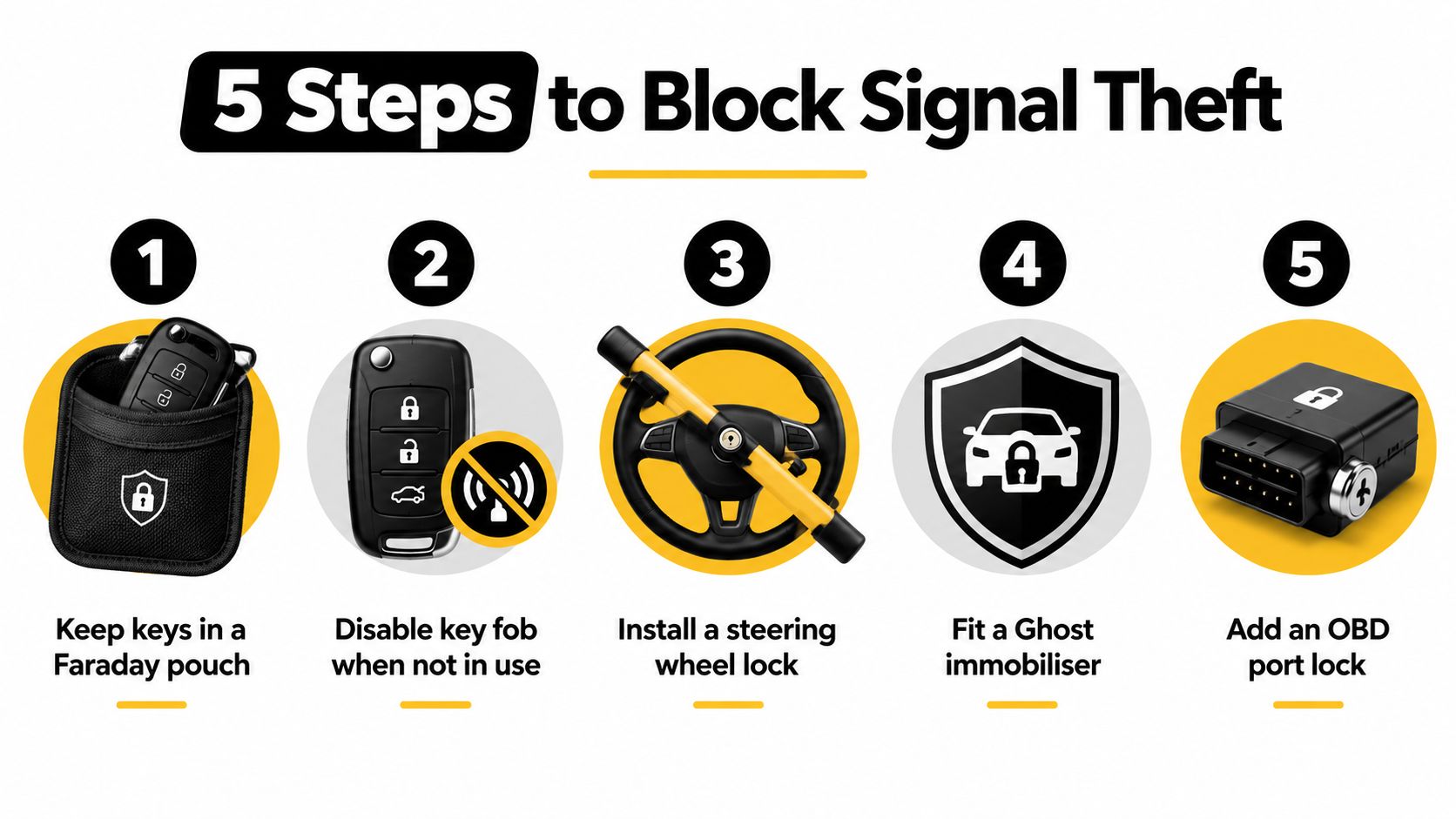
Start with the fob, not the vehicle. If the key sits near a front door, window, or external wall, a thief may be able to work closer to it than you expect. South Wales Police advises keeping keys away from the vehicle, using a signal-blocking pouch, and turning off wireless signals when the fob isn't in use in its vehicle theft prevention guidance.
Make the wireless signal harder to use
Store the fob in a tested Faraday pouch. The pouch should block the relevant radio signal when closed. Test it by standing beside the locked vehicle with the fob sealed inside and checking whether passive entry still works.
Use a signal-blocking box at home. A pouch is useful for an individual key, while a box can hold spare fobs. Keep the container away from doors and windows, and test it periodically because damaged lining or poor closure can defeat the protection.
Activate the manufacturer's sleep mode if available. Some fobs can disable wireless responses while stationary or after a period of inactivity. The precise method varies, so use the handbook or ask a manufacturer-approved technician rather than guessing the button sequence.
Add a visible steering wheel lock. It doesn't stop a relay signal, but it creates a separate physical obstacle and can make the vehicle less attractive during a quick attempt.
Consider a PIN immobiliser and tracker for a higher-risk vehicle. These address different problems. The immobiliser helps prevent unauthorised starting, while the tracker supports location and recovery after a theft.
The keyless entry remote cover guide also helps owners understand why protecting the fob matters. Don't rely on a pouch without testing it, and don't treat a wheel lock as a substitute for electronic immobilisation on a vehicle that is particularly attractive to thieves.
A short demonstration of signal-blocking habits can reinforce the correct routine:
Upgrading to Ghost Immobilisers and Trackers
A Faraday pouch protects the communication path. It doesn't protect the vehicle once a criminal has obtained a valid key, accessed the cabin, cloned an authorisation, or defeated another part of the factory system. For that reason, aftermarket immobilisation is a sensible second layer for many South Wales owners, particularly where the vehicle is valuable, routinely parked outside, or used by a fleet.
What a Ghost immobiliser changes
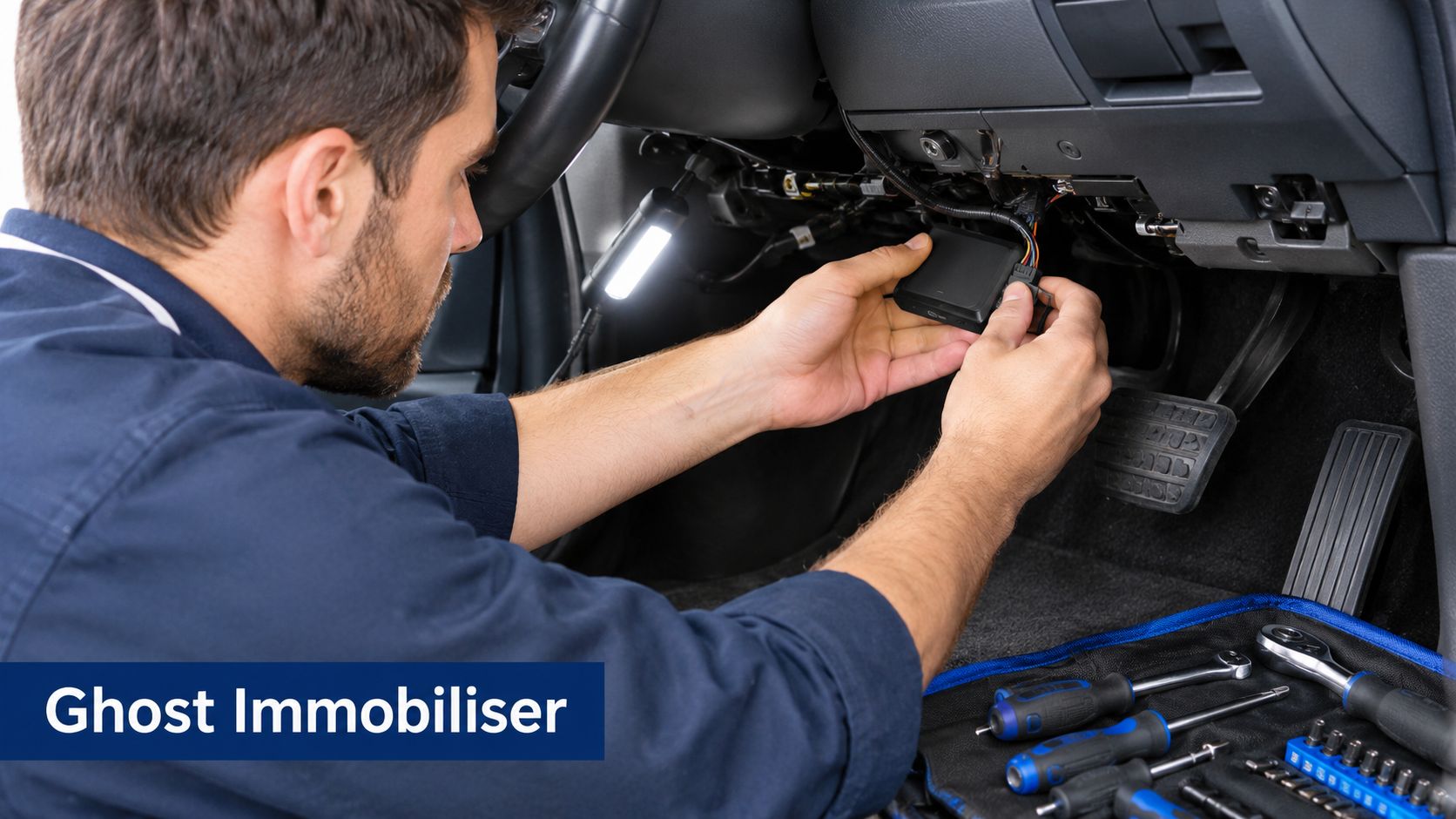
A Scorpion Ghost immobiliser is designed as a PIN-code immobilisation system. The driver enters a personal code through existing factory buttons, such as steering wheel or dashboard controls, before the vehicle will permit engine start. The independent PIN requirement means a thief can possess a working-looking fob and still face another authorisation barrier.
That changes the problem from “Can the thief make the car believe the key is nearby?” to “Can the thief also enter the owner's private PIN?” It doesn't remove the need for careful fob storage, and installation must be carried out correctly so the system integrates with the specific vehicle without creating reliability problems.
Information about Scorpion X-Series immobiliser installation in South Wales is relevant for owners comparing installation options. A proper assessment should cover the model, existing security equipment, daily users, PIN usability, and whether the vehicle is a hybrid or electric model with different access and start procedures.
Prevention and recovery are different jobs
A tracker doesn't replace an immobiliser. Tracking equipment is intended to help locate and recover a vehicle after unauthorised movement, while an immobiliser is intended to prevent the engine from starting without the required authorisation. A sensible security plan may use both, especially for commercial vehicles, high-value cars, and vehicles left in exposed locations.
A South Wales vehicle-security provider describes Ghost immobilisers as PIN-code systems intended to protect against key cloning, relay theft, and keyless theft, and offers Thatcham-approved trackers alongside them through mobile fitting across South Wales locations and services. Its published product information separates the roles clearly, advertising Ghost installation from £499 and tracker options including Thatcham S7, S5, and S5 Plus, as shown in its Ghost immobiliser and tracker information.
The strongest practical combination is layered. Keep the fob protected, add a visible physical deterrent where appropriate, install an independent immobiliser when the risk warrants it, and use a tracker to improve the recovery position.
Professional Key Replacement and Programming
A failed or missing smart key creates two separate problems: gaining entry without damage and restoring the vehicle's electronic authorisation. Cutting a metal blade may solve only the first part, and some modern vehicles don't use a blade as the primary means of access or starting.
A qualified automotive locksmith begins by confirming the vehicle identity, ownership, model, year, and key type. The technician then chooses a non-destructive entry method suitable for the lock and vehicle, rather than forcing a window, damaging a seal, or attacking the ignition. This approach matters particularly with hybrids and electric vehicles, where unfamiliar high-voltage components and electronic control modules make improvised work unsafe.
How programming works
The replacement fob contains electronic identification hardware that must be accepted by the vehicle's immobiliser system. Specialist diagnostic equipment communicates with the relevant vehicle modules, which may include the engine control unit and body control systems, and synchronises the new key according to the manufacturer's security procedure.
The exact sequence varies by make and model. Some vehicles require an existing working key. Others need security-code access, an authorised diagnostic route, or a controlled process that removes missing keys from the vehicle's accepted-key list. A professional should explain what can and can't be completed at the roadside before beginning.
Why a spare key helps
Waiting until every key is lost usually makes the job more complicated and can leave the vehicle immobile. A spare key gives the technician a reference for the correct profile and electronic system, while also reducing the disruption caused by a single fob failure. Owners should keep spare keys in a secure location, not in the same place as the everyday fob.
Local automotive locksmith support can also cover remote fob replacement, key cloning where appropriate, reprogramming, and emergency entry. Blade Auto Keys provides on-site key cutting and programming for traditional keys, remote fobs, keyless systems, and electric or hybrid vehicles, with non-destructive entry and emergency call-outs across South Wales. The technician should still verify that any replacement or cloning method is appropriate for the vehicle and compliant with its security design.
Choosing the Right Security Strategy for Your Car
The best approach depends on what your car can do, where it's parked, and what would happen if it were stolen. A small vehicle with remote locking and no passive entry may need a different starting point from a high-value SUV with full keyless access and push-button starting.
Vehicle and situation | Priority | Suitable layers |
|---|---|---|
Remote locking, no passive entry | Protect the keys and deter opportunistic attacks | Secure storage, wheel lock where practical |
Keyless entry, lower exposure | Reduce signal availability | Tested Faraday pouch, sleep mode, physical deterrent |
Keyless entry and keyless start, driveway parking | Add independent engine protection | Faraday storage, steering wheel lock, Ghost immobiliser |
Valuable vehicle or exposed overnight parking | Combine prevention and recovery | Ghost immobiliser, Thatcham-approved tracker, physical deterrent |
Fleet or delivery vehicle | Control user access and improve recovery | Documented fob control, immobiliser assessment, tracker |
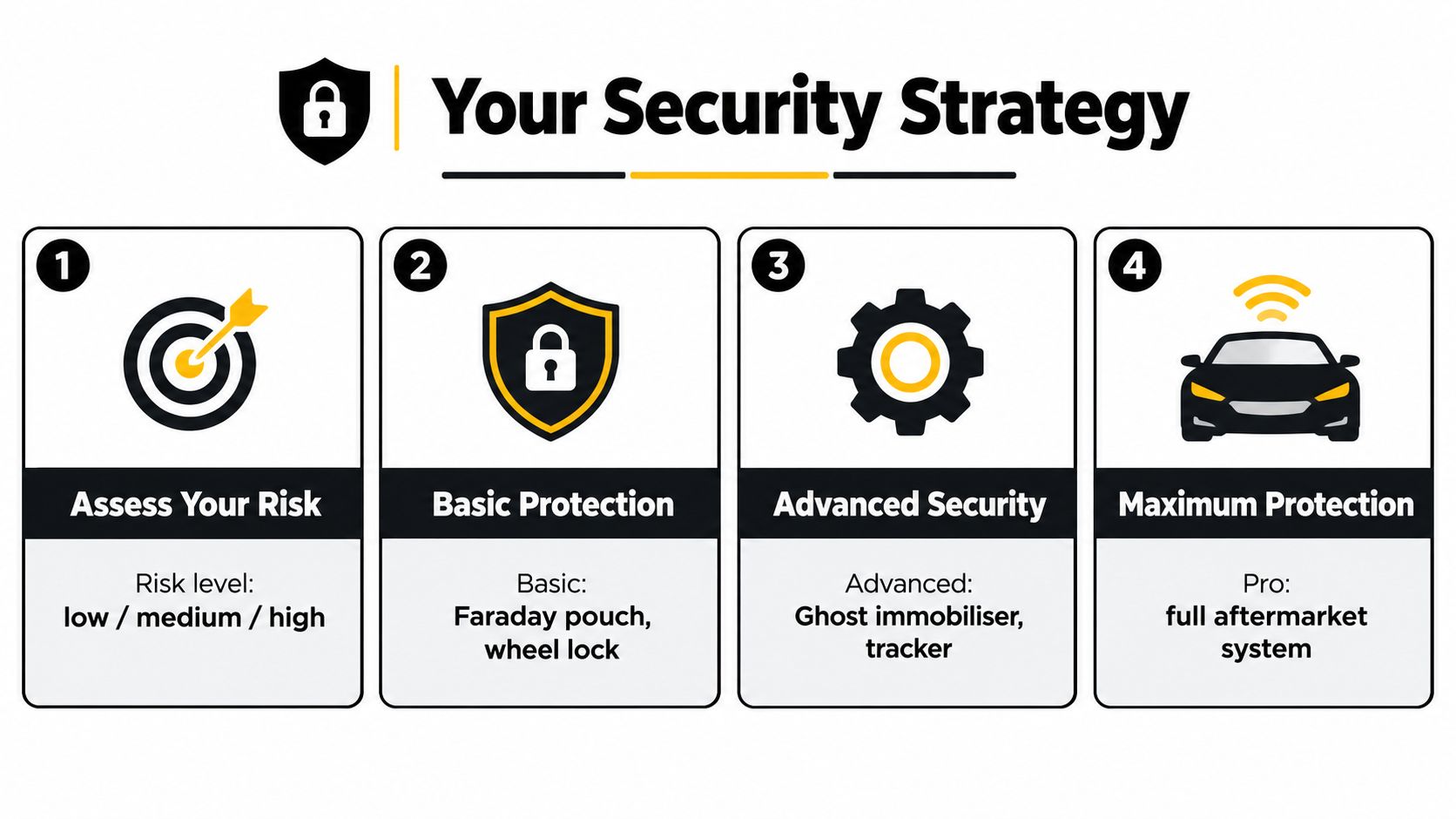
Don't buy a device because a vehicle is advertised as keyless. First establish whether the car has passive entry, passive starting, or both. Then check whether the fob has a sleep function, test your signal-blocking equipment, and decide whether the likely loss justifies independent immobilisation and tracking.
For a South Wales driver with full keyless functionality, a pouch alone is often too narrow a response because it protects the fob but doesn't add a separate PIN barrier or improve recovery. For a lower-risk vehicle, good key storage and a visible physical deterrent may be a proportionate starting point. Review the plan after changing vehicles, moving home, adding a fleet driver, or discovering that the model has known relay vulnerabilities.
If you're unsure whether your vehicle has keyless entry, keyless start, or both, visit Blade Auto Keys for professional advice on replacement keys, programming, Scorpion Ghost immobiliser fitting, and vehicle trackers across South Wales. Arrange an assessment before a lost fob or theft attempt leaves you without transport.
Comments