
Lost Car Keys Service in South Wales What to Do Next

You're standing beside your car in a supermarket car park in Cardiff, turning out the same coat pocket for the third time. The key isn't there. Your phone is nearly out of charge, the children are waiting, and the car won't move until someone gets you in and creates a working key.
That situation is stressful, but it doesn't need to become chaotic. A sensible lost car keys service follows a clear order: secure the vehicle, confirm what has happened, verify the car and ownership details, recover access without damage, then decide whether the missing key should be deleted from the vehicle's system. In South Wales, that last decision matters because a lost key can become a security problem, not merely an inconvenience.
When Your Car Keys Go Missing in South Wales
The first few minutes usually look the same. A driver checks the ignition, opens the boot, searches a handbag or work bag, then retraces the route between the car, a shop and the front door. In the valleys, it may happen on a narrow roadside with poor lighting. In Cardiff, Swansea or Newport, it may happen in a multi-storey car park where leaving the vehicle unattended creates a different concern.
The practical response is to slow the situation down. Don't force a door, prise a window or try an improvised tool. Modern vehicles use delicate seals, locks, wiring and electronic security systems, so a rushed entry attempt can turn a key problem into bodywork or electrical damage.
South Wales drivers also need to allow for differences in access and travel time between urban centres, coastal areas and valley communities. A mobile specialist may be able to attend the vehicle, but the technician still needs accurate location information, the correct vehicle details and enough information to bring the right key equipment.
Why a modern key isn't just a cut piece of metal
Older vehicles may use a mechanical blade, but many current cars combine a cut blade with a remote, transponder or proximity system. Cutting a blade that fits the lock doesn't necessarily create a key that starts the engine. The replacement may need to communicate with the vehicle's immobiliser and, in some cases, the car's remote locking system.
The financial impact can also be considerable. RAC-reported research found that 43% of UK drivers, about 16 million motorists, regularly misplace their keys, while 5%, around 2 million drivers, have permanently lost them. Of those who lost keys permanently, 54% bought a replacement at an average cost of £176.20, contributing to UK spending of more than £181 million. Modern replacements can reach £500, depending on the vehicle and its technology, as reported by the RAC's lost-key research.
Blade Auto Keys operates as a 24/7 South Wales specialist, covering Cardiff, Swansea, Newport and the Welsh valleys. The useful question isn't “Can someone cut me a key?” It's whether the vehicle can be opened safely, whether the correct mechanical and electronic data can be recovered, and whether the missing key should be removed from the car's authorised key list.
Key takeaway: Treat a missing car key as two connected problems, getting mobile again and deciding whether the lost key still poses a security risk.
For broader guidance on choosing a mobile provider, see this practical resource on finding a locksmith near you in the UK.
Immediate Actions Before You Call for Help
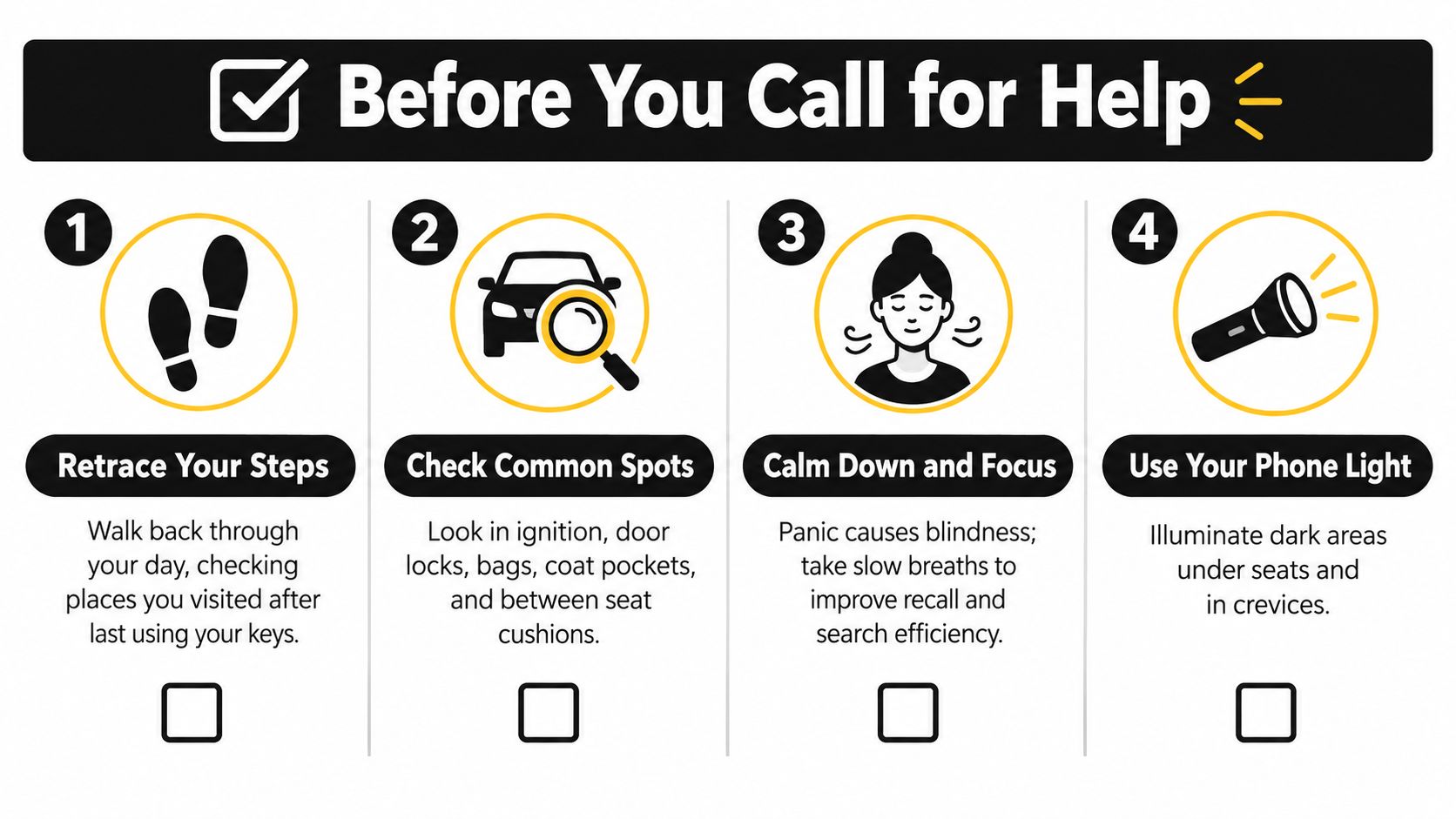
Panic makes familiar places look empty. A systematic search works better than repeatedly checking the same pocket, especially when you've been rushing between work, school, shops or a railway station.
Run a short, deliberate search
Start where you last used the key, then move through the route in the order you travelled. Don't rely on memory alone. Look at the ground, the top of bags, shelves, counters and the areas beside seats.
Check these places before you escalate:
The vehicle itself: Look in the ignition, door locks, boot area, footwells and between seat cushions. A key may have been left in a door or dropped beside the driver's seat.
Clothing and bags: Empty coat pockets, trousers, work trousers, handbags, rucksacks and shopping bags completely. Small keys often sit underneath receipts or loose items.
Common drop points: Check kitchen surfaces, hallway furniture, shop counters, reception desks and the floor beside the car.
Dark gaps: Use your phone light under seats, around pedals and beside kerbs. A dark key fob can disappear in shadows even when it's close.
Recent stops: Contact the last shop, workplace, café, petrol station or car park office if the route suggests you left the key there.
Keep the vehicle and people safe
If the car is parked on a live road, near a junction or in a poorly lit area, move people to a safer position and use hazard lights where appropriate. Tell a colleague, family member, site manager or car park attendant what has happened, particularly if you're alone or the vehicle contains children, animals or valuable equipment.
Don't try to open the car with a coat hanger, screwdriver or wedge. Those methods can damage weather seals, airbags, wiring and door mechanisms. They can also make later non-destructive entry more difficult.
Write down where and when you last saw the key, whether the car is locked, and whether any other keys are available. That information helps the locksmith distinguish between a spare-key job and an all-keys-lost job, and it can indicate whether key deletion should be discussed.
Stop searching when you're repeating the same checks, the location is becoming unsafe, or the key may have been taken rather than misplaced. At that point, call a professional and keep your notes ready.
A five-minute search is useful. An hour of searching beside an exposed roadside usually isn't. If the key remains missing after a careful route check, secure the vehicle, gather the vehicle details and move to the next stage.
What to Have Ready to Verify Ownership and Speed Up Help
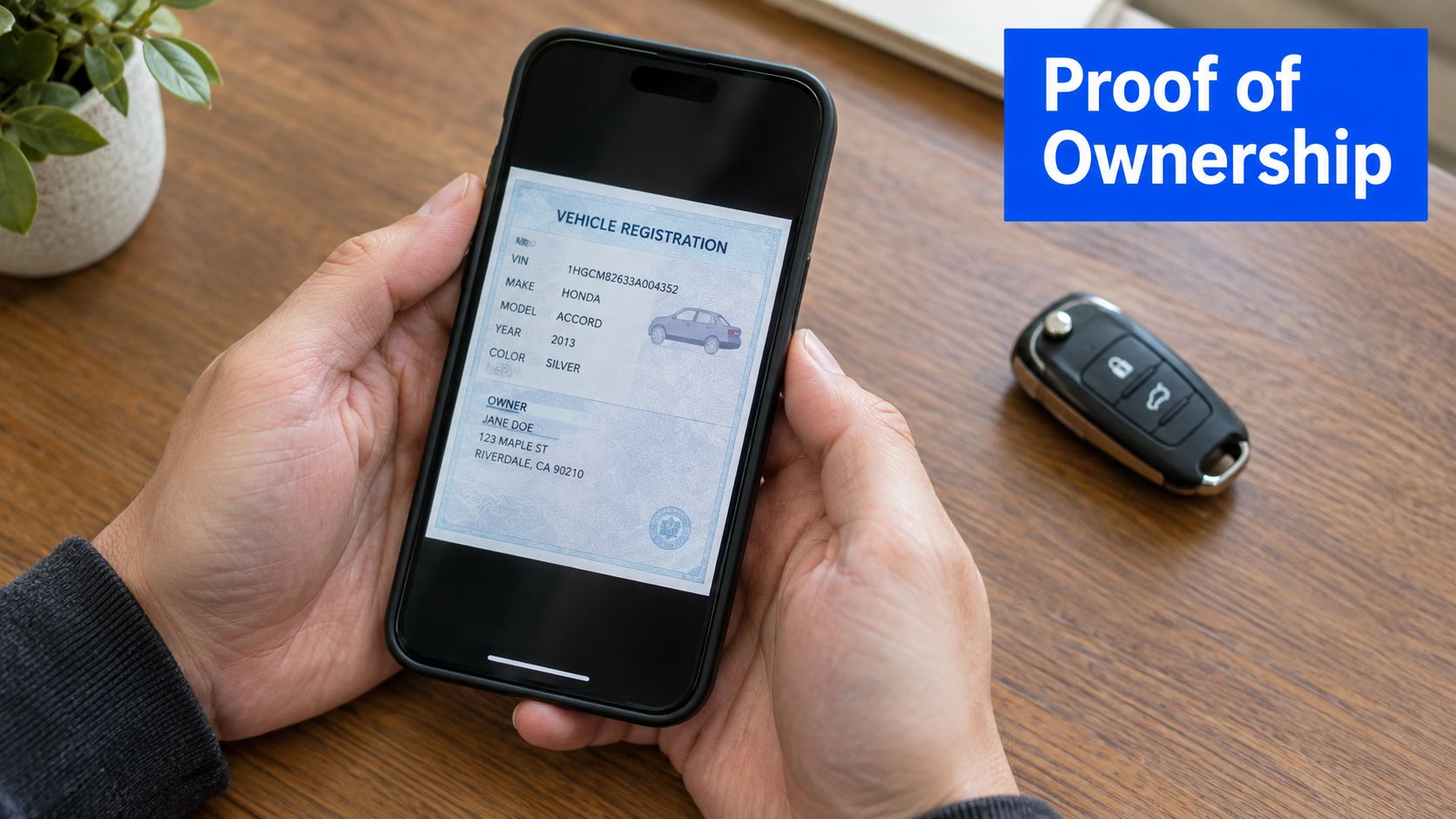
A reputable auto locksmith needs enough information to confirm the vehicle can be supported and to arrive with suitable equipment. This isn't unnecessary paperwork. The make, model, year and key type influence the blank, diagnostic method, transponder system and programming procedure required.
Have the registration number ready first. If you know the vehicle identification number, or VIN, keep that available too. Depending on the vehicle, the VIN may be visible through the windscreen, in the door frame, in vehicle paperwork or through a manufacturer-linked application. Don't send sensitive documents to an unknown number without checking who you're dealing with.
Information to give on the first call
Explain the situation in plain terms:
Vehicle identity: State the make, model, registration and approximate year.
Key type: Say whether it uses a metal blade, remote fob, flip key, smart key, proximity key or push-button start.
What remains: Confirm whether you have a working spare, a damaged key, an empty fob shell or no keys at all.
Vehicle position: Give the exact address, postcode, car park level, bay number, nearby landmark or what3words location if useful.
Access conditions: Mention gates, barriers, underground parking, narrow lanes, poor lighting, locked compounds or height restrictions.
Vehicle status: Say whether it's locked, alarmed, immobilised or showing a warning light.
A straightforward script keeps the call efficient: “I've lost the only key for a [make and model], registered [registration], parked at [precise location]. It's a [key type], the car is locked, and I can provide proof of ownership.”
Proof, specialist vehicles and payment questions
Expect to show identification and evidence that you're entitled to access and operate the vehicle. This may include a driving licence, V5C details, insurance documents, purchase paperwork or fleet authorisation. A locksmith may also record the vehicle identification details as part of a legitimate key replacement.
Fleet managers should provide the vehicle's depot location, driver contact, fleet reference and any restrictions on immobiliser changes. If a delivery vehicle is loaded, say so. The technician can then plan access and handover around the operational requirements rather than discovering them on arrival.
EV and hybrid owners should identify the vehicle as early as possible. The key itself may resemble an ICE vehicle key, but the programming route, diagnostic access and manufacturer security process can differ. Tell the provider whether the vehicle is fully electric, plug-in hybrid or hybrid, and whether it's parked at a charging point.
You may also have a route through motor insurance, breakdown cover, leasing support or a roadside assistance provider. Ask whether the policy covers entry only, key creation, programming, towing or security reprogramming. For general preparation advice, this guide to quick car key replacement is a useful reference.
A precise location and an accurate key description often save more time than a long explanation of how the key disappeared.
How Blade Auto Keys Gets You Back on the Road
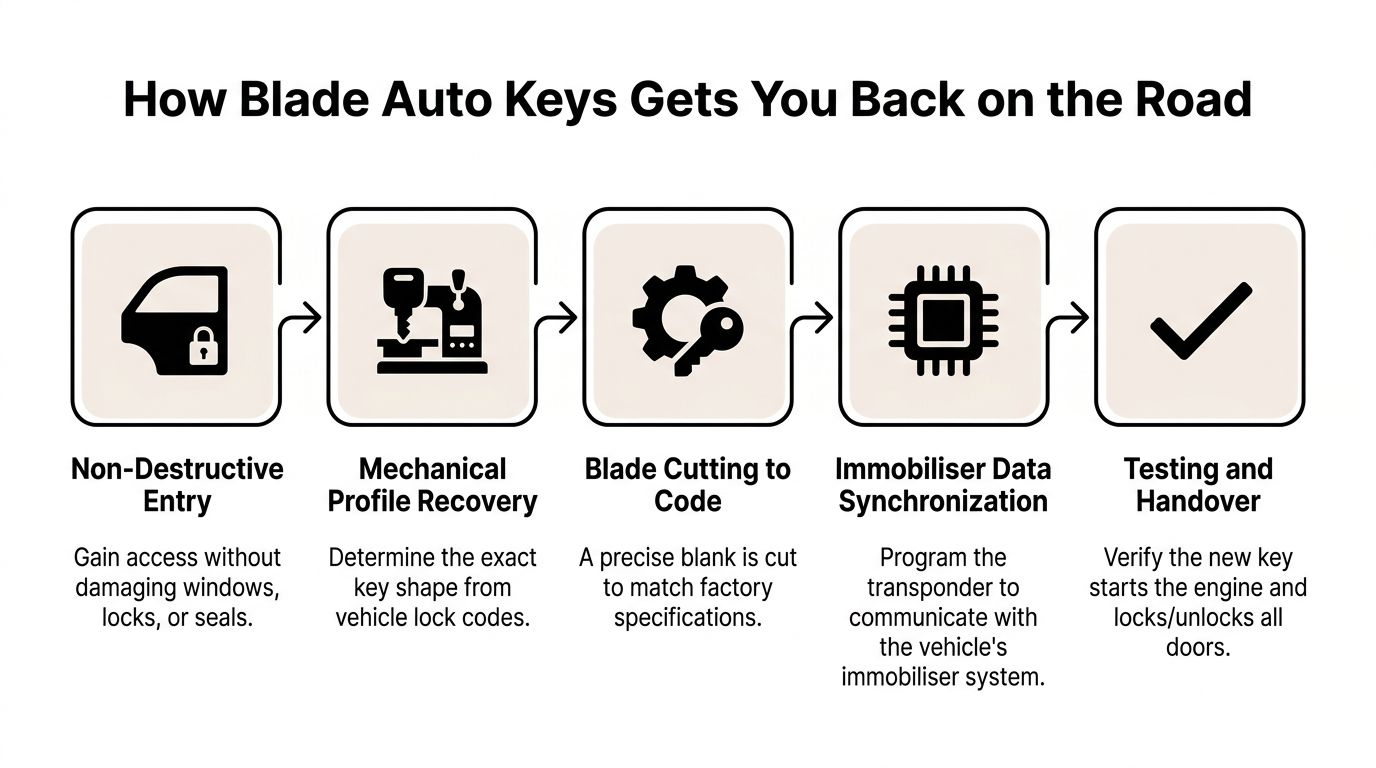
A proper on-site replacement is a connected technical workflow. Entry, cutting and programming each solve a different part of the problem, and skipping one can leave the driver with a key that looks correct but won't start or secure the vehicle.
The first task is non-destructive entry. The technician assesses the vehicle and uses appropriate access methods to avoid damaging windows, seals, locks and trim. This is especially important on vehicles with side airbags, frameless glass or complex locking assemblies.
Once inside, the technician identifies the mechanical profile. For an all-keys-lost job, that may involve recovering the lock or ignition code and determining the exact blade pattern. The blade is then cut to code, rather than guessed from a similar-looking key blank.
The electronic stage determines whether the car starts
The replacement key must be matched to the vehicle's immobiliser system. That can involve recovering immobiliser data, selecting the correct transponder generation and programming or synchronising the chip. Remote locking and proximity functions may require additional pairing.
A cutting-only service falls short. A blade can turn a lock without authorising the engine, and a remote can lock the doors without being accepted by the immobiliser. Misidentifying the transponder or immobiliser generation can lead to failed programming, repeat visits or dealer involvement.
For a mainstream car with a working key, industry guidance places a spare-key job at 20 to 45 minutes on site. An all-keys-lost job is usually 1 to 3 hours, because the blade may need to be cut to code and immobiliser data recovered. Encrypted platforms can add a security-access waiting window of 15 minutes to several hours, according to UK auto-locksmith workflow guidance.
The same approach applies to many EVs and hybrids, but the diagnostic route must suit the vehicle. On-site programming can avoid a tow when the car can be supported with the available equipment and authorised security procedure. A technician should confirm that point before travelling, not after gaining access.
A working replacement should be tested before handover. That includes starting the engine, checking remote locking, confirming the alarm behaves normally and testing every supplied key. Ask what warranty applies to the replacement and programming work.
The following table gives a realistic framework, not a promise for every make and model.
Job Type | Typical Time on Site | What Can Extend It |
|---|---|---|
Spare key with a working key available | 20 to 45 minutes | Key type, access conditions, programming and testing |
All keys lost | 1 to 3 hours | Lock-code recovery, immobiliser data, vehicle security generation and blade cutting |
Encrypted security platform | 15 minutes to several hours of added waiting | Security-access authorisation and manufacturer-dependent procedures |
For same-day availability and mobile scheduling, see the information on same-day car key replacement.
Securing Your Vehicle After a Lost Key in South Wales
Getting the car started solves the immediate problem. It doesn't automatically deal with a missing fob. If the old key remains authorised, someone who finds it may still be able to open the vehicle or start it, depending on the vehicle's system and the key's condition.
Ask whether the old key can be deleted from the vehicle's key memory and whether the replacement can be programmed afterwards. This is particularly important when the key was lost near the vehicle, taken with a bag, or lost alongside documents showing the registration or address. The precise result depends on the make, model and security system, so the technician should confirm what the vehicle supports.
South Wales has reasons to take that risk seriously. ONS-linked reporting cited by Auto Express found that 58% of car thefts between March 2023 and March 2024 involved criminals replicating or manipulating key-fob signals, as reported in its coverage of continuing keyless theft risks. South Wales Police also recorded 74% of car theft offences as unsolved in the referenced year, according to Welsh Liberal Democrat coverage of the figures.
Ghost immobiliser and tracker protection do different jobs
A Scorpion Ghost immobiliser is designed to prevent the vehicle being driven away without the correct code. It addresses the starting and driving decision, even if a thief has access to a valid-looking key or has obtained a programmed key.
A Thatcham-approved S5 or S7 tracker serves a different purpose. It can alert a monitoring centre if the vehicle is moved, towed or loaded, and it can support police location recovery. The distinction is set out in this explanation of Ghost immobilisers and vehicle trackers.
Security option | Main function | Suitable concern |
|---|---|---|
Key deletion and reprogramming | Removes the missing key from the vehicle's authorised key list where supported | A lost or stolen fob may still be recognised |
Scorpion Ghost immobiliser | Prevents driving without the correct code | Theft using a key, cloned key or other entry method |
S5 or S7 tracker | Sends monitored movement alerts and supports recovery | Vehicle moved, towed or loaded after theft |
Local risk varies sharply. Independent crime coverage records East Cardiff at 859 offences per 10,000 cars, while SA9 recorded 33 offences per 10,000 cars, showing how much the decision can change between South Wales postcodes, as detailed in South Wales car-crime data.
A driver who parks overnight in a high-risk area may prioritise a Ghost immobiliser. A fleet manager may value a tracker for recovery and monitoring. Owners of desirable vehicles, vans carrying tools or cars regularly left in public car parks may choose both. Blade Auto Keys now offers fitting for Scorpion Ghost immobilisers and vehicle trackers, with the correct option depending on the vehicle, parking pattern and insurance requirements. More keyless-theft prevention advice is available in this guide to protecting a keyless car.
Your Emergency Plan and Next Steps With Blade Auto Keys
The most reliable response is simple: search methodically, protect the vehicle, gather proof and call with accurate details. Tell the locksmith whether you've lost a spare or every key, because the technical work and likely time on site can be different.
Blade Auto Keys provides 24/7 emergency call-outs across Cardiff, Swansea, Newport and the South Wales valleys. On the call, give the registration, make, model, year, key type and precise location. The technician can then confirm vehicle support, explain the work required and discuss the price before attending where possible.
Mobile work is useful because the vehicle stays where it is. Non-destructive entry, on-site key cutting and diagnostic programming can avoid a tow when the vehicle and security system can be handled roadside. The service covers traditional keys, remote fobs, keyless systems and programming for electric and hybrid vehicles, with replacement warranties available.
Keep a short prevention routine
Make a spare early: A spare-key job is generally more straightforward while one authorised key still works.
Store it separately: Keep the spare in a secure place away from the main key, not loose in the same bag.
Record vehicle details: Save the registration, make, model, year and provider contact in your phone.
Review security after loss: Ask about key deletion, reprogramming, a Scorpion Ghost immobiliser and a tracker.
Tell your insurer when required: Check whether fitted security equipment must be approved or recorded on the policy.
Save the contact details before the next incident, not while standing beside a locked car in the rain. A calm call, accurate information and the right technical response will usually do more than a forced entry attempt or an unplanned dealer tow.
Blade Auto Keys provides 24/7 mobile lost car keys service across South Wales, including non-destructive entry, on-site cutting, programming, key deletion, Scorpion Ghost immobiliser fitting and vehicle tracker installation. If your key is missing now or you want a spare and stronger security before it happens, visit Blade Auto Keys to arrange help.
Comments