
Replacement Car Keys with Transponder: South Wales Guide

You're in a supermarket car park in Cardiff, the shopping is loaded, and the key suddenly turns without starting the engine. Or perhaps the key has disappeared somewhere between a delivery round in Newport and home in the Valleys. The familiar metal blade may still look perfect, but the vehicle can refuse to start because the electronic authorisation inside the key is missing, damaged, or no longer recognised.
That's the practical reality of replacement car keys with transponder technology. A new blade alone won't solve the problem, and repeatedly trying the same key can waste time when the fault lies in the immobiliser, remote electronics, or vehicle-side antenna. Drivers in South Wales also need to think beyond getting the engine running, because a lost key can remain authorised until the vehicle's key memory is managed properly.
A key problem can feel as urgent as any other vehicle electrical fault. For broader questions about vehicle safety modules, the seat belt and airbag module FAQ is a useful resource, but transponder replacement needs an automotive locksmith with the right programming equipment and access to the car's security system.
When Your Transponder Key Fails in South Wales
A failed key rarely chooses a convenient location. It may stop working outside a workplace in Swansea, beside a rural road near Pontypridd, or when you're trying to leave Cardiff after a late shift. If the engine cranks but won't start, or the immobiliser warning light stays illuminated, the blade may not be the primary problem.
Older mechanical keys only had to match the lock and ignition barrel. A modern transponder key has two jobs. The blade must physically operate the lock and ignition, while the chip must prove to the vehicle that the person attempting to start it has an authorised key.
Practical rule: If the key turns but the engine won't run, don't assume cutting a sharper copy will fix it.
The distinction matters during a roadside call-out. A locksmith may need to identify whether the issue is a worn blade, a damaged chip, a weak remote battery, a failed antenna ring, or lost synchronisation between the key and immobiliser. Replacing the coin-cell battery can restore buttons on some remotes, but it won't power the passive transponder chip used for engine authorisation.
Why a hardware-shop copy often fails
A standard key-cutting service can reproduce the visible metal profile. It generally can't establish the electronic relationship between the replacement chip and the vehicle's immobiliser control system. You may end up with a key that locks and opens the door but leaves you stranded when you turn the ignition.
The correct solution depends on what you still have. A working key can make duplication more straightforward. If every key has been lost or stolen, the locksmith may need to retrieve security data, access the immobiliser through an approved route, remove absent or stolen keys from the vehicle's memory, and register new keys.
What to tell the first person you call
Give the locksmith the make, model, registration, approximate year, exact location, and whether the key is lost, damaged, locked inside, or present but not starting the car. Mention any immobiliser warning light and whether the remote buttons still operate the central locking.
That information helps the technician bring the right blank, diagnostic equipment, and access method. It also prevents an unrealistic promise based only on the appearance of the key.
How Transponder Keys and Immobilisers Actually Work
A transponder key is best understood as a small electronic identity tag built into the key head. The chip is a passive RFID device, so it doesn't rely on an internal battery. When the key enters the ignition area, or approaches the vehicle's relevant antenna, the antenna coil creates the field that energises the chip.
The chip then returns its coded response. The vehicle's immobiliser checks that response against its authorised data, usually through a security relationship involving the immobiliser and ECU. If the code is accepted, the engine management system permits starting. If it isn't, the starter may operate while fuel or ignition authorisation remains blocked.
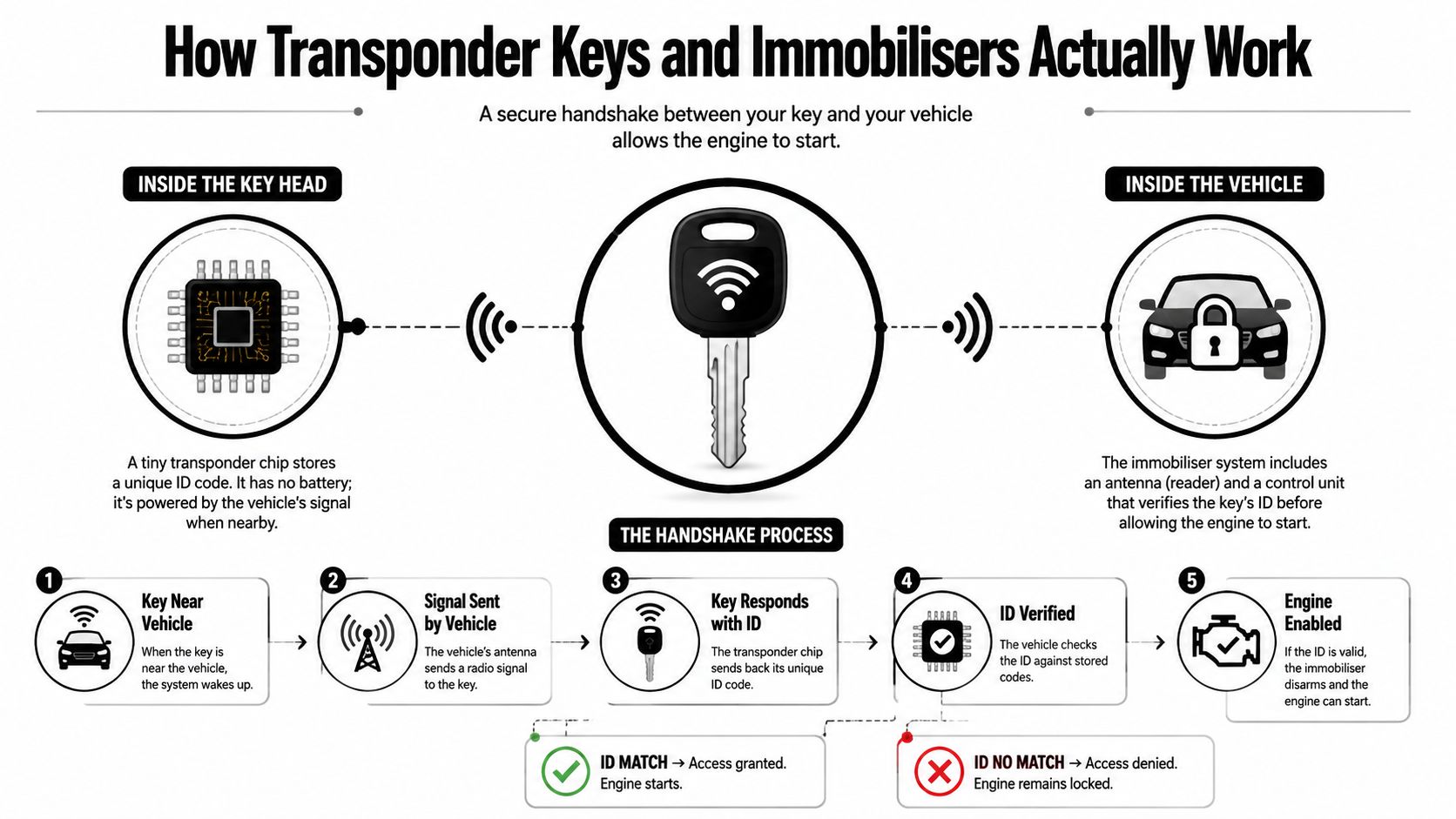
The handshake in simple terms
Think of the blade as the part that operates the lock and the transponder as the part that answers a challenge from the car. Cutting the blade correctly doesn't create the electronic answer. Programming establishes or restores the authorisation that allows the immobiliser to accept that particular key.
That's why a replacement can appear correct yet fail at the final stage. The remote locking function, the transponder chip, and the engine-start authorisation can be separate functions in the same key housing. A technician must test each one rather than treating a working button as proof that the key is fully operational.
The transponder key explanation from Blade Auto Keys provides another accessible description of this relationship. In practice, the important point is simple: the car starts only after the immobiliser recognises the correct code.
Why the 1990s changed vehicle security
Transponder technology became a major turning point in UK vehicle security during the 1990s. UK industry information says chips began appearing in mainstream production during that decade, and by 1998 all new cars sold in the UK were required to have an immobiliser. The same historical account records that cars in England and Wales without immobilisers fell from 77% in 1991 to 22% in 2006, while cars without central locking fell from 60% to 12% over that period, as described in this history of car keys and immobilisers.
The security effect was significant. A UK industry summary links the arrival of immobilisers and transponder keys with car crime falling by about 80% by 2016, with stolen cars reducing from around 500,000 per year to roughly 175,000, and theft from vehicles falling from 2.4 million to 1.1 million. Those figures come from the UK transponder key security overview.
The technology reduced straightforward hot-wiring, but it didn't remove every route into a vehicle. Modern key programming, signal attacks, and unauthorised access to security systems create a different set of risks, especially when a key is lost and remains registered.
The Four Stages of Transponder Key Replacement
A professional replacement normally follows four technical stages. The visible key is only one part of the job, and the vehicle's immobiliser architecture often determines the equipment, access route, working time, and final price more than the shape of the blade.
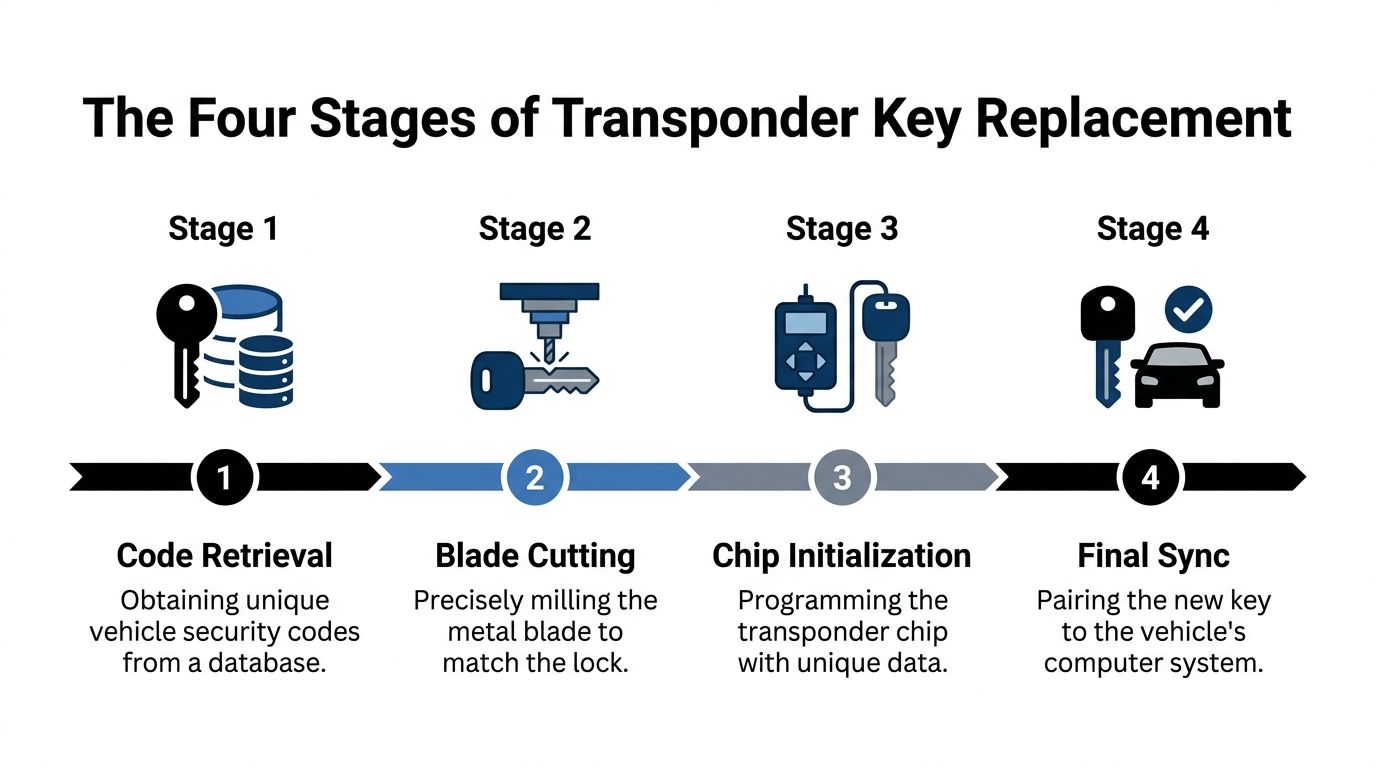
1. Vehicle identification
The locksmith confirms the exact platform before cutting or programming anything. Make, model, year, registration, VIN, key type, and whether a working key is available all matter. Two vehicles that look similar can use different immobiliser systems, key frequencies, blade profiles, or security procedures.
Identification also includes checking whether the vehicle uses a standard ignition transponder, remote key, proximity system, or a more protected architecture. Guessing at this stage can lead to the wrong blank or an interrupted programming attempt.
2. Blank cutting
The replacement blade is cut to match the vehicle's locks and ignition. If the original key is available, the locksmith can often decode or copy it. With all keys lost, the technician may need to decode the lock or retrieve key information through the vehicle's systems before producing a usable blade.
A perfect cut still doesn't guarantee a start. It only completes the mechanical side.
3. Immobiliser synchronisation
The new chip must be registered or synchronised with the vehicle's immobiliser relationship. Depending on the platform, the technician may use diagnostic access through the OBD connection, read security data from a module, or work directly with an immobiliser component.
UK programming guidance commonly describes OBD work as taking about 20 to 60 minutes, EEPROM work about 1 to 3 hours, and bench or boot-mode work about 2 to 4 hours. These are technical working ranges, not promises for every South Wales call-out, and the UK key-programming workflow guide explains why access method changes the job.
4. Verification
The locksmith tests starting authorisation, remote locking, blade operation, warning lights, and any additional keys. The vehicle should be checked in the condition in which it will be used, not just with a programmer reporting success.
Use the following video as a visual introduction to the replacement process:
A replacement that starts but leaves an old stolen key active may solve the immediate breakdown while leaving a security gap. Ask what has been added, what has been removed, and whether the vehicle's stored key list has been checked.
Cloning a Spare Now Versus Full Reprogramming Later
If you still have one working key, the decision is usually clearer than drivers expect. A technician can often use the authorised key as the reference for a duplicate, then cut and programme an additional key without rebuilding the entire key system.
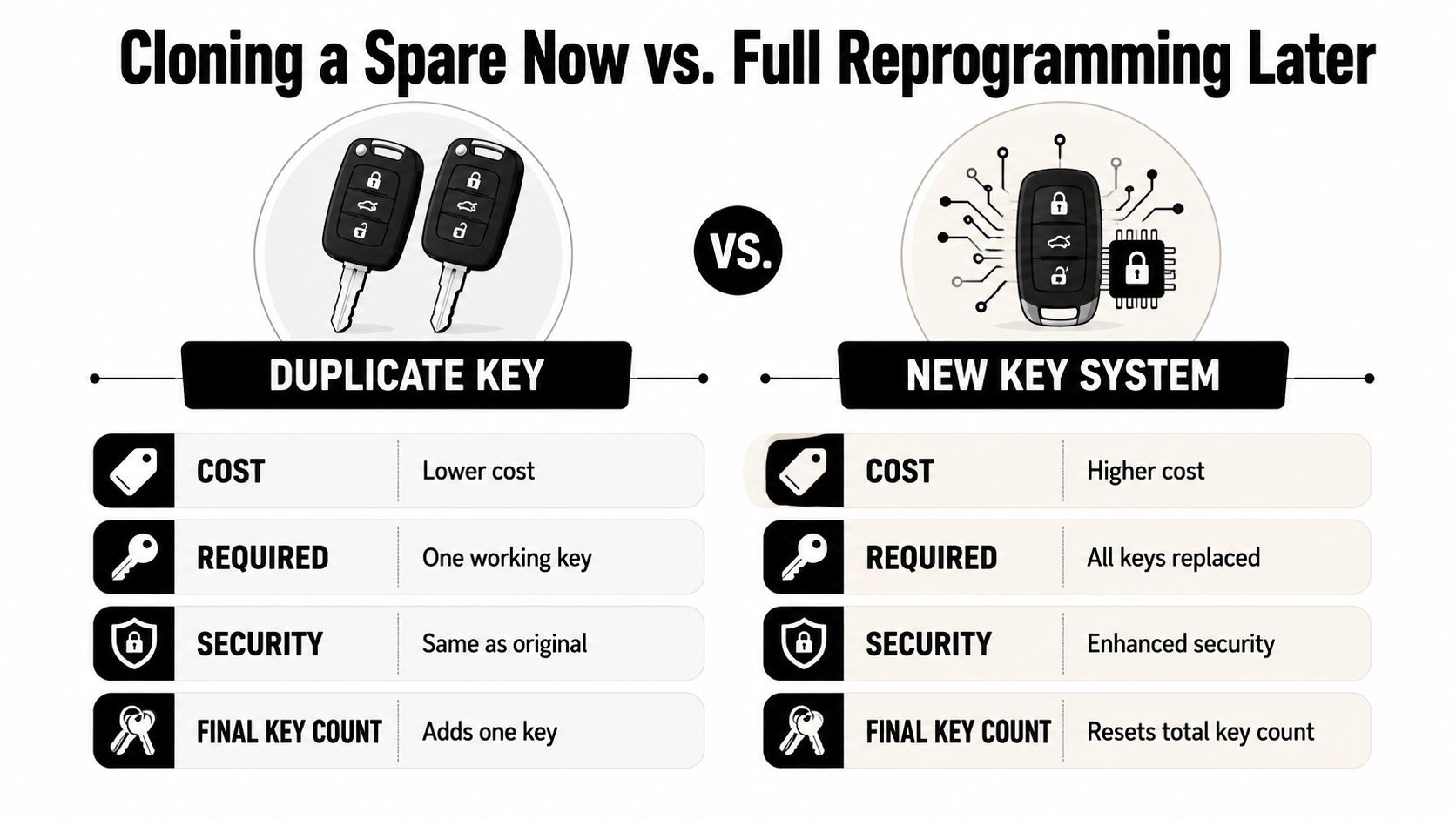
The working-key route
Cloning or adding a spare normally involves less disruption because the vehicle already has an accepted key. The locksmith can verify the platform, cut a matching blade, transfer or programme the relevant chip data where supported, and test the new key alongside the original.
That doesn't mean every key can be cloned in the same way. Some systems support a direct duplicate, while others require the new key to be added through the vehicle's immobiliser. The technician should confirm which process applies rather than labelling every duplicate as a clone.
The transponder chip replacement guide explains why the chip itself must be treated as part of the vehicle's security system, not as an optional extra inside the plastic housing.
The all-keys-lost route
When no working key remains, the job becomes a recovery and security exercise. The locksmith may need to identify the vehicle from its VIN and security platform, decode the lock, obtain the required data, access the immobiliser, and register new keys from scratch.
An all-keys-lost job can also require removal of keys that have been lost or stolen. That step matters because replacing the physical key without reviewing the stored authorisation may leave someone else's key capable of starting the car.
Situation | Main advantage | Main drawback |
|---|---|---|
One working key available | Simpler route to an additional key | The existing key's security status remains relevant |
No working keys available | Allows the vehicle's key memory to be rebuilt | More technical access, more time, and greater security checking |
Key stolen rather than misplaced | Creates an opportunity to remove the missing key | The owner must tell the locksmith that theft is suspected |
Lost-key incidents are common enough to justify acting before the final key disappears. Direct Line Group reports that 9.8 million UK drivers, 25%, have had a key-related issue, while 3 million, 7%, needed breakdown help. Its report also gives an average lost-key replacement cost of £176.20, as shown in the key-related driver research. The useful lesson isn't that every South Wales replacement costs that amount. It's that waiting until an all-keys-lost emergency can turn a planned spare-key job into a more involved recovery.
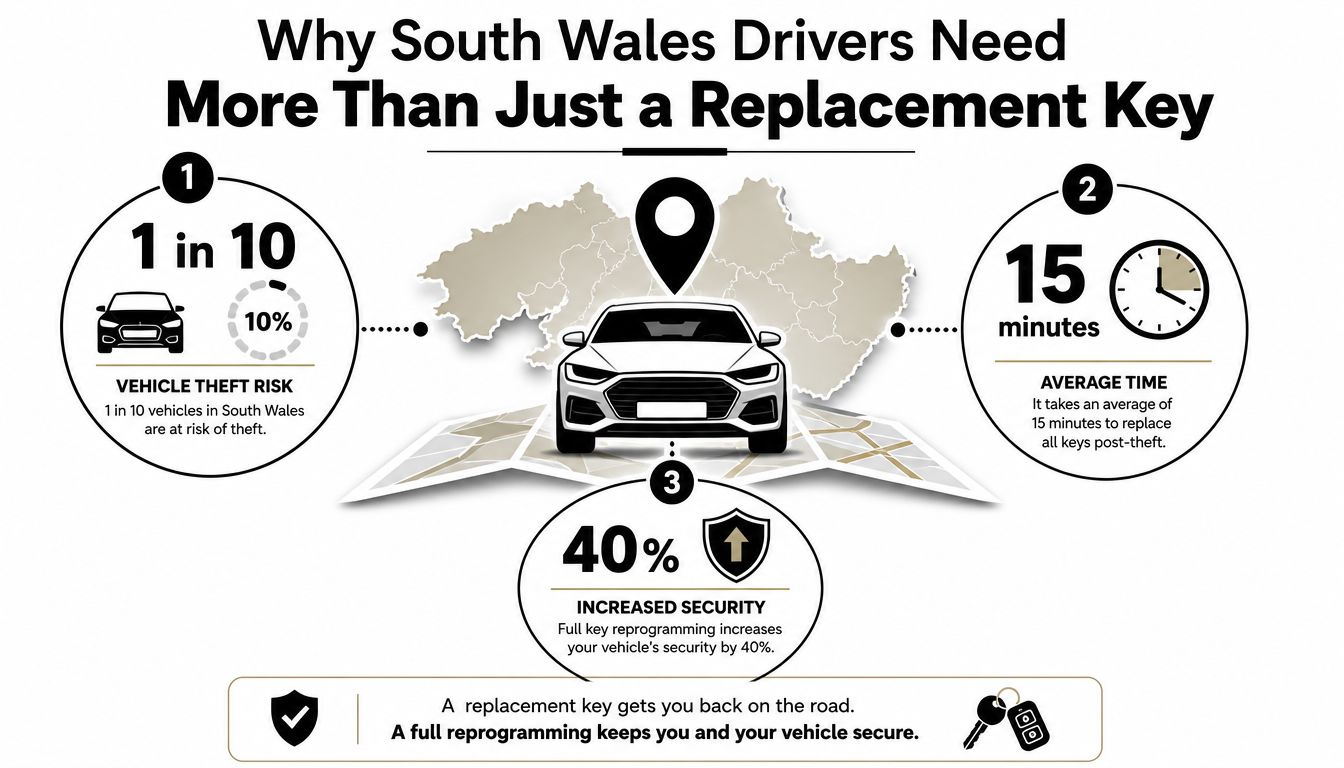
Why South Wales Drivers Need More Than Just a Replacement Key
A transponder key protects the start authorisation it was designed to protect. It doesn't automatically defend against every modern theft method, and it won't locate a vehicle after an unauthorised journey. South Wales owners therefore need to separate starting prevention from vehicle recovery.
Government crime reporting distinguishes vehicle theft into theft from a vehicle, theft of a motor vehicle, and vehicle interference. That classification matters because a replacement key and immobiliser address unauthorised starting, while other protections may be needed for entry, tampering, and recovery. The categories are set out in the government vehicle crime data definition.
The regional picture
South Wales Police recorded 83.9% of vehicle offences with no suspect identified in the year ending March 2025, with 643 such closed vehicle offences in that period, according to the Crime Outcomes in England and Wales statistics. Separate House of Commons Library-derived figures cited by Welsh Liberal Democrats say 74% of car theft offences in the South Wales police force area went unsolved in the last year, as reported in their South Wales car theft statement.
A Welsh crime analysis also reported one car theft for every 370 vehicles, ranked South Wales 27th out of 45 UK police forces, and recorded a 9% rise in car thefts from 2023 to 2024. Those figures are detailed in the regional Welsh car theft analysis. The unresolved nature of incidents makes prevention and recovery worth considering together.
Pairing a replacement with stronger protection
Police and media reporting increasingly describe theft methods involving signal replication, signal manipulation, and programming new electronic keys. ONS-linked reporting found that 58% of car thefts between March 2023 and March 2024 involved signal replication or manipulation of keyfob emissions, according to this report on vehicle theft and hacking devices.
A Scorpion Ghost immobiliser adds a separate authorisation layer. Rather than relying only on the factory key, it can require a discreet driver input or sequence before the vehicle's systems allow movement, subject to the specific installation and vehicle compatibility. It should be fitted by a trained installer who can explain the disarm procedure, service implications, and what happens if the owner loses the authorisation method.
A vehicle tracker serves a different purpose. It doesn't replace the immobiliser, but can support location and recovery after unauthorised movement, depending on the device, subscription, signal coverage, and response process. Ask whether the tracker includes monitored support, how alerts are delivered, and how installation affects the vehicle's warranty or electrical system.
For owners comparing technical options, the immobiliser key replacement information is relevant to the relationship between key programming and vehicle security. A practical package may involve a correctly programmed replacement, removal of stolen keys from memory, Faraday storage for suitable keyless systems, a Ghost immobiliser, and a tracker. The right combination depends on the vehicle and the owner's risk, not on adding every product automatically.
What You Need to Provide Before Calling a Locksmith
Good information shortens diagnosis and reduces the chance of bringing the wrong key or tool. Before calling, write down the vehicle's make, model, approximate year, registration, VIN if available, and exact location. Tell the locksmith whether you have a working key, a damaged key, a locked-in key, or no keys at all.
Proof of ownership is essential. Have the V5C, insurance documents, driving licence, or another accepted ownership document ready, subject to the locksmith's verification policy. A professional should not programme a replacement key for an unverified caller merely because that person can provide a registration number.
Describe the fault accurately
Use symptoms rather than guesses. Tell the technician whether:
The blade turns: The ignition may operate mechanically while the transponder fails electronically.
The remote works: Door locking doesn't prove that engine-start authorisation works.
The warning light remains on: This can point towards an immobiliser or recognition issue, although diagnosis is still required.
The key is stolen: Ask specifically whether the old key can be removed from the vehicle's stored authorisation.
The key is inside the car: Request non-destructive entry first, followed by key assessment rather than immediate replacement.
A photograph of the key head, ignition, dashboard warning light, and vehicle identification plate can help the locksmith prepare. Don't post the full VIN publicly, but provide it through a secure channel when requested.
Hybrid and electric vehicles need extra care
Hybrid and electric vehicles still use key authentication, but their high-voltage systems add safety considerations. The technician needs to know the exact model and whether the vehicle is safely accessible, charged, and parked in a location where programming equipment can be connected without creating a hazard.
Programming a key doesn't mean opening high-voltage components. A qualified automotive locksmith should follow the manufacturer-specific procedure, use suitable diagnostic equipment, and avoid unnecessary interference with orange high-voltage cabling. Fleet managers should also record which keys remain active when a vehicle changes driver.
Questions to ask before agreeing
Ask whether the quoted service includes cutting, programming, testing, and any required emergency entry. Confirm whether the replacement is new, refurbished, cloned, or manufacturer-supplied, and ask what warranty applies to the key and workmanship.
The emergency guide to quick car key replacement can help you organise the details before calling. A transparent locksmith should explain likely access routes and tell you if the job may require specialist module work rather than pretending every vehicle follows the same procedure.
Your Action Plan for Transponder Key Replacement in South Wales
Start with the key you still have. If one working key remains, ask for a properly tested spare and confirm whether the vehicle supports cloning or requires immobiliser registration. Don't wait until the last key is damaged, intermittent, or lost during a journey.
If every key has disappeared, state that clearly. Ask the locksmith to check the vehicle's stored key list, remove keys believed stolen, and explain whether the job needs OBD access, EEPROM work, or bench or boot-mode programming. The access method can determine the time and price more than the blade itself.
Use this short checklist when arranging help:
Verify the vehicle: Provide make, model, year, registration, VIN, location, and key type.
Prove ownership: Keep accepted documents available before programming begins.
Describe the failure: Separate a lockout, damaged blade, dead remote, and immobiliser fault.
Confirm the finished job: Test starting, locking, remote functions, and every remaining key.
Review security: If theft is suspected or the vehicle is particularly exposed, discuss Faraday storage, a Scorpion Ghost immobiliser, and a tracker.
Get written terms: Check the replacement warranty, programming coverage, and any tracker subscription or installation conditions.
South Wales motorists don't need the cheapest key that merely fits the lock. They need a verified replacement that starts the vehicle, a clear record of which keys remain authorised, and sensible protection against the next problem.
Blade Auto Keys provides mobile transponder key cutting, key cloning, immobiliser programming, and support for hybrid and electric vehicles across South Wales, including Cardiff, Swansea, Newport, and the Welsh Valleys. The service also includes Scorpion Ghost immobiliser and vehicle tracker fitting, with emergency call-outs available around the clock. Visit Blade Auto Keys to arrange a replacement or discuss a security upgrade for your vehicle.
Comments