
MG Car Keys: Replacement, Programming and Security Guide

You're standing outside your MG in South Wales, pressing the remote again and again while nothing happens. Perhaps the key is locked inside the boot, the blade won't turn in the ignition, or a tired plastic fob has finally stopped responding. In each case, the first priority isn't automatically ordering another key. It's identifying whether the problem is entry, the lock, the blade, the electronics, or the immobiliser.
MG car keys have changed considerably across the marque's long British history. A classic mechanical key, a remote transponder key and a modern smart key can look similar to an untrained eye, but they need different cutting, testing and programming methods. This guide covers the main MG key types, the failures that cause the most roadside trouble, replacement routes, programming, costs, turnaround considerations and security upgrades available to drivers in Cardiff, Swansea, Newport and the Welsh valleys.
When Your MG Key Lets You Down
A driver in Cardiff calls after locking an MG key inside the boot. The vehicle is secure, the key is visible through the glass, and the temptation is to force a door seal or try a household tool is strong. That approach can damage weather seals, trim, wiring or the locking mechanism, turning a straightforward vehicle-entry job into a repair bill.
Another common South Wales call starts with a key that still looks usable. The remote buttons have become unreliable, the blade feels stiff, or the key turns but the engine refuses to start. Owners often assume the whole key has failed, when the actual fault may be a worn blade, a damaged lock, a flat fob battery, a transponder issue or a separate ignition problem.
Practical rule: If the key still exists, diagnose the vehicle before paying for a replacement.
UK breakdown data supports that distinction. In 2024, 62% of car key call-outs involved keys locked inside the vehicle, 21% involved keys jammed in a lock or ignition, 12% involved lost keys and 5% involved broken or snapped keys, according to Green Flag's breakdown data. The figures aren't MG-specific, but they show why “lost key replacement” doesn't describe every emergency.
This guide follows the practical decision process used at the roadside:
Identify the key: Establish whether your MG uses a mechanical blade, transponder, remote, flip key or smart system.
Diagnose the failure: Separate a lockout from a jammed ignition, damaged blade, flat battery or immobiliser fault.
Choose the replacement route: Compare a main dealer with a mobile automotive locksmith based on access, programming and recovery needs.
Protect the vehicle afterwards: Consider a spare key, a Scorpion Ghost immobiliser or a tracker when the risk justifies another layer of security.
Whether you're locked out outside your home in Swansea or planning ahead for an older MG restoration, the correct first step saves time and prevents avoidable damage.
The Four Types of MG Car Keys Explained
MG keys fall into four useful categories. The boundaries can overlap, particularly on models with a remote fob and a separate immobiliser chip, but the distinction helps you understand what a replacement involves.
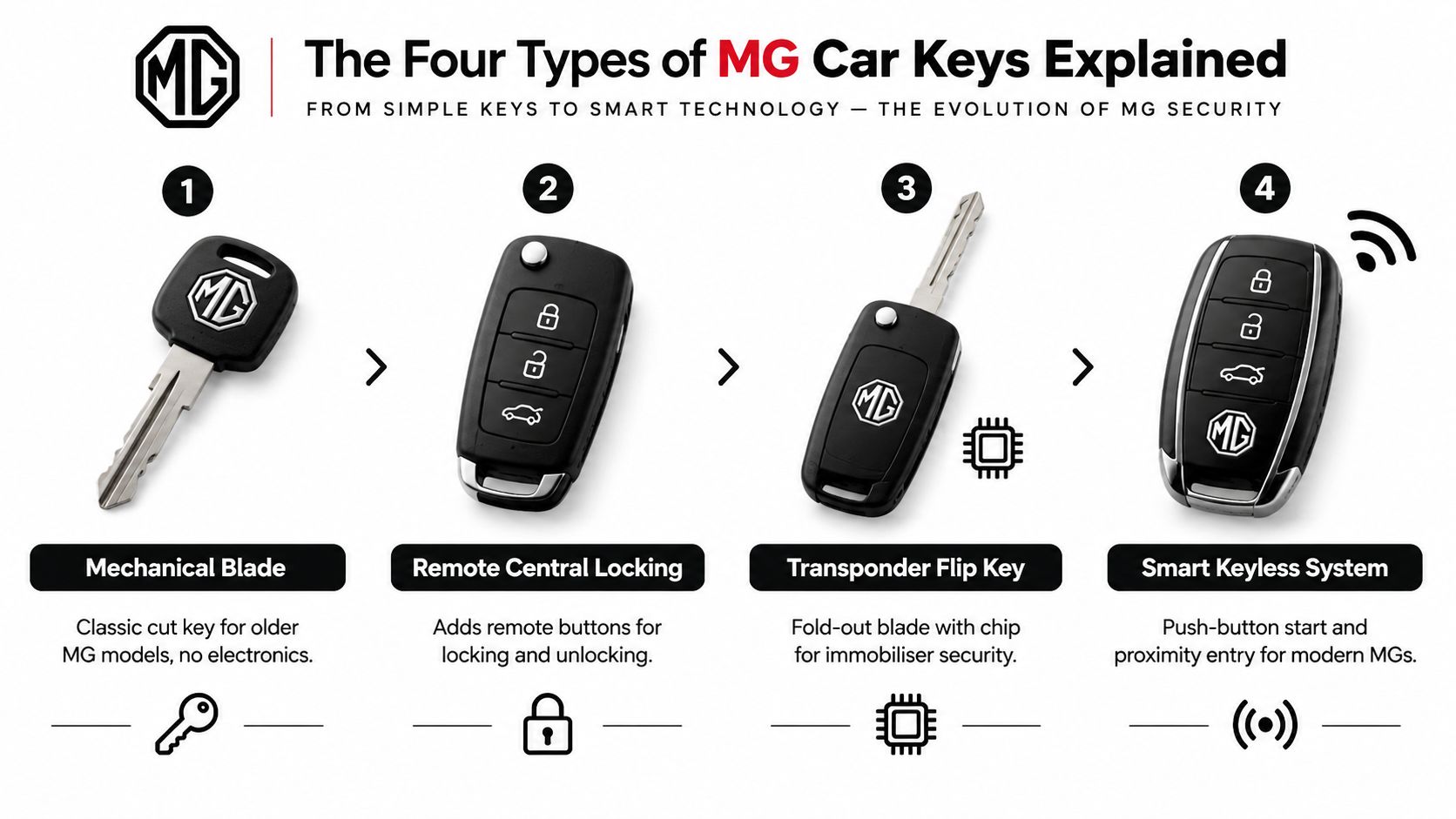
Mechanical blades
Older and classic MGs may use a conventional metal key with no electronic component. Cutting accuracy still matters, particularly where the lock or ignition has worn over time. Classic MG key codes can also help confirm originality and compatibility during restoration. The MRN sequence covered 1 to 50 from 1932 to 1948 and beyond, FA covered 501 to 625 from 1948 to 1955, and FP covered 626 into the 7xx range from 1955 to 1962, as detailed in this MG ignition key reference.
Wilmot Breeden, also known as UNION, supplied keys for early MGs and other British marques. The code could be stamped on the lock face or recorded on a metal tag, which is valuable when a restorer needs an authentic replacement rather than an approximate copy.
Remote central locking keys
A remote key adds buttons for locking and opening. The metal blade may still operate the driver's door manually, while the remote controls central locking. A replacement therefore needs the correct case, blade profile, button layout and electronic pairing procedure.
A worn button doesn't always mean the immobiliser has failed. The shell, switch, battery and transponder should be checked separately.
Transponder and flip keys
A transponder key contains a small coded chip that communicates with the vehicle's immobiliser. The blade may be cut perfectly, but the engine still won't start if the chip hasn't been accepted by the car.
That's why a hardware-shop copy is often inadequate for a modern MG. It may open a lock, yet it won't necessarily disarm the immobiliser. Flip keys add a folding blade and remote electronics, so the replacement must match both the mechanical and electronic systems.
For a broader visual explanation of key construction, this guide to the seven main types of car keys is useful. Owners of newer electric MGs should also separate key questions from battery health, and this resource on MG4 and ZS EV battery checks provides relevant maintenance context.
Smart keyless systems
A smart key communicates with the vehicle when it's nearby, allowing proximity entry and push-button starting on compatible MG models. Current UK owner documentation shows that pressing the door-handle button locks the vehicle and immediately places it into an immobilised, alarm-armed state.
The emergency feature is easy to overlook. A mechanical key blade is still supplied for manual access through the driver's door if the smart function fails. You need the correct blade cut and the model-specific method for exposing the hidden lock trim. A flat battery doesn't remove the physical entry route, but it can make that route difficult to find when you're under pressure.
What Actually Goes Wrong with MG Keys
MG key trouble is rarely limited to ordering a replacement. A locked-in key needs controlled entry first. A blade stuck in the ignition needs careful removal before anyone cuts another key. For an accurate diagnosis, check three points: do you have the key, can you reach the vehicle, and does the key physically operate the lock or ignition?
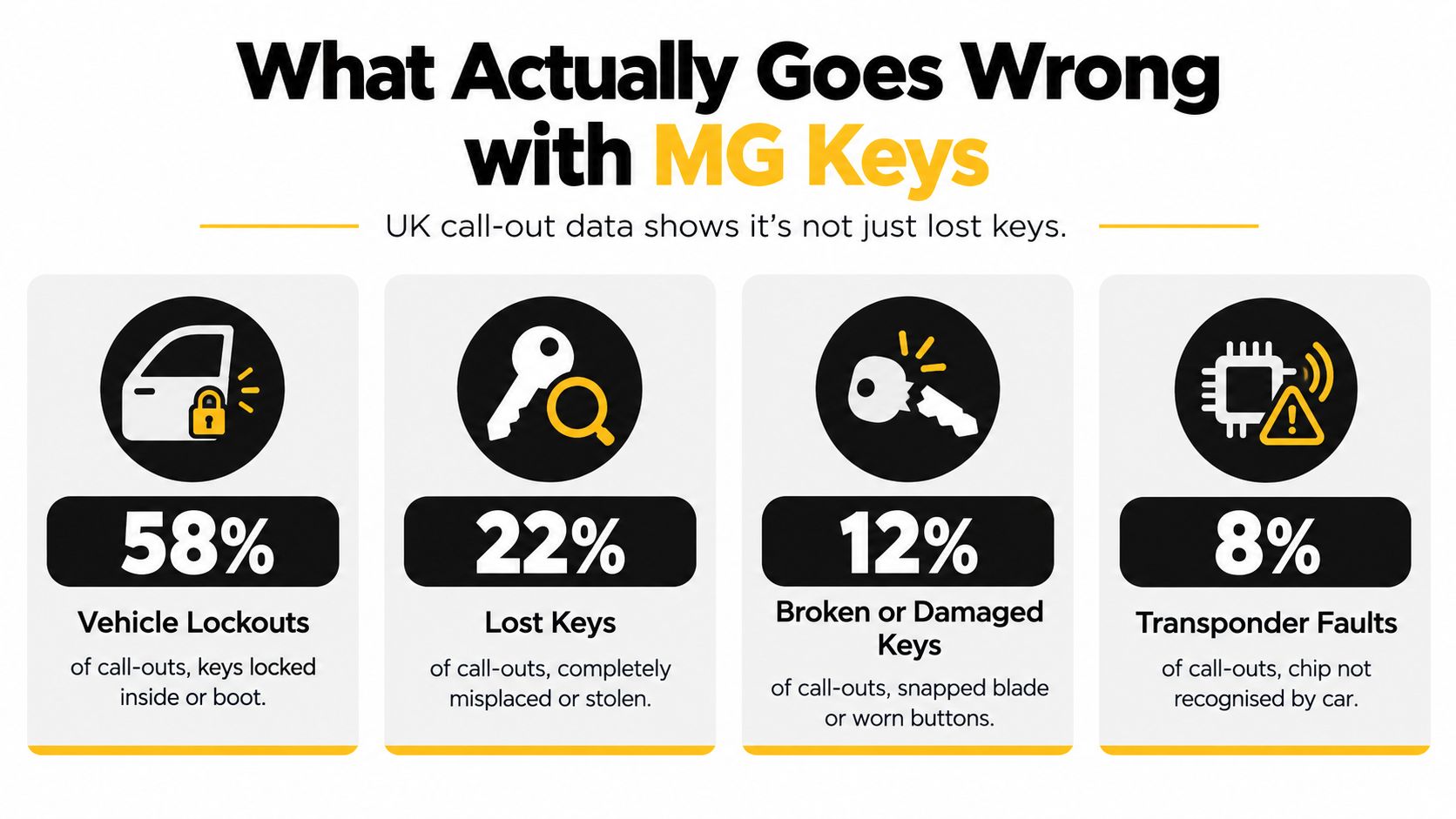
Locked-in keys
On an MG ZS or MG3, a key left in the cabin or boot becomes an entry problem, not a programming job. Use controlled, non-destructive access. A screwdriver or forceful pulling can bend the frame, damage seals, scratch paint, or affect wiring inside the door.
A mobile automotive locksmith will assess the lock layout and choose suitable entry equipment. Once the vehicle is open, test the key and confirm whether the remote and immobiliser still respond before arranging further work.
Jammed locks and ignitions
A key that will not turn can point to a worn blade, debris, steering-lock pressure, a binding cylinder, or a failing ignition barrel. On older MGs, wear may show first as a key that turns only when the steering wheel is positioned carefully. Repeated force can bend or snap the blade inside the cylinder.
Keep the key still and avoid twisting harder. The technician should establish whether the key can be removed safely, then test whether the fault follows the key or remains with the lock. That distinction affects both the repair and the final cost.
Lost keys and snapped blades
A lost key creates a different job from a snapped one. With no working key available, the locksmith may need vehicle identification, a compatible key, cutting, and immobiliser programming. If part of the blade remains inside the lock, extraction comes first. Cutting and programming a replacement before removing the obstruction will not restore use of the vehicle.
MG remote faults can also be mistaken for complete key failure. A flat coin cell, worn buttons, damaged casing, or water ingress may affect remote locking while the transponder still allows starting. Conversely, a key may look intact but fail immobiliser recognition, leaving the engine unable to start. Check the physical blade, remote response, and immobiliser behaviour separately before replacing the whole unit.
Replacement Costs and Turnaround Times for MG Keys
MG key pricing depends on the key type, whether a working key remains, the model, the blade profile, the electronic system and whether the vehicle is accessible. A basic mechanical key is a different job from a remote transponder key, and a smart key requires more electronic work than either.
A useful UK benchmark comes from RAC-reported figures. UK motorists spent over £181 million replacing lost car keys, 54% of drivers who permanently lost keys bought a replacement, and the average replacement cost was £176.20. Modern transponder and remote keys can cost up to £500, as reported in this UK car-key replacement cost overview.
Those figures aren't a quotation for your MG. They show why you should request a model-specific price before authorising work.
Dealer or mobile locksmith
A main dealer may be appropriate where the car has unusual security requirements, a warranty-related concern or a key system that requires dealer-only access. The trade-off is that the vehicle may need to reach the dealer, particularly when all keys are lost and the car cannot be driven.
A mobile automotive locksmith works at the vehicle. That can reduce disruption for a lockout or roadside failure, but you still need to confirm that the technician has the correct equipment for your MG model and can supply the required key rather than only cut a blade.
Criteria | Main Dealership | Mobile Automotive Locksmith |
|---|---|---|
Vehicle access | May require recovery to the dealer | Usually works at the vehicle |
Key supply | Uses the dealer's approved channel | May offer selected compatible replacement options |
Programming | Dealer diagnostic process | Specialist mobile diagnostic equipment |
Convenience | Appointment and transport may be needed | Useful for roadside and home call-outs |
Cost structure | Can include recovery, labour and dealer parts | Often combines entry, cutting and programming on site |
Best fit | Complex dealer-specific cases | Lockouts, spare keys and many replacement emergencies |
Turnaround depends on stock and system complexity. A common key may be completed during the visit, while an uncommon shell or smart key may need to be ordered. Ask whether the price includes cutting, programming, testing, VAT, emergency attendance and any replacement of all missing keys. Guidance on same-day car key replacement can help you compare the practical questions to ask.
A spare key is usually easier to arrange while the vehicle is working and one original key remains. It won't prevent every failure, but it reduces the chance of an all-keys-lost emergency and gives you a tested fallback.
How MG Key Programming and Cloning Works
Cutting creates the physical key. Programming makes the vehicle recognise it. A transponder chip exchanges its coded identity with the immobiliser system, allowing the vehicle's control systems to permit starting when the correct conditions are met.
A technician normally begins by confirming the MG model, year, key type and security configuration. The vehicle's identity and ownership details must also be checked before security work starts.
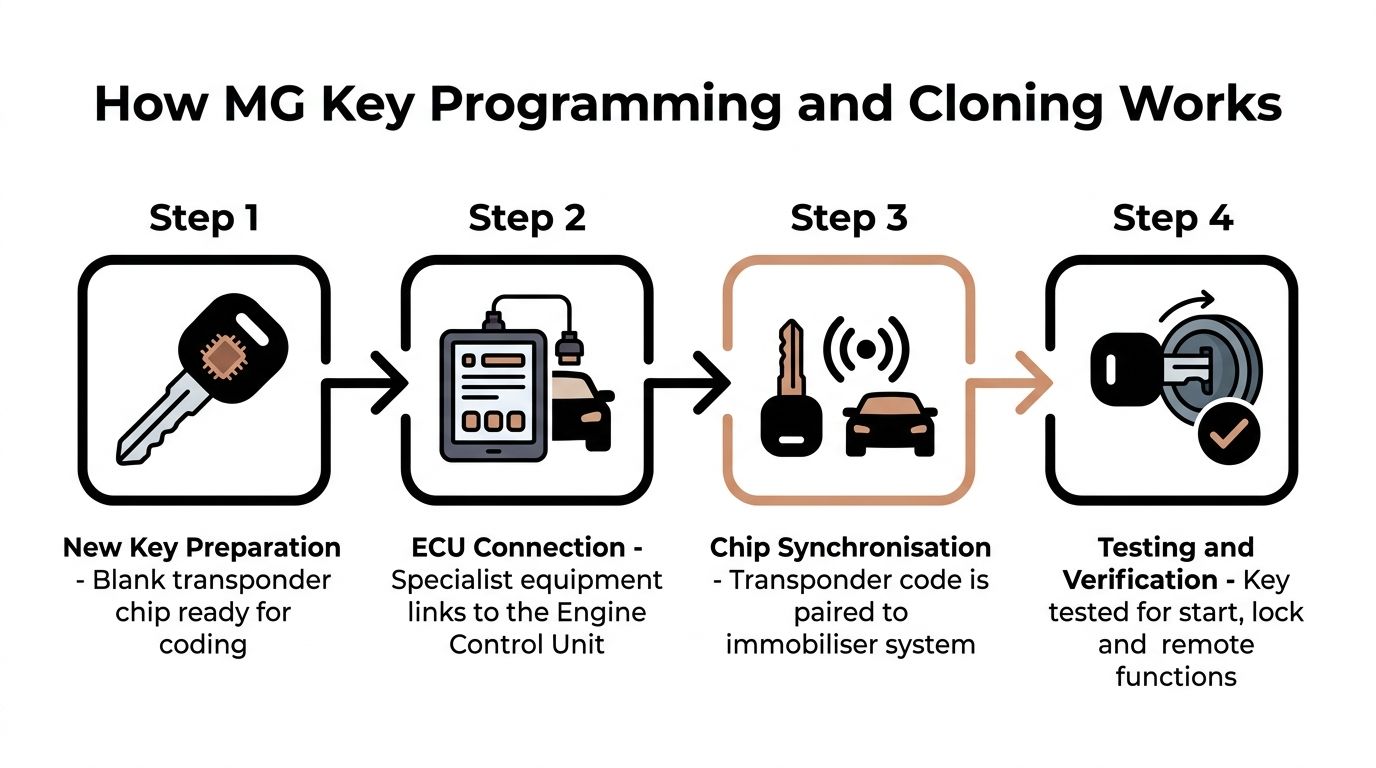
New-key programming
With a new key, the technician prepares a compatible blank, cuts the blade to match the vehicle and connects specialist diagnostic equipment to the vehicle's relevant control system. The transponder is then paired with the immobiliser, and the remote functions are configured where supported.
The final stage matters as much as the coding. The technician should test the blade in the lock and ignition, confirm remote locking, check the immobiliser response and verify that the vehicle starts correctly.
A generic OBD reader may display basic diagnostic information, but it isn't a substitute for key-programming equipment and model-specific software. Online instructions can also omit security steps or leave an incomplete key record, especially after all original keys have been lost.
Cloning an existing key
Cloning copies the relevant identity from a working key to a compatible replacement. It can be useful when the original key still starts the car but the shell is damaged, buttons are worn or a spare is required.
Cloning isn't identical to adding a completely new key. The correct method depends on the MG system, the condition of the original and whether the vehicle needs a new key stored in its security memory. Proximity systems also require specialist handling, as explained in this guide to proximity key fob cloning.
Hybrid and electric MG models can require specialised protocols and careful handling around high-voltage systems. The key task remains low voltage, but the technician still needs the right diagnostic process and must avoid treating an electric vehicle like an older mechanical model.
A short demonstration of the general workflow can be useful before booking work:
Protecting Your MG with Ghost Immobilisers and Trackers
A replacement key solves access and starting problems. It doesn't automatically address theft risk. Modern MG owners need to consider what happens if someone attacks the vehicle's keyless system, obtains a key signal or gains access using a method that doesn't involve physically stealing the key.
South Wales risk varies by location. South Wales Police data lists CF24 at 859 vehicle offences per 10,000 registered vehicles, while SA9 recorded 33 offences per 10,000 in the same dataset. The source records theft from vehicles as 47% of incidents and criminal damage as 40%, supporting a layered approach rather than dependence on one lock or alarm (South Wales vehicle-crime data).
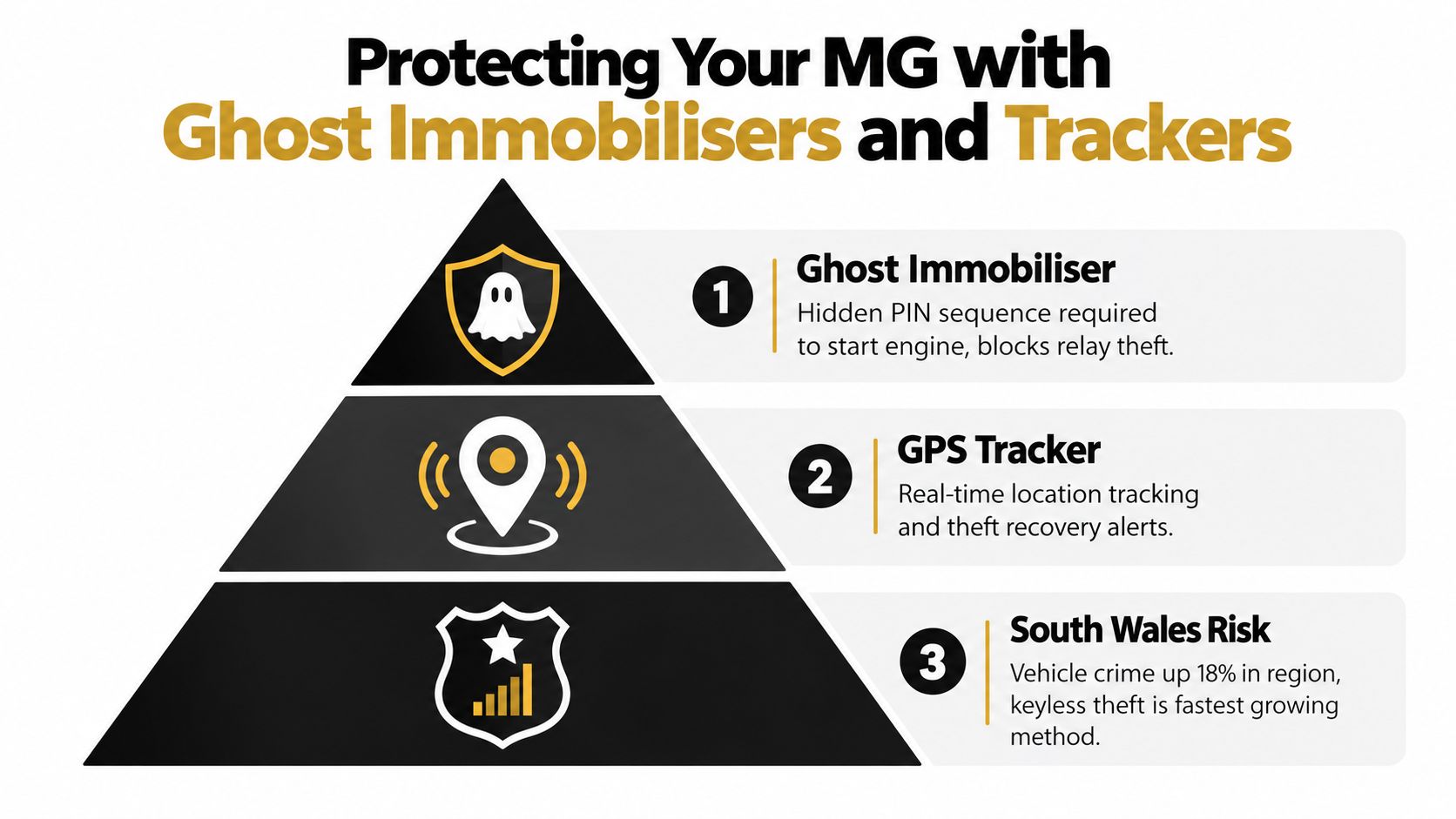
The Ghost layer
A Scorpion Ghost immobiliser prevents unauthorised start-up by requiring a unique PIN sequence through the vehicle's existing controls. A thief may have access to a key signal, but the engine still won't start without the additional sequence.
That makes the immobiliser useful against attacks focused on keyless entry and key cloning. It works as a separate layer, so it complements a properly cut and programmed MG key rather than replacing one.
The tracker layer
The ScorpionTrack S5 is described as a Thatcham Category S5 accredited tracker with 4G connectivity and European coverage. It's covertly fitted inside the vehicle, which makes removal more difficult than finding an obvious aftermarket device. Thatcham and insurer-oriented guidance identifies S5 and S7 trackers as gold-standard categories with 24/7 monitoring and direct police coordination, and reports that 95% of vehicles fitted with Thatcham-approved trackers are recovered within 24 hours (tracker guidance and recovery data).
Independent reporting also indicates that immobiliser and tracker adoption remains incomplete. Fifty-seven per cent of drivers reported having an immobiliser in 2022 to 2023, down from a peak of 71% in 2018 to 2019, while tracker use rose from 4% in 2012 to 2013 to 8% in 2022 to 2023 (UK car-theft statistics).
For owners who want both layers, Scorpion X-Series immobiliser installation in South Wales covers the practical fitting route. The Ghost blocks unauthorised starting, while the tracker supports location and recovery after a theft. Neither replaces sensible parking, key storage and insurance checks, but together they address different stages of the attack.
Why Blade Auto Keys Is the South Wales Choice for MG Key Solutions
MG owners in Cardiff, Swansea, Newport and the Welsh valleys need a response that matches the actual fault. A locked-in key needs safe entry. A snapped blade needs extraction and accurate cutting. A remote or smart key needs the correct electronics, programming and testing. Treating all three as the same job creates delays and unnecessary expense.
Blade Auto Keys provides 24/7 emergency call-outs, non-destructive vehicle entry, mobile key cutting and key programming across South Wales and surrounding areas. Its equipment covers traditional mechanical keys, remote fobs and keyless entry systems, with on-site cloning, reprogramming for hybrid and electric vehicles, spare-key production and a warranty on replacements.
Before calling, have the MG model, registration or vehicle details, your location, the type of key and a clear description of the fault ready. Say whether the key is locked inside, jammed, snapped, lost or present but not starting the vehicle. That lets the technician assess entry, key supply and programming requirements before attending.
Owners can also discuss fitting a Scorpion Ghost immobiliser or vehicle tracker during a key appointment. For a vehicle in a higher-risk area, combining an accurate replacement key with layered security is more useful than solving only today's lockout.
Blade Auto Keys provides mobile MG key cutting, replacement, programming, non-destructive entry and Scorpion Ghost immobiliser and tracker fitting across South Wales. If your MG is locked, jammed, damaged or missing its keys, visit Blade Auto Keys with your model and location details to arrange practical assistance.
Comments