
Van Tracker Guide: Types, Battery Life and Recovery

The van is on the driveway, the tools are in the back, and the keys are on the hall table. That's the arrangement most South Wales owners are running tonight, and it's why a van tracker gets bought in a rush the week after something goes missing rather than the week before.
Here's the honest version, from someone who fits this kit. A tracker improves your chances of getting the van back. It does not stop someone opening the door, lifting the keys or clearing out a load of power tools. Bought as a force field, it disappoints. Bought as the recovery layer in a stack that also includes key control and an immobiliser, it earns every penny.
So the useful question isn't which tracker is best. It's which tracker suits this van, this driver and this risk, and what happens in the first ten minutes after an alert.
What a Van Tracker Is and Which Type Fits
The alert reaches your phone after the van has already left the street. From that point, the tracker has one job: produce a usable position quickly enough to make recovery possible.
A van tracker combines a satellite receiver with a mobile data modem and reports the vehicle's location to an app or monitoring centre. It can record movement, flag unexpected use and support recovery. It cannot prevent someone getting in, using a stolen key or emptying the load area.
That distinction matters across South Wales. A van parked on a Cathays terrace, outside a job in Canton or in a Newport yard can disappear before anyone has reason to check it. The tracker's value comes from shortening the gap between theft and a usable location, not from creating a barrier around the van.
Monitoring should also stay proportionate. Continuous location history may suit a high-risk vehicle, but it can expose a driver's movements when simpler theft alerts would do.
Four tracker types cover most installations. Power supply and placement separate them more clearly than the size of the unit.
Van tracker types compared
Tracker type | Power and fitting | Typical fitting time | Best for and main weakness |
|---|---|---|---|
Plug-in OBD tracker | Plugs into the diagnostics port under the dashboard | Under 5 minutes, no tools | Short-term or trial use; easy for a thief to unplug |
Hardwired tracker | Wired to the van's main battery and ignition circuit | 1 to 3 hours by a professional | Permanent and hidden; relies on the main battery |
Hardwired with backup battery | Main battery plus an internal rechargeable cell | 1 to 3 hours by a professional | High-value vans; keeps reporting after disconnection |
Battery-only tracker | Internal rechargeable battery, magnetic or concealed placement | Minutes to place | Trailers, tools and hire vans; needs regular charging |
Three questions narrow the choice faster than a feature list:
How costly would a lost van be? A 2016 Transit carrying pipework and a £900 press may justify a concealed hardwired unit with backup power even when the van's resale price is modest.
Are tools left inside overnight? Prioritise movement alerts and an internal backup battery over route reporting.
Does more than one person use it? Driver identification helps separate legitimate journeys from unauthorised use. Set alerts around the theft risk rather than recording trips nobody needs to review.
Match those answers to the table and the type usually picks itself. For a van carrying valuable equipment, hidden power and continued reporting after disconnection matter more than extra dashboard features.
How Van Trackers Find and Report Your Van
Finding a van takes two systems working together, and it's worth separating them because they fail in different places. Satellites tell the unit where it is. The mobile network carries that answer to a server. Think of a driver checking the map, then phoning the office with what they found.
Satellites give the position
The receiver listens to GNSS constellations, mainly GPS and Galileo, and calculates its own coordinates. Under open sky that's accurate to a few metres, enough to place a van on a named street. Under a multi-storey in Cardiff city centre, in a railway cutting or between tall terraced blocks, the fix weakens or vanishes.
In practice, a van left underground goes quiet and the last known position is what recovery works from. A unit that reports that last fix with a timestamp is far more use than one showing a blank map.
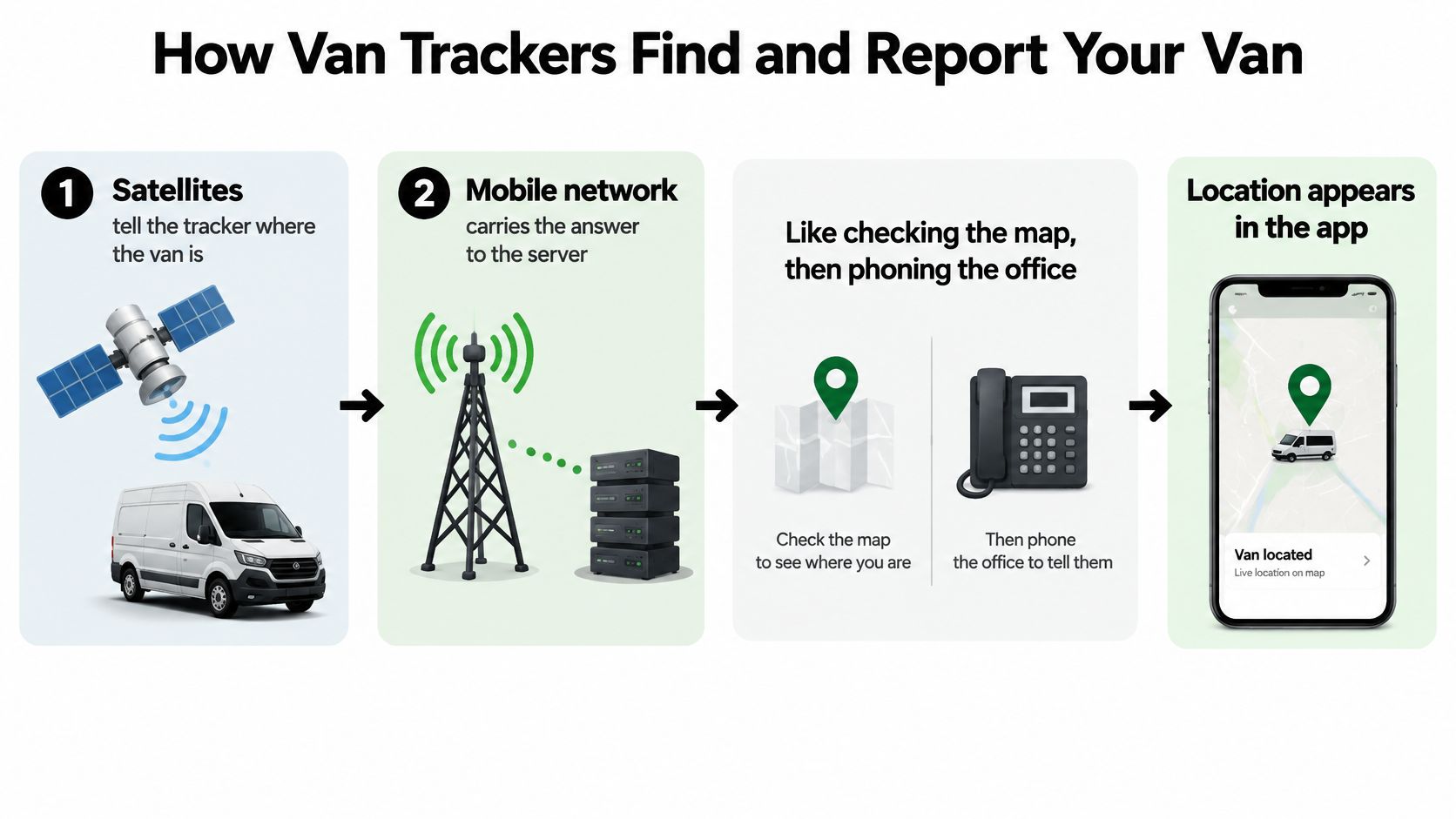
The mobile network carries it
The modem pushes the fix over 4G, often on LTE-M or NB-IoT, the low-power cellular standards built for small devices. As a fallback it can report which cell tower it's talking to. That's much rougher, often hundreds of metres out in rural areas, but it keeps a rough position when satellites are blocked. Good units use both.
UK networks have retired their 2G and 3G services, so confirm 4G support before buying. A cheap unit on a legacy network is a paperweight with a sticker on it.
Across the Welsh valleys, coverage gaps are normal. Decent devices use store and forward: they buffer journey points while out of signal and upload the batch when the connection returns, so the recovery trail survives a dead spot.
Rule of thumb: if the newest fix is more than fifteen minutes old, treat the position as a search area rather than a pin on a map.
The full path looks like this:
The tracker receives satellite signals and calculates its position.
It sends the fix over the 4G link.
The mobile network passes the report to the monitoring server.
The server updates the owner's app with the latest location.
Before you buy, ask the supplier for the device's GNSS and cellular specifications, then drive your regular routes with the app open and note where the dots stop. A tracker that's blind between Pontypridd and Merthyr isn't much of a tracker.
Battery Life and Power Sources Explained
Start with the answer people want. A hardwired tracker runs for as long as the van's battery is healthy. A battery-only unit runs on its own cell, and how long that lasts depends almost entirely on how often it reports.
Hardwired units draw a small current from the vehicle and stop drawing before the battery is flat. That's the low-voltage cut-off, usually set between 11.5V and 12V depending on the installer and the model. Set it high and the tracker protects the van but goes quiet early during a theft. Set it low and you get a van that won't start on a frosty January morning.
Plug-in OBD units sit at the other extreme. Many drop to a low-power state or lose the feed once the ignition is off, and anyone who knows what a diagnostics port looks like can pull one out in seconds.
Why the backup cell matters
A backup battery keeps the unit reporting after the main supply is cut or the wiring is disturbed. That's the feature that decides whether you keep a trail after a theft, because cutting power is the first thing an organised thief does. It's also why a hardwired unit with an internal cell is worth the extra fitting time on a van carrying tools.
Reporting pattern and indicative battery-only run time
Reporting pattern | Indicative battery-only run time | Suits |
|---|---|---|
Frequent: every 30 seconds moving, every 30 minutes parked | 2 to 4 days | Fleet live tracking and active recovery |
Standard: every 2 minutes moving, hourly when parked | 1 to 3 weeks | Most private and trade vans |
Economy: daily check-in plus movement-triggered alerts | 3 to 6 months | Trailers, spare vehicles and tool storage |
Treat those run times as indicative. Real figures move with battery capacity, reporting frequency, signal strength along the route and temperature. Cold weather cuts capacity, and a van battery that's already six winters old shortens the window before the cut-off bites.
Ask the installer three things before booking: where the cut-off is set, what capacity the backup cell has, and how often the unit itself is likely to need replacing.
Geofencing and Live Recovery Features That Matter
A dot on a map is only useful if something happens when the dot moves. That's the gap between a cheap tracker and a configured one, and it's where most installs fall down.
A geofence is a virtual boundary drawn around a depot, a home driveway or a customer site. Say 200 metres around a Newport yard. Cross it outside agreed hours and the system alerts. Draw it too tight and every three-point turn in the yard fires an alert, so people start ignoring them, which is worse than no alert at all.
Time-window alerts cover ignition or movement outside set hours, such as anything between 7pm and 7am. Movement alerts catch a van that shifts while it's meant to be parked. Both take minutes to configure and are easy to switch off, so decide who owns them before the fitter leaves.
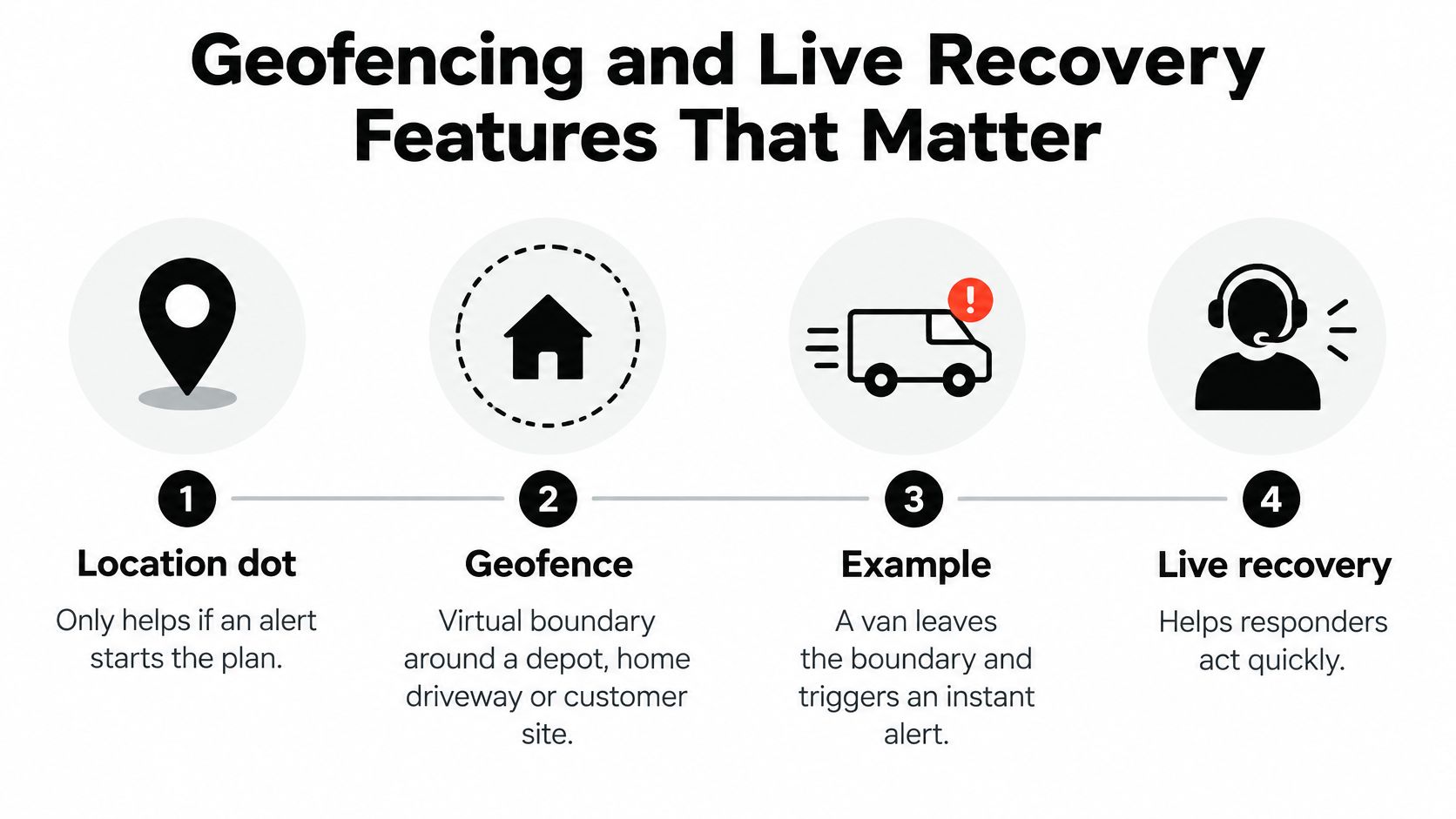
Tamper alerts flag interference with wiring or power. Tracker-silence alerts flag the absence of reports, and the reporting pattern you chose sets how long the silence runs before anything fires. A daily check-in unit can stay quiet for a day before anyone notices, which is a poor fit for a van full of tools.
Feature checklist for a van tracker quote
Feature | What to check | Action on alert |
|---|---|---|
Geofence | Radius around depot, home or site, such as 200 m around a Newport depot | Alert when van crosses boundary |
Time-window alert | Ignition or movement outside agreed hours, such as 7am to 7pm | Contact key holder and check live location |
Movement alert | Van moves while parked | Confirm event before escalating |
Tamper alert | Wiring or power disturbed | Escalate and check backup battery |
Tracker-silence alert | Reporting stops | Treat as possible disconnection and escalate |
Low-battery and comms-loss notice | Battery or signal status falls short | Ask installer to fix or replace |
Live tracking and journey history | Route replay after theft | Share with police and insurer |
Detection only pays off when it's wired to a workflow. UK connected-fleet systems use geofencing and automated analysis of vehicle data to spot unusual movement, validate a suspected theft and start coordinated recovery, working through alert generation, event confirmation, live-location monitoring, police liaison and recovery support. Independent transport reporting on IVECO's UK-facing connected-vehicle service describes recovery rates of up to 90%, but that figure is manufacturer-reported and isn't a benchmark you should expect from every unit.
Practical rule: an alert nobody owns is a notification, not a security system.
So write the escalation down:
Confirm the alert against live location before doing anything else.
Report an active theft to the police on 999, or other crimes on 101.
Tell the monitoring provider and ask for the journey history.
Inform the insurer and have the fitting record to hand.
Tell key holders to stop attending the van.
A tracker provides evidence and location intelligence. It doesn't replace physical security, key control or prompt reporting.
Theft Recovery and Fleet Management Benefits
A stolen van found within hours is a recovered asset. A stolen van found three days later, stripped of tools, is a paperwork exercise. That gap between detection and recovery is where a tracker earns its keep, but the features worth paying for depend entirely on who's buying. A sole trader wants the van found. A depot manager wants to know where eight vans are at half four on a Friday.
Tracker benefits by user type
User type | Main benefit | Feature to prioritise | Main limit |
|---|---|---|---|
Private van owner | Faster location report after theft | Tamper and tracker-silence alerts | Does not stop the van being taken |
Tradesperson | Recovery of the van and evidence for insurers | Backup battery and home geofence | Tools still need physical security |
Delivery fleet | Route visibility and less downtime | Journey history and out-of-hours alerts | Needs driver transparency and a privacy policy |
Roadside or hire fleet | Asset control and utilisation tracking | Multi-vehicle dashboard and alerts | Hire terms must cover tracking |
What adoption looks like
Van tracking is standard equipment on commercial vans, not an add-on. Larger fleets adopted telematics first and treat it as routine, with location data often arriving bundled alongside driver-behaviour monitoring, while single-van operators and small firms are still catching up. The savings tend to be administrative before they're dramatic: the 2024 Telematics Survey from Teletrac Navman found 96% of respondents saw savings through improved administration, fuel efficiency or lower operating costs.
On a small fleet, tracking pays off fastest when it's tied to key discipline. A van off the road waiting for a replacement key costs the same as a van off the road for any other reason, so pair the fit with a proper fleet key management routine covering who holds what and what happens when one goes missing.
One limit runs through every row of that table. A tracker improves detection and recovery; it does not stop entry, key theft or a tailgate being opened. Downtime, replacement keys and unsecured equipment cost more than the vehicle's market value, and no GPS unit addresses any of them.
Insurance, Installation and Privacy Checks
More tracking isn't automatically better tracking. Assuming it is causes two problems: a bill for data nobody uses, and a compliance headache that surfaces later as a grievance.
Start with the insurer. The RAC states that fitting a tracking device does not itself prevent a vehicle from being stolen, though it can improve the chances of recovery and return by police. The same guidance treats an immobiliser as a priority where a vehicle has no effective security, and notes Thatcham-approved equipment may reduce premiums as well as theft risk.
That's the sensible order of operations. Prevention first, recovery second. Tell your insurer in writing what's fitted, ask whether the tracker or the immobiliser needs declaring, and keep the fitting record and product approval details somewhere you can find them at renewal.
What professional fitting actually involves
Wiring a tracker into a modern van isn't a matter of finding a live wire. The unit taps the main battery and ignition circuit through a fused connection, sits where it can't be kicked loose and doesn't interfere with hybrid or electric van electronics. The fitter should check cellular signal on the routes the van regularly drives, confirm whether the van's warranty is affected, and record where the device is hidden.
Privacy belongs in the same conversation
Vehicle location becomes personal data the moment it identifies a driver, which brings it under UK GDPR and the Data Protection Act 2018. Define a clear business purpose, tell drivers before the system goes live rather than after, decide how out-of-hours use is handled, set a retention period and restrict who can pull journey history. Systematic monitoring may justify a Data Protection Impact Assessment. Always-on collection isn't a default best practice, and pretending otherwise is how fleet managers end up in disputes they can't win.
The most common mistake isn't buying the wrong tracker. It's fitting the right one and never writing down who does what when it fires.
Before booking, tick these off: purpose written down, drivers informed, out-of-hours policy agreed, retention period set, access list limited, and the immobiliser arranged alongside the tracker rather than six months later. Prevention is easier to book in the same visit, and a Scorpion X Series immobiliser installation in South Wales can be scheduled with the tracker fit.
Layered Van Security in Practice
Layers work because each one frustrates a different attack. Three vans, three setups, none of them relying on a single device.
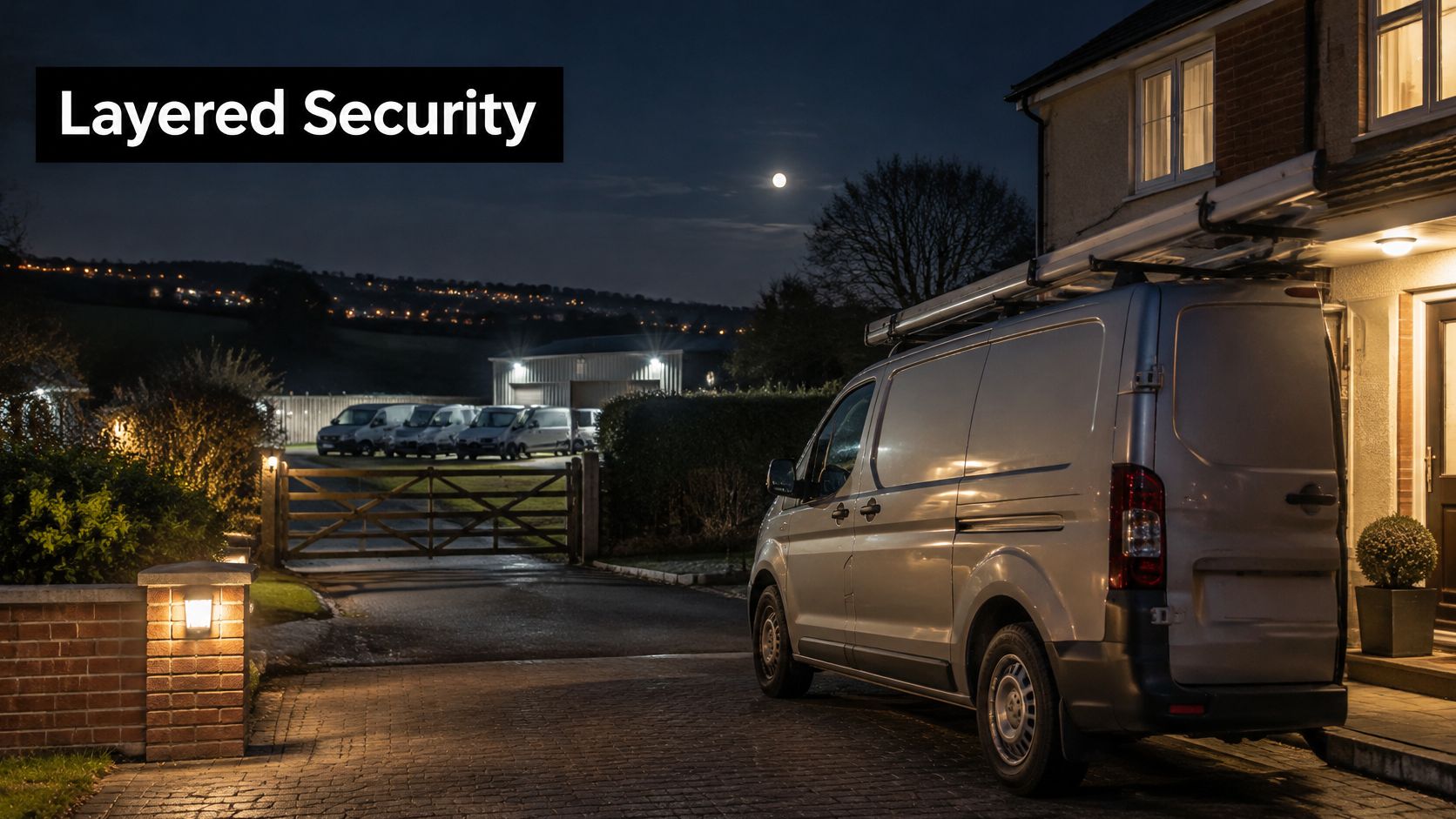
A Cardiff plumber parks on a driveway off a residential street. The stack starts with key control: the spare lives in a locked cabinet indoors and never in the van. Add a mechanical lock on the rear doors, a Ghost immobiliser, then a tracker with a geofence around the driveway and a movement alert after 8pm. When the alert fires he checks live location, rings 999 if the van is moving, then rings his insurer. Nobody drives to the van.
A Swansea delivery fleet runs six vans from a depot. The stack is a depot geofence, driver identification tags so the system knows who's in which van, out-of-hours movement alerts, and a written escalation line naming who contacts the police and who contacts the monitoring provider.
A rural Valleys van works lanes with patchy signal. Here the stack leans on store-and-forward reporting and a backup cell, so losing the main supply doesn't end the trail, plus a slightly wider geofence so a theft isn't confused with a farm track clipping the boundary.
Why prevention and recovery sit together
The Scorpion Ghost immobiliser requires a unique, concealed PIN sequence before the engine can start, which targets key cloning, relay attacks and hot-wiring. The accompanying ScorpionTrack S5 tracker uses driver-identification tags, real-time location tracking, automatic theft alerts and 24/7 monitoring, with S5 approval identified as a Thatcham category.
That's the pairing I'd fit on a van carrying tools. The immobiliser handles the stage where someone tries to start it. The tracker handles the stage where it's already moving.
Cargo and tool theft run alongside vehicle theft rather than behind it, so the cargo theft prevention guidance from My Safety Manager is a useful check on the loading and parking side of the same problem.
What changes between the three scenarios is small but decisive. The Valleys van needs signal resilience. The fleet needs driver tags and a named escalation contact. The tradesman needs key control, because a cloned or lifted key beats an immobiliser when nobody's watching. For a wider comparison of physical and electronic layers, this guide to the UK's best car security systems covers what sits above the tracker.
Choosing a Local Fitter for Your Van Tracker
Fitting is where most tracker purchases are won or lost, and it's worth using someone who works on South Wales vans rather than a national call centre reading a script. Blade Auto Keys covers Cardiff, Swansea, Newport and the Welsh valleys, and now offers Scorpion Ghost immobiliser and vehicle tracker fitting. If you need an out-of-hours slot, confirm availability when you book rather than assuming it.
Eight questions worth asking any fitter
Which tracker model is fitted, and what approval does it carry?
What reporting pattern is set, and what battery life does that give?
Is a backup battery fitted, and what capacity is it?
What low-voltage cut-off is set?
Has cellular signal been checked on your regular routes?
Where is the device located, and who can access that record?
What's the monthly monitoring fee, the contract length, and what happens to the device when the contract ends?
Is a fitting certificate provided?
Question seven is the one people forget. A tracker on a three-year airtime contract attached to a van you're replacing in eighteen months is a cost, not a safeguard.
Have your vehicle registration, make, model, approximate year and location ready before you call, because those details decide which unit and which mounting method apply. Tracker and immobiliser wiring is auto electrical work, so it's worth knowing what a proper installation looks like, and this guide to auto electrician work in Bridgend covers the basics. If the yard also runs electric or hybrid vehicles, keys for those can be programmed on-site during the same visit rather than booked separately.
Then work in this order. Write down how the van is used and what it carries. Match that description to a type that handles it. Only then ask for a quote and a fitting slot.
Blade Auto Keys fits Scorpion Ghost immobilisers and vehicle trackers for owners across Cardiff, Swansea, Newport and the Welsh valleys, and can program keys on the same visit where the van shares a yard with electric or hybrid vehicles. Whether you want prevention, recovery or both wired into one setup, we'll talk through the unit that matches how your van is used. Visit Blade Auto Keys to book a fitting or ask which tracker suits your van.
Comments