
Ghost Immobiliser Explained: How It Works in 2026

Your car's parked on the drive in Cardiff, Swansea or Newport, keys in the hallway, and you're wondering if that's enough. For a lot of South Wales motorists and fleet managers, that question comes after a neighbour's car disappears overnight or a delivery van is targeted at a depot. A Ghost immobiliser won't stop someone trying, but it can stop them driving away. I would judge it on that narrow, practical job, not on promises of total protection.
Ghost Immobiliser and Standard Immobiliser Compared
A Ghost immobiliser is an aftermarket start-authorisation device that keeps the engine from starting until you enter a personalised sequence on existing dashboard or steering-wheel controls. A standard factory immobiliser works differently. The car checks that the key's transponder matches the stored code, and that check alone is the only gate.
Think of the factory system as a lock that checks the key. A Ghost immobiliser is a second lock that needs a code only the owner knows. If the first check is fooled, the second one still has to be passed.
Where the Two Systems Differ
The difference matters most on keyless models, where entry and start are separate electronic steps. Understanding the difference between keyless entry and keyless start helps you see why opening the door shouldn't automatically mean the engine can run. The Ghost unit separates those two events again.
Feature | Standard factory immobiliser | Ghost immobiliser (aftermarket) |
|---|---|---|
Start check | Key transponder must match the stored code | Key check plus a personalised dashboard or steering-wheel sequence |
Forged key-valid message | Engine can be started if the message is accepted by factory systems | Engine start still needs a separate driver authentication event |
Who sets the activation method | Manufacturer and key programming | Owner, set during fitting |
Where it is fitted | Built in during vehicle manufacture | Fitted by a qualified installer after vehicle-specific checks |
Role in a security plan | Primary start barrier | Additional layer alongside factory systems, keys and tracking |
Insurer acceptance | Included in vehicle specification | Set by insurer, installation standard and policy wording |
This isn't a plug-in gadget you order and clip onto the dashboard. A qualified installer fits it after vehicle-specific checks on the exact make, model and electrical architecture. That fitting work is part of the security, because a poorly integrated unit can create faults, drain issues or starting problems that have nothing to do with theft.
What It Doesn't Replace
I wouldn't fit one and then relax about everything else. The device doesn't replace the factory immobiliser, careful key control, physical security or a tracker. It adds one extra decision point before the engine runs, and that's where its value sits.
A Ghost immobiliser doesn't make your key irrelevant. It makes your key, on its own, insufficient.
For a family car in the Welsh valleys, that may be enough to turn a quick electronic theft into a failed attempt. For a van carrying tools or a fleet vehicle parked away from base, you'll usually want tracking as well. The right question isn't which single product wins, it's which layers cover the ways your vehicle is likely to be taken.
How the Two-Step Start Check Works
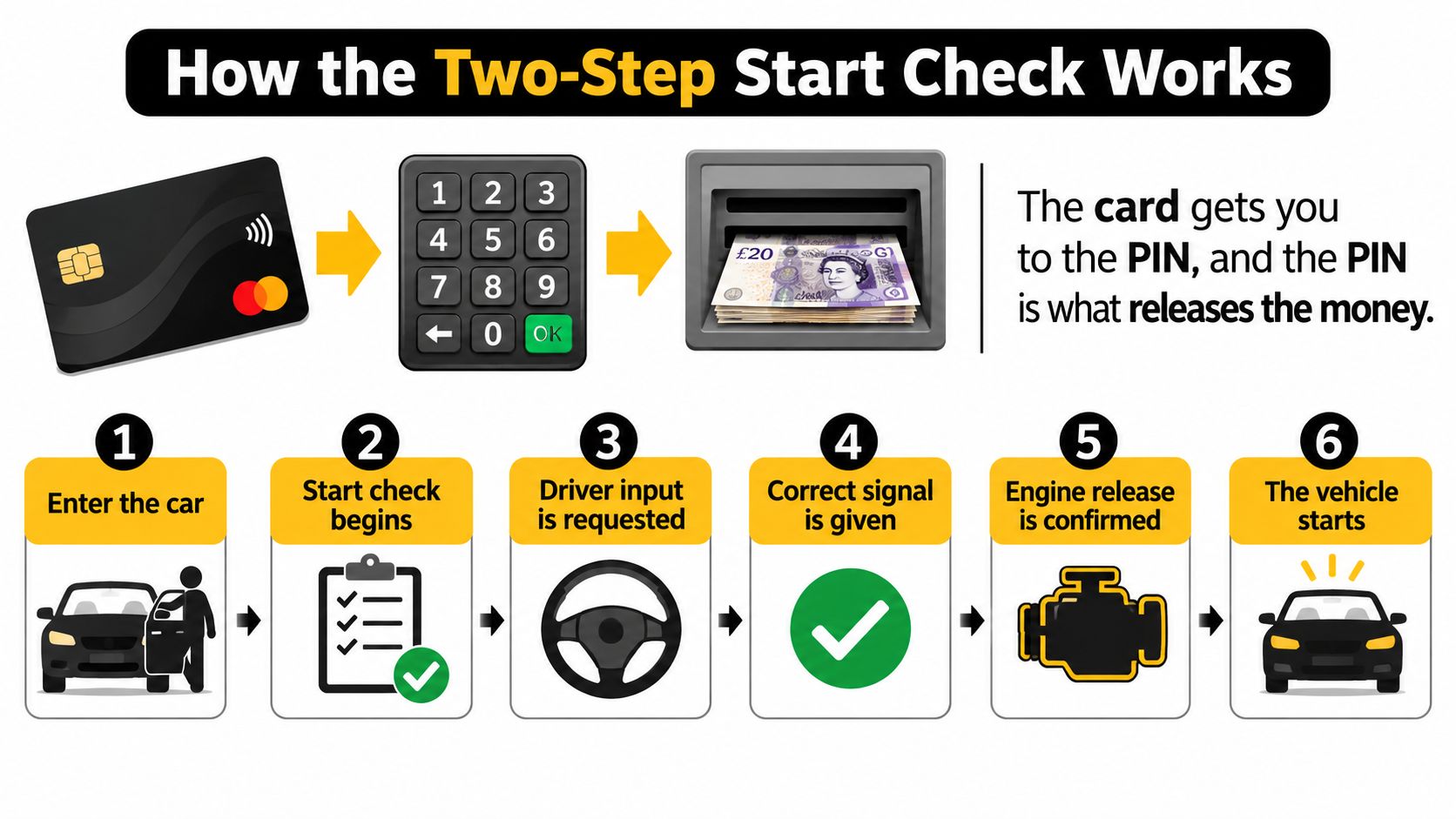
A key can pass the factory check and still fail to start a car protected by a Ghost immobiliser. The device adds a second authorisation step: after using the key as usual, the driver enters a personalised button sequence.
The Six Steps at Every Start
You turn the key or press start. Entry and key use stay as normal.
The factory immobiliser checks the key transponder. The vehicle's original key check remains in place. The Ghost unit adds another layer rather than replacing it.
The Ghost unit keeps engine start blocked until the second check is passed. A key that passes the factory check alone is not enough to authorise the start.
You enter your personalised sequence using controls already fitted to the dashboard or steering wheel. There is no extra fob to carry.
The correct sequence allows the engine to start. The car then runs normally. In ordinary use, you do not enter the sequence again at traffic lights or after a stall, subject to the installer's configuration.
An incorrect or missing sequence keeps the engine blocked. A working key on its own cannot complete both checks.
Before driving away, ask the installer how incorrect entries are handled and what to do if you forget the sequence. Confirm the recovery process and the procedure for servicing the vehicle. Those details matter if the car needs attention away from home.
Fleet managers should set clear rules for PINs and driver handovers. A code shared across the whole team may remain known to a driver who has left. Control who receives the current sequence, and update it when driver access changes.
The trade-off is practical: drivers add a short sequence at each start but continue to use their usual key. For a South Wales motorist or fleet manager, the second check is designed to stop a theft attempt that relies on a key alone.
Why Factory Immobilisers Fall Short and Which Attacks Get Through
Start with the numbers, read correctly. The Office for National Statistics crime bulletin for the year ending December 2024 reports that police-recorded vehicle offences in England and Wales fell by 7% to 364,208. That total covers vehicle offences broadly, not thefts alone, so it isn't a count of cars stolen and shouldn't be quoted as one.
Police figures show what was reported and recorded. The Crime Survey for England and Wales captures victims whether or not they reported the incident, so the two measures answer different questions. ONS datasets also record methods of entry, including manipulated remote-locking signals, which is the detail that matters when you're choosing security.
A Short History of the Problem
Mechanical steering locks and alarms gave way to factory electronic immobilisers, and that shift cut the easy thefts. Thieves adapted by attacking the electronics rather than forcing the lock. Newer methods created the case for independent layers that the factory key check doesn't control.
That history explains the current gap. Your factory immobiliser still does its job against a wrong key. It struggles when the attacker persuades the car that the right key has already been approved.
The key principle: A Ghost immobiliser doesn't stop a thief reaching the wiring. It stops the engine starting after the wiring has been reached.
CAN-Bus Injection
In a CAN-bus attack, criminals access vehicle wiring, sometimes through a headlamp or bumper area, and inject false messages into the network. The BBC report on CAN-bus car theft describes how one UK policing alert states that some attacks can occur in under three minutes. Speed is the attraction, because the car is told, electronically, that a valid key is present.
A separate driver sequence breaks that chain. The injected message may satisfy the factory systems, but the Ghost unit still waits for an authentication event it hasn't seen. I'd describe this as the attack the device is best suited to stopping.
Keyless Relay
Relay theft extends your key's signal from inside the house so the car believes the key is standing next to it. The Ghost sequence still blocks the start, which helps, but you should fix the signal problem first. Keyless deactivation where available, or a Faraday pouch used properly every night, addresses the entry point directly.
Don't treat the immobiliser as permission to leave keys by the front door. Stopping the relay opening the car at all is better than relying on the start block afterwards. Our own guide to layered car security systems in the UK sets out how those layers fit together for South Wales drivers.
Stolen or Copied Keys, and Physical Entry
A stolen, found or copied key passes the factory check because, as far as the car knows, it's genuine. It fails at the Ghost stage if the holder doesn't know your sequence. That's a clean stop, provided you haven't shared the code widely or written it on paperwork left in the glovebox.
Physical entry is different. If someone breaks in and works on wiring or the ignition area, the immobiliser blocks the start but can't prevent damage, tool theft from a van, or the vehicle being towed. There it only slows and limits the outcome, while secure parking and a tracker aid recovery.
Attack method | How it works | Layer that helps |
|---|---|---|
CAN-bus injection | Criminals access vehicle wiring, sometimes via headlamp or bumper, and inject false messages | Separate driver PIN before engine start |
Keyless relay | Signal from a key is extended so the car believes the key is nearby | Driver sequence still required, plus keyless deactivation or a Faraday pouch |
Stolen or copied key | A found or copied key is used to open or start the car | Owner-set sequence the key holder does not know |
Physical entry and wiring access | Thief breaks in and works on wiring or ignition area | Immobiliser blocks start; tracker and secure parking aid recovery |
Be honest about the limits. The device doesn't stop glass being broken, contents being taken, or a determined crew loading the vehicle onto a transporter. It doesn't locate the car afterwards either.
No single countermeasure is enough for a vehicle parked on a street in Newport or a fleet van left at a Swansea industrial estate overnight. Pair the immobiliser with keyless deactivation or a Faraday pouch, secure parking where you can manage it, and a tracker for recovery. Each layer covers a failure in the others, and that's what makes the overall setup hard to beat quickly.
What a Scorpion Tracker Adds to the Immobiliser
A Ghost unit tries to prevent the drive-away. A tracker deals with the bad day when prevention fails, the vehicle is towed, or it's taken with the sequence known. Scorpion systems blur that line slightly because they can immobilise as well as track.
Two Separate Immobilisation Modes
The ScorpionTrack Thatcham tracking page explains that automatic immobilisation allows the vehicle to start only when an authorised Automatic Driver Recognition tag is present, with arming and disarming controlled through the mobile application. That's a presence check, different from entering a dashboard sequence.
Remote immobilisation is a recovery feature rather than a start-up routine. If the vehicle is stolen while the tag is present and automatic immobilisation hasn't operated, vehicle-recovery specialists can remotely prevent the engine from being restarted. The system supplements the manufacturer's factory immobiliser instead of replacing it.
Monitored Tracking Versus Location Only
The Scorpion alarms and immobilisers page states that its S7, S5 and S5+ trackers are monitored 24 hours a day, 365 days a year. When the system detects a trigger, an alarm can sound and the monitoring team contacts you to confirm whether a theft has occurred, and the company says its team can liaise with police.
That's materially different from a cheap tag that only shows a dot on a map after you notice the car missing. Scorpion also states the product is designed and manufactured in the UK to Thatcham specifications and intended to address key theft, key cloning and OBD hacking.
We fit trackers for private motorists and fleets across Cardiff, Swansea, Newport and the Welsh valleys. The same vehicle checks apply to tracker wiring as to the immobiliser, so don't accept a rushed tracker install tucked in wherever there's space.
Installation and Compatibility Checks Before Fitting
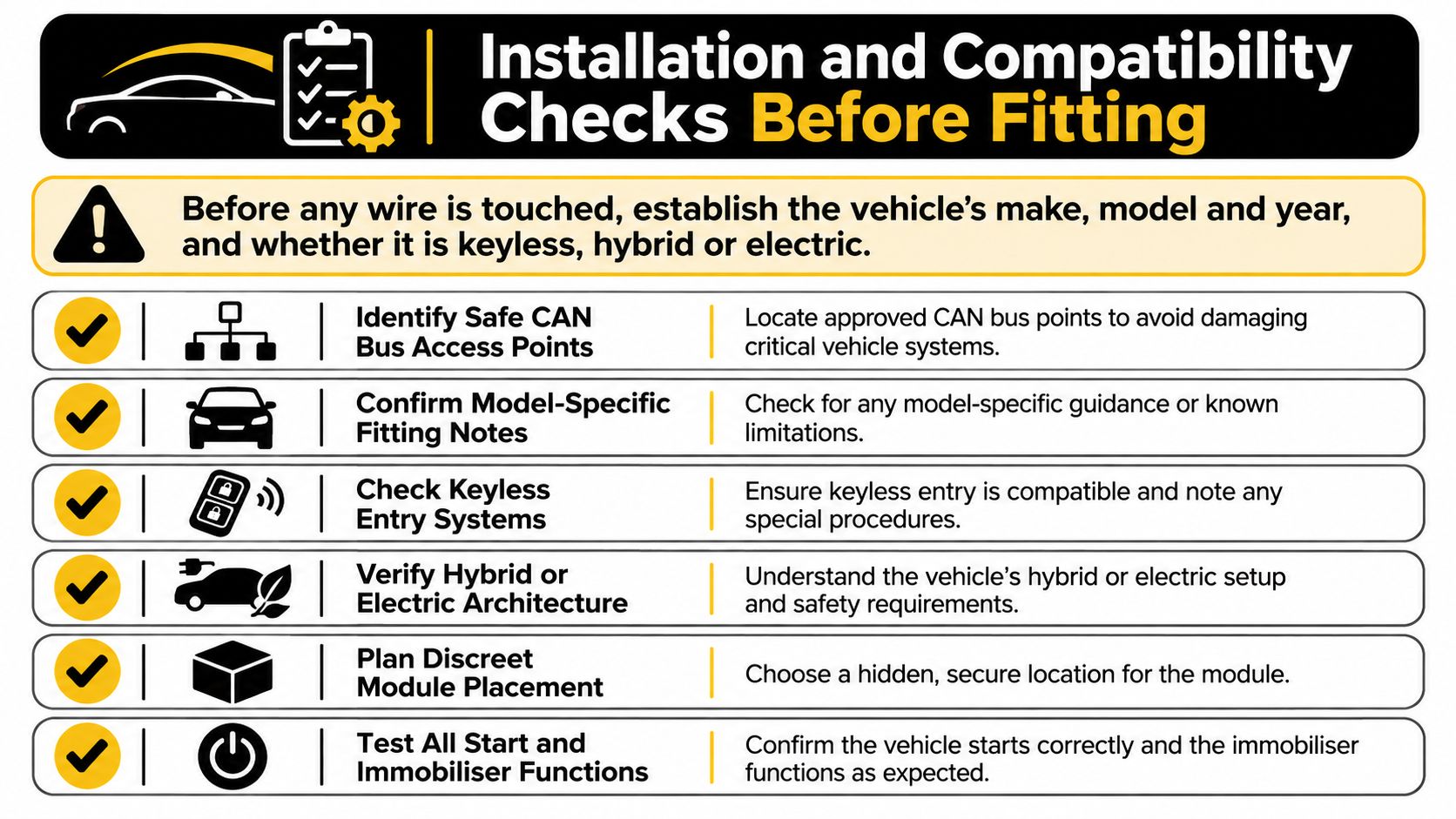
Before any wire is touched, the installer must establish the vehicle's make, model and year, and whether it's keyless, hybrid or electric. Those three facts decide where the unit can integrate and what must be avoided. If a fitter quotes without asking them, I'd walk away.
The Ten Checks That Matter
Identify safe CAN integration points for that exact vehicle, because a poor CAN point can cause fault codes and warning lights.
Confirm the fitting avoids airbag, steering, ADAS and hybrid high-voltage systems. Disturbing safety or driver-assistance wiring is never an acceptable trade for security.
Test normal starting with the unit fitted, repeatedly, hot and cold where practical.
Test immobilisation with an incorrect sequence, so you know the block engages.
Test battery isolation, because a flat or disconnected battery shouldn't leave you stranded or unprotected without warning.
Test diagnostic communication, so a garage can still read the vehicle at service time.
Test remote locking, including keyless functions, to catch integration clashes early.
Test the emergency recovery route, since a missing recovery route can leave the car stranded at a service or after a battery failure.
Test hybrid or EV operating states where applicable, including ready modes that don't behave like a conventional ignition.
Record the emergency-disarm and service procedures in writing, and hand that record to the owner, not just the driver on the day.
A generic kit fitted without vehicle knowledge is the most common route to a poor installation. Model-specific checks matter more than the badge on the device, and it's worth weighing mechanic labor against DIY rework before assuming a cheaper fitting saves money. Reworking disturbed CAN wiring costs more than doing it properly once.
You can see how we approach Scorpion immobiliser installation across South Wales before you commit to a date. The same vehicle-specific checks apply to tracker wiring fitted at the same visit.
Ask for the test results in writing. If it wasn't tested and recorded, you're trusting memory instead of evidence.
When you collect the vehicle, you should receive a written record of test results and a procedure card for the driver. Record the tracker's immobilisation settings in that card alongside the Ghost unit's settings, so anyone authorised to move the vehicle has one clear sheet. Keep a copy at home or at the fleet office, away from the keys.
Insurance, Fleet Downtime and Booking the Fitting
A Ghost immobiliser may or may not reduce your premium. Any saving depends on the insurer, vehicle, installation standard and policy wording, so ask your insurer before booking and get its requirements in writing.
A 2025 Fleet News report based on Tracker and police recovery data found that 4% of recovered stolen cars were valued above £50,000, while one in ten were worth less than £10,000. Theft affects vehicles across price ranges. For a South Wales family or a trades business, the cost of losing access to an ordinary car or van can matter as much as its value.
Police.uk recommends Thatcham-rated category 1 or 2 alarm systems with tracking, immobilisation, anti-grab and movement sensors. If your policy specifies an alarm category, confirm that the proposed system and its paperwork meet the requirement. A Ghost immobiliser does not automatically satisfy an alarm-category requirement.
Case | Main concern | Confirm first |
|---|---|---|
Private family car | Theft affects ordinary cars as well as luxury models | Insurer approval and a written fitting record |
Delivery van or commercial fleet | Downtime when drivers change or vehicles need attention | Driver PIN policy, handover records and recovery procedure |
Hybrid or electric vehicle | Correct operation with the vehicle's systems | Installer experience with that exact model |
Policy requires an alarm category | Certification and tracking requirements | Whether a Thatcham-rated category 1 or 2 alarm, as recommended by police.uk, meets the policy wording |
Fleet Downtime Is the Hidden Cost
For South Wales fleets and delivery operators, driver changes, servicing and a lost or unavailable key can all take a vehicle off the road. A van that cannot start for a relief driver at 5 a.m. can disrupt a delivery round. Clear fleet key management procedures help keep keys, PINs and access records under control.
Decide who manages driver codes, how access is removed when a driver leaves, and where the recovery procedure is kept. Put the process in writing before fitting. Agree with the garage how the system should be handled during servicing, so staff know the correct procedure.
Four Steps Before You Book
Ask your insurer in writing whether it must approve the fitting and what certification or paperwork it requires.
Set a driver PIN policy for shared vehicles, including handovers and code changes when drivers leave.
Ask what documentation the fitter will provide, including the fitting and test record, warranty and recovery instructions.
Book once those details are settled so the fitting can go ahead with the right vehicle and policy information.
When you contact Blade Auto Keys, provide the vehicle's make, model and year, whether it is keyless, hybrid or electric, and who will drive it. Those details help the team give more accurate information. For urgent key or lockout assistance, call 0330 043 3804 or 07777 930667. Blade Auto Keys is open 24 hours a day, seven days a week.
Blade Auto Keys offers Scorpion Ghost immobiliser and vehicle tracker fitting. A Ghost immobiliser adds a PIN-based start check, while a tracker can help locate a vehicle after theft. Neither replaces the factory immobiliser, and tracker recovery depends on the circumstances and the service in use.
If you are considering a Ghost immobiliser, a Scorpion tracker or both, provide the vehicle details and ask what fits your car or fleet. Confirm the insurer's requirements before booking. Visit Blade Auto Keys or call to discuss a fitting assessment.
Comments